
Leather RAF Type Straps
Copyright © David Boettcher 2005 - 2026 all rights reserved.My RAF Type strap design is based on original straps. It is as close as I can get to replicating the one piece pull through leather straps that were officially issued by the RAF in the 1940s and 1950s. The two leather loops, one fixed and one floating, and the round end, are genuinely authentic period features. The only difference is that I have been unable to source nickel plated wire buckles. I have tried every supplier in the UK that I can find, but they are just not made any more, so I use the best period looking buckles available.
These seemingly simple straps add an authentic period feel to any watch. Apart from the attention to detail, the oiled pull-up leather has a quality and character that is difficult to explain. The best witnesses to this are the testaments received from customers, which can be found on the Customer's Watches and Straps page. Comments include comfy, good length, good thickness, looking like it will age really well, and looks awesome. If you've got the right watch, you need one of these straps!

Leather RAF Type strap in brown oiled leather fitted to an Omega W.W.W. wristwatch ref. CK 2444
Click image to enlarge
Leather RAF Straps
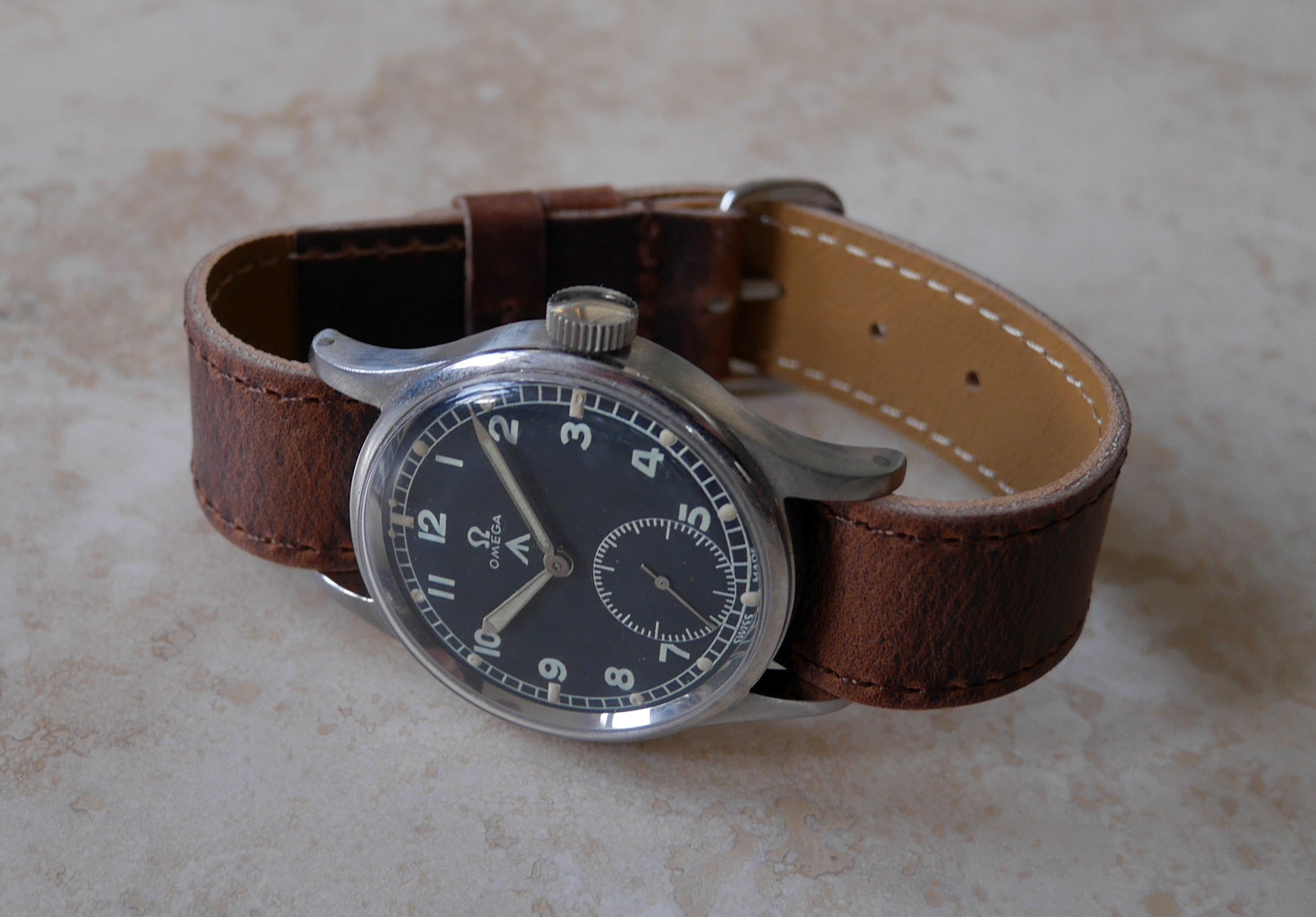
Leather RAF Type in brown oiled leather fitted to an Omega W.W.W. wristwatch
Click image to enlarge
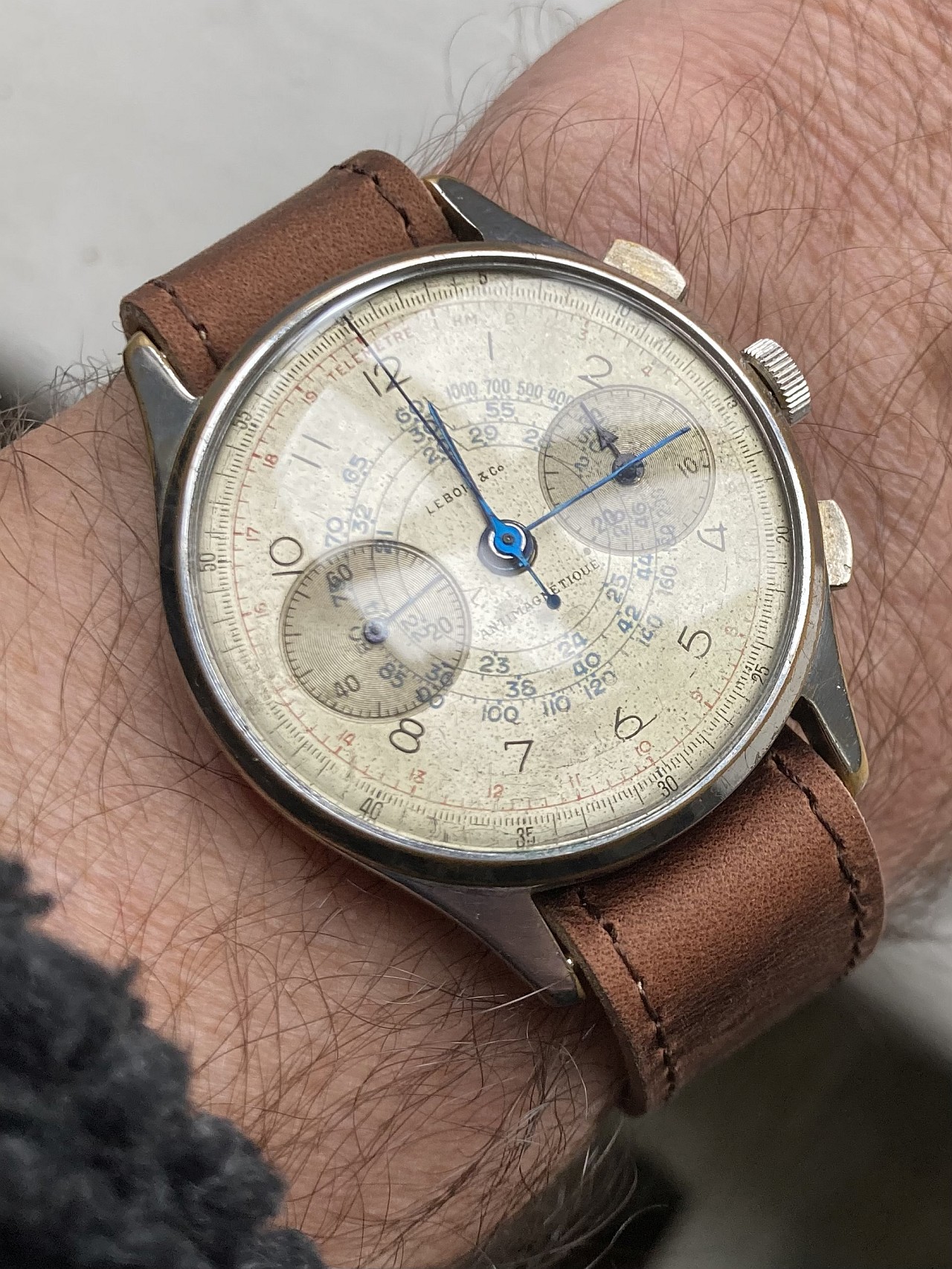
Leather RAF Type in brown oiled leather fitted to a customer's watch
Click image to enlarge
My leather RAF style straps, sometimes called a NATO RAF, are a single piece pull through strap, a bit like a G10 strap but without the extra layer of leather under the watch.
Old customers please note that the disaster in the old workshop in January 2024 meant that new tooling had to be made, which is expensive, so at the moment the RAF Type straps are only available in 18mm width and one length.
The RAF Type straps are made in a brown oiled pull-up leather that has bags of period character and is the perfect complement to a period RAF or W.W.W. watch. This leather changes colour as it is bent, and has an aged patina that improves with time. It looks great with an old service watch. In the photos here, one of these straps is fitted to an Omega W.W.W. wristwatch ref. CK 2444 from the 1940s.
The second photo shows a customer's watch fitted with one of these straps. This was one of the first customers for the new RAF Type straps, who commented ‘Such a nice piece of kit. Comfy. Good length. Good thickness. Looking like it will age really well. Many thanks!!’
The design of the RAF style straps is based on original straps that were issued to RAF pilots during WW2 for use with wristwatches such as the reference 6B/159 and 6B/234. The cutter was copied from an original strap to produce the authentically rounded ends as shown in the photograph. There are two leather keepers, one fixed and one floating. This is an authentic detail, the straps supplied by the RAF to pilots had two leather keepers exactly like this.
I am always on the hunt for more authentic buckles made from nickel plated round wire. I have contacted every supplier of buckles in the UK without success; they are just not made any more, so I have used the best period looking buckles I can find.
These one piece pull through straps fit period RAF and W.W.W. watches perfectly; these watches have fixed bars that were designed to take a one piece pull though leather strap for security; if one of the fixed bars pulled out or gave way, itself unlikely, the strap remains fixed around the wrist and the watch is held to it by the remaining bar.
Because period RAF and W.W.W. watches were designed to take a one piece leather strap, they have longer horns which hold the bars further from the watch case than many modern watches and there is a wider gap between the bars and the case for the strap to pull through. If you are thinking about fitting one of these straps to a modern watch, please read the section Will It Fit My Watch? to see if the strap will pass between the bars and across the back of the case.
Leather RAF straps don't have the long tail of the Perlon or nylon strap, they are a normal length sized to go around your wrist. They are a nice clean simple design that looks good and authentic with a period watch without distracting attention from it.
Details
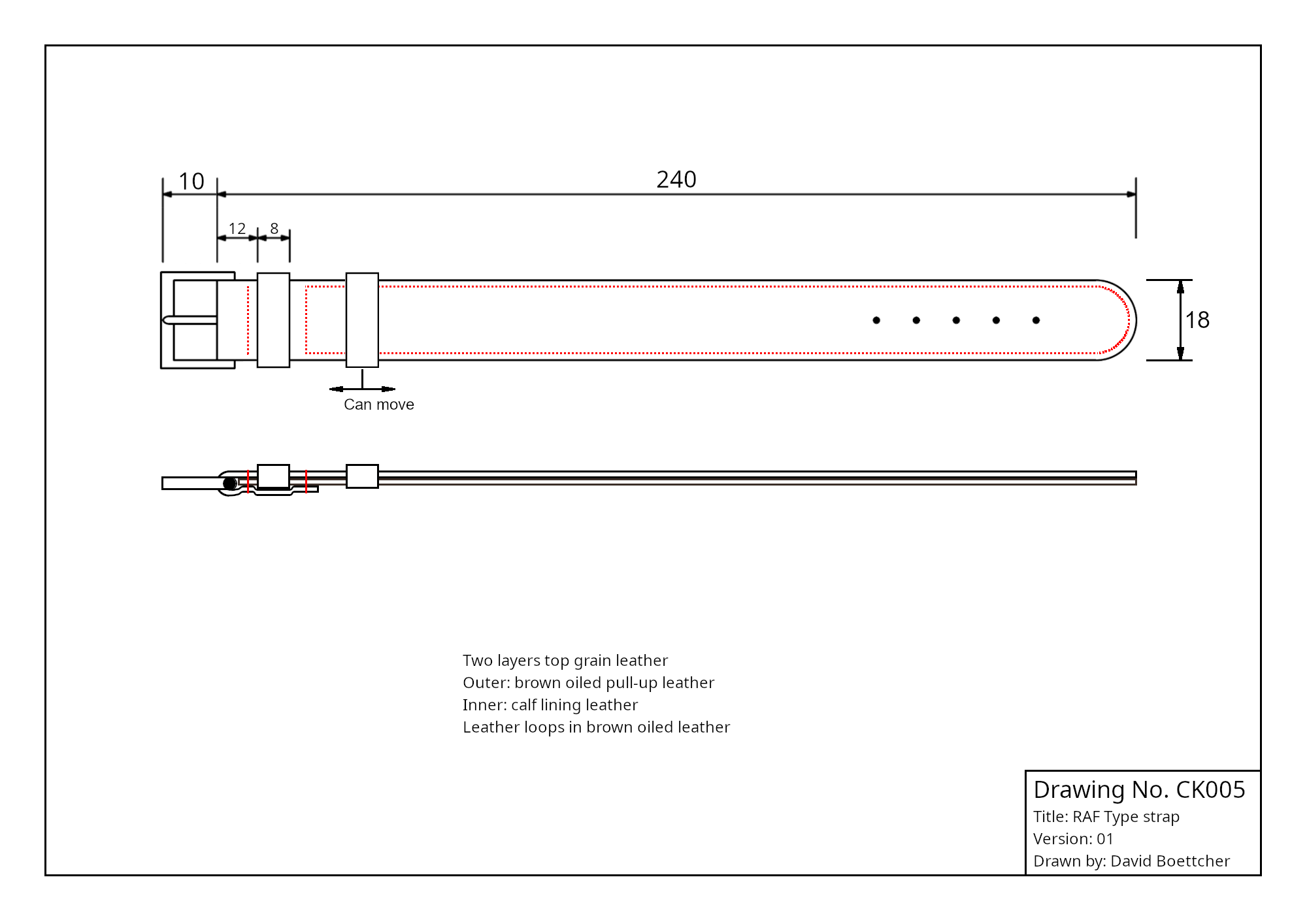
Dimensions of RAF Type straps
Click image to enlarge
The disaster in the old workshop in January 2024 meant that all the tooling was lost. I have had new tooling made, but because this is limited compared to the old stock of tooling that was built up over many years, I cannot offer any variations to the design or custom made sizes.
The drawing here shows the dimensions of the RAF Type straps. The leather part is 240 mm long, and the straps are in 18 mm in width. These dimensions are fixed by the tooling, so cannot be altered. Please check that the length and width are suitable for your wrist and watch.
The RAF Type straps are only available in brown oiled pull-up leather. The brown oiled pull-up leather is far and away the most appropriate leather for these replica straps.
There are more details about the straps further down on this page. If you have not had one of these new version RAF Type straps before, please read these details before initiating an order.
It is important to fit a strap in a way that doesn't cause damage. If you haven't fitted a one-piece pull through leather strap to a watch before, please read the Note About Fitting at the bottom of this page.
Prices
The price of RAF style straps in brown oiled leather is £35.00, plus postage & packing.
Postage Costs
EU customers please note: Due to the EU GPSR - General Product Safety Regulation 2023/988 - I can no longer deliver to the European Union, the compliance requirements are not practical. If you know someone who lives outside the EU, orders can be shipped there.
USA customers please note: US Customs Duty now has to be paid before dispatch. This is paid to Royal Mail as part of the postage. The duty is 10% of the value of the goods, plus a 50p handling fee.
- UK post: First Class £3.70, Royal Mail Tracked: £4.30
- Europe: Not available due to GPSR - see note above
- Outside Europe: Standard Airmail £5.00, tracked £12.50
Standard post and airmail is not tracked. If you want a tracked service, please let me know.
How to Place an Order
Orders are initiated by email.
To place your order, send an email to me at with your requirements. If the link doesn't pop up a new email when you click on it, please use this link: Order Instructions.
To make the payment for your order, I will send you a Stripe payment link. You don't need to have an account with Stripe, the payment can be made using a credit or debit card.
Make sure your address details in your PayPal account are correct, or let me know exactly where you want the package to be delivered.
Buckles
I am always on the look out for authentic period buckles; for instance, I know that the RAF straps originally had buckles made from round section nickel wire. Unfortunately, many of the buckle suppliers that used to exist in Britain have closed down and the range of available buckle has shrunk to very small. These days buckles almost always come from overseas and period styles are not available. The buckles illustrated on this page are the most period correct ones that I have been able to find.
Construction, Thickness and Tail Length
Perlon or nylon NATO straps are made extremely long, this seems to be not only to accommodate different size wrists but also so they can be worn on the outside of clothing. The long tail is usually folded back and tucked under one of the keepers. With a leather strap this presents a problem. A leather strap the same thickness as a nylon strap would be very weak. You will see straps like this advertised as being "soft" and "flexible", which is true, but for some reason they don't also say that they are "floppy" and "weak".
I prefer to supply leather straps that will last, so my straps are made in the traditional way, from two pieces of leather glued back to back and stitched all round. The finished thickness is about 2mm.
Stitching all the way round obviously involves a cost in labour time and machinery, but it means that the two pieces of leather aren't going to come apart after a little bit of wear as can happen with cheap copies that are simply glued. Unstitched straps also stretch easily in wear. I have in the past, against my better judgement, supplied straps made from a single thickness of leather, and also straps made from two thicknesses but unstitched, but due to customer dissatisfaction I will not supply any more; as an engineer by training and at heart I prefer things made in a way that I feel comfortable with.
Wrist Size and Strap Length
The RAF Type straps are 240 mm long in the leather part, plus the buckle, as shown in the drawing. From experience I know that this length suits most men, with wrists between about 170 mm / 6¾" to 200 mm / ~8" around.
The disaster in the old workshop in January 2024 meant that all the old tooling was lost. I have had new tooling made, but because this is limited compared to the old stock of tooling that was built up over many years, I cannot offer custom made lengths.
Will It Fit My Watch?

Details of how the strap pulls through the fixed bars of an Omega W.W.W. wristwatch
Click image to enlarge
I am often asked if a one-piece leather pull through strap will fit a modern watch. There is such a variation of watch case designs that I can only offer some general advice. It goes without saying that a strap needs to be the correct width to fit between the lugs.
If your watch is fitted with a metal bracelet, the lugs and bars are sometimes designed so that only a metal bracelet, and perhaps a two piece strap, will fit. You will need to take the bracelet off and examine the clearance between the case and the bars using the following information.
To assess whether your watch will take a one piece pull-through leather strap like the RAF Type, you need to look at the gap between the bars and the case to see if a leather strap of 2mm thickness will pass. If a 2mm thick strap won't go through, then the watch was probably designed to take a nylon strap and a thicker leather strap will not be suitable.
You also look at the path the strap must take through the lugs and across the back of the case, and make sure that it does not require sharp bends that a leather strap cannot make.
Modern Perlon or nylon NATO straps are very thin and because of this they will fit modern watch cases that leather straps can't fit. Also, a modern watch may cause the strap to make sharper bends around the case, which effectively shortens a leather strap because it has to take a longer path.
The watch in the picture is an Omega W.W.W. supplied to the British military in the 1940s. This watch was designed to take a leather or heavy canvas webbing strap, the thin nylon NATO strap did not exist at the time. Look carefully at the part of the picture I have outlined in red - click on the picture to enlarge it to get a clearer view, and also look at the horns and lugs of this same watch shown without a strap in the picture lower down on the page.
You can see that on this watch the horns that hold the fixed bars are long and the bars are a long way from the case so that the strap can take a gently curved path through the lugs and then across the back of the case. It is easy to fit a leather G10 strap to this watch. The path the strap has to take, which is only slightly curved, means that a standard length strap fits my wrist perfectly. If the lugs make the strap take a more contorted path, then extra length may be required, see the section "Long Path" below.
Modern watches, by which I mean anything later than WW2, whether they have spring bars or fixed bars, usually have a narrow gap between the case and the bars, which is why I advise you to assess your watch carefully before trying to fit a leather strap. Uou do need to examine your watch carefully to see if a leather strap of 2mm thickness will pull through between the bars and the case, and also how it would need to bend to run across the back of the case.
Looking at your own watch, if there is at least a 2mm gap between the case and the lugs for the strap to pass through, and the strap does not have to make a very sharp turn, then it should be fine. Leather is a very flexible and adaptable material and once fitted will take up whatever shape it needs to as you wear it. But you do need to be able to fit it to the watch in the first place!
Note About Fitting
Fitting a leather strap to a modern watch that was not specifically designed to take a leather strap, or to a wire loop watch where the strap is tight in the lugs, can be a bit tricky. However, don't despair; leather is a very accommodating material and once you get it in place it will settle in just fine. Here is a tip about how to get the strap in place without damage.
Some modern watches have a narrow gap between the bars and the body which, although wide enough to take a leather strap, can make fitting difficult but not impossible. This is usually because the location of the lugs and the shape of the case makes the strap take a sharp bend to turn across the back of the case.
Modern watches are not designed with leather straps in mind, and the watch case often has razor sharp edges that can damage the leather as you pull it through. In this case, the strap needs some protection even if it is not a very tight fit in the lugs.
The best method is to use a piece of plastic film, e.g. a piece cut from a carrier bag. Simply cut a strip of plastic just over twice the width of your strap from a carrier bag, wrap this tightly around the strap and secure with sticky tape. Leave a couple of inches of empty plastic surplus at the end as a "leader" and feed this through the lugs. Because the leader doesn't have the strap in it, it goes through easily. You can then use the leader to gently pull the rest of the plastic containing the strap through the lugs. After the strap is in place, just hold the buckle end of the strap and pull the plastic out.
You can use this technique to fit a one piece leather strap to a modern watch easily, and without damaging the surface finish of the leather.
The plastic bag method also works for Texas cowboy boots or any other footwear that doesn't have any laces or zips, and it is very effective. You just cut the end off a carrier bag to make a tube. You slip this tube into the boot, then slide your foot in, and pull out the carrier bag, which comes out easily because you cut the end off.
If you have any comments or questions, please don't hesitate to get in touch via my Contact Me page.
Copyright © David Boettcher 2005 - 2026 all rights reserved. This page updated July 2026.
Back to the top of the page.