
Watch Cases and Crowns
Copyright © David Boettcher 2005 - 2026 all rights reserved.This page is about the manufacture, design and features of watch cases, and the crowns used for winding and hand setting.
Making Watch Cases
Making watch cases was one of the most difficult tasks to mechanise or automate. The development of automatic machinery in the nineteenth century meant that watch movement parts could be made by mass production methods, but case making remained an almost entirely manual craft skill.
This was principally because watch cases were usually made from silver or gold, and the amount of metal used to make the case had to be kept to a minimum. It would have been possible to machine a watch case from a solid block of silver or gold, but the cost of the raw material and the amount of waste that would need to gathered and recycled made this impossible due to the large financial outlay that would have been required.
The trade of watch case making began in the medieval period as an offshoot of gold and silver smithing, but quickly developed its own specialities and working methods. Philip Priestley identified signatures of 31 watch box and watch case makers on the 1697 Oath of Allegiance to William III, indicating that the separate trade of watchcase making was firmly established by then.
Gold and silver items must be hallmarked before being put on sale. An item cannot be accepted at a British assay office for hallmarking unless it carries a sponsor's mark which shows under whose responsibility it is submitted. In watch cases, the sponsor's mark identifies either the company that ordered the case to be made, or the company that made it. Watch case makers were businesses that employed a number a number of specialised craftsmen. The person who entered the sponsor's mark was the owner or a principal of the business. Whether they had any role in actually making watch cases is usually not known.
By the 19th century, watch cases were made in dedicated workshops containing the tools and machines required; lathes, draw benches, rounds and weights, and hearths for annealing the work and heating the soldering irons. Although steam power was available, and was used in some of the larger watchmaking factories, English gold and silver watch cases were almost all made in small workshops without power. Electricity was not available, so lighting was by gas lamps and power was provided by human muscles. A notable exception to this rule was the Dennison Watch Case Company.
The manually (foot) powered “pole lathes” used for turning operations would be familiar to any ancient Egyptian who happened to stop by. A flexible pole is fixed to the floor near the head of the lathe and a rope fastened to its top is wrapped around a pulley behind the chuck, with its lower end fastened to a foot pedal. When the foot pedal is pressed down and the rope drawn downwards, the work spins in one direction and then, when the pedal is released, it spins the other way as the bow pulls the rope upwards. The graver is used to make a cut as the pedal is pushed down and withdrawn when it is released.
The efficient production of watch cases was due to the work being divided into a number of specialist areas, the principal ones being:
- Case Maker, who formed, soldered and turned the main parts of the case
- Joint Maker, who made the joints (hinges) of the case
- Pendant Maker, who made the pendant that carries the bow
- Bow Maker, who made the bow and bow screw
- Boxer-In or Springer, who made and fitted the springs that open the case
- Engine Turner, who engraved the geometrical patterns using a rose engine lathe
- Polisher, who polished the case, and rectified the marks left by hallmarking
It might be noted that both pendant and bow makers were separate trades. In part this can be explained by the pendant being made as a casting, which required metal to be melted and poured into a mould; a process that would be unwelcome in the case maker's workshop. But another reason is that the bow and the pendant were the parts of the case that wore out soonest so there was a demand for these parts from the watch repair trade. A striking illustration of this is that from 30 November 1895 to 1 October 1896, the Birmingham Assay Office hallmarked 3,467 dozen silver cases and 17,331 dozen silver pendants.
Watch Cases were fabricated from sheet and bar material, which were formed into shapes, turned to the required size and cross-section and then soldered together. At least three grades of solder with different melting points were used so that successive solderings can be performed without the previous ones melting. There are about 50 solderings required in making a hunter case.
The hinges on watch cases are called “joints”, and making them was a highly skilled craft. To make the knuckles of the joints, tubes were formed from sheet, rolled and then passed through successively smaller holes in a draw-plate on a draw bench. Grooves for the joint were filed into the parts to be jointed, e.g. the middle part of the case and the back, and small sections of tube to form the knuckles soldered into each groove. Once the knuckles are soldered into place there is no possibility of altering their position, so it has to be right first time.
The joint pin is steel, and may be made shorter than the joint so that the ends can be plugged with the same metal as the case. If the pin is to be removed, the plugs must first be removed by, eg, digging them out with a graver. By convention, the pin is inserted from the right when the middle part of the case is away from the viewer, so should be pushed out from the left. The same applies to the joint that holds the movement to the case in a bolt and joint fitting.
There is a short video on YouTube of watch cases being made by Martin Matthews. There is also a short video about engine turning. Full length versions of both of these videos can be purchased from Martin Matthews Watchcase Maker. Martin, who died aged 77 years on 31 January 2013, was the fourth and last generation of watch case makers in his family. Although Martin made complete cases from start to finish, that would not have been a competitive way of working in the nineteenth century and his cases could have been expensive compared to those made by the typical watch case workshop of the time, where teams of workers each performed their own specialist aspect of the work.
Case Making by Machinery
A report of a visit to the factory of Thomas Wallen in King Street, Coventry, in 1877 describes in detail the manufacture of watch cases by machinery. The machinery in the factory was powered by a steam engine located on the ground floor. The report describes how blanks for the parts of the case were stamped out by a machine from a strip of gold or silver at the rate of twenty a minute. These blanks were then formed by die press machine into the back, bezel and middle part of the case, the beds for the joints and the thumb piece for opening the back being formed at the same time. Another machine finished the middle part of the case, applying the knurling to band, and then a final machine jointed the cases, at the rate of one every five seconds.
Today, watch cases are pressed from stainless steel by powerful hydraulic machines that stamp them from thick strips of metal and press them into shape. Because the raw material for each case costs only a few pence, economy in its use and reduction of waste is of no concern. One of the first, if not the first, companies to make watch cases in this way in the late 1920s was Taubert & Fils, who took over the Borgel case making business in 1924.
Back to the top of the page.
Onion and Pumpkin Crowns

Onion Crown: click to enlarge.

Pumpkin Crown
The round knob that sticks out from the top or side of the case and is used to wind the spring and set the hands is called the “couronne” in Swiss/French, which is crown in English.
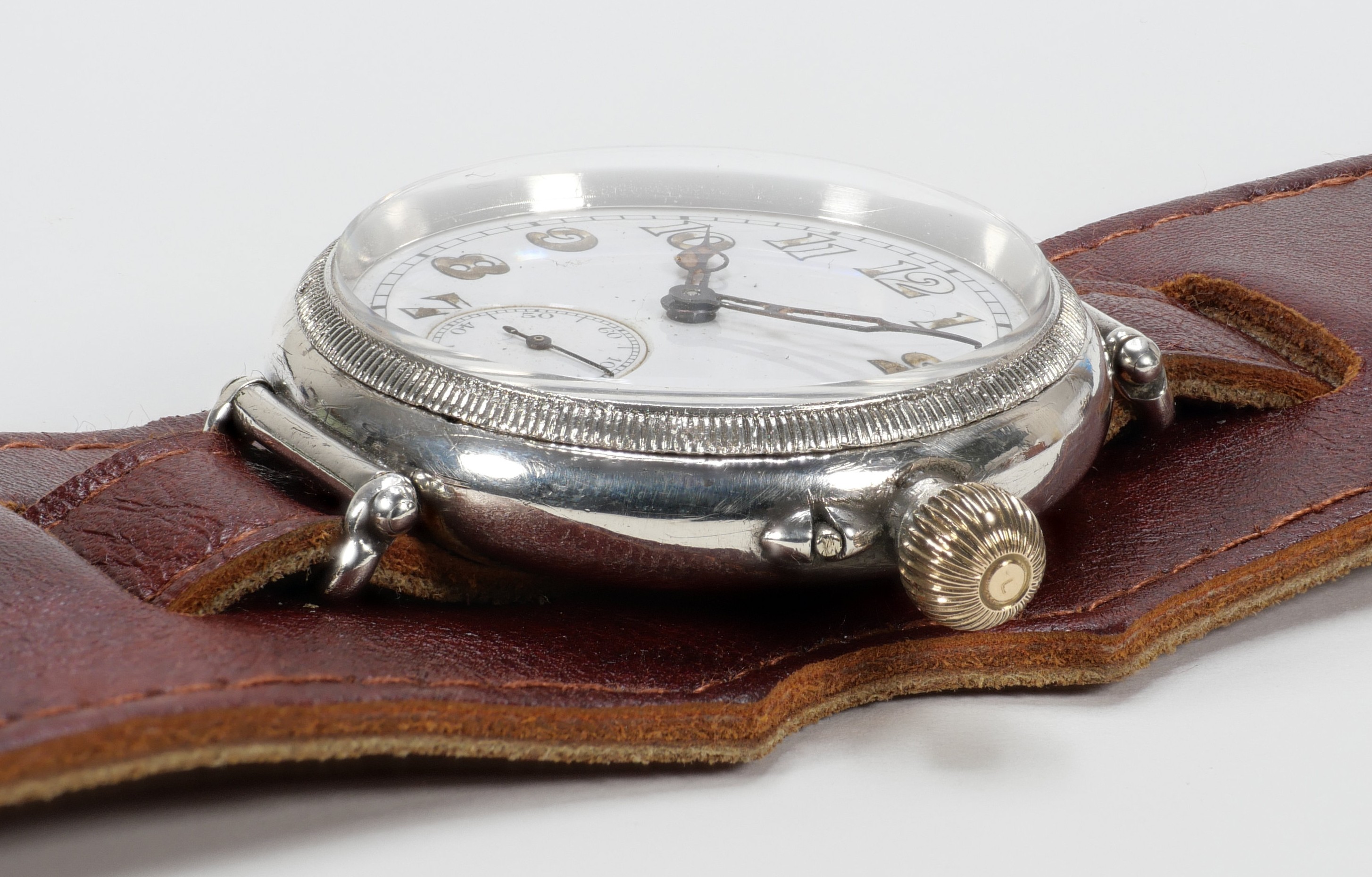
On the type of old watches that I am interested in from the time of the First World War, crowns were usually one of two styles, onion or pumpkin. One often sees old watches with their crowns described as onion or pumpkin that look like nothing of the sort, which is rather confusing, so here are pictures of two crowns with my take on the terminology.
It is very simple really; does the crown look more like an onion, or more like a pumpkin?
The one at the top is an onion crown. You can see how its spherical shape with the vertical grooves to grip looks like an onion. This crown is on a Borgel cased wristwatch, the shape of the crown is necessary because of the design of the stem of a Borgel watch which required a significant stem tube projecting from the case.
The onion form is the older and sits neatly on the pendants of key wound pocket watches. Wristwatches don't usually have noticeable pendants, but one is necessary on a Borgel case to give space to accommodate a helical coiled spring.
The one below is a pumpkin crown. It is similar to the onion crown but more flattened, like the shape of a pumpkin.
The pumpkin form looks better at the side of an ordinary wristwatch case, the stem entering through a simple hole in the side of the case.
English watchmakers and repairers sometimes use the term “button” for this item. But since English watchmakers persisted with the fusee, which made keyless winding virtually impossible, they have little claim to name the part that operates the keyless work. I don't like the term button, it is usually used in English for something sewn on to a garment to fasten it or something you press, e.g. to summon a lift. For watches I prefer the term crown.
Hunter / Savonnette and Open Face / Lépine
Watches are traditionally divided into two broad categories: savonnette or Lépine, which in English are called hunter or open face. In old British catalogues, open face watches were sometimes referred to as crystal watches.
The terms hunter, open face, savonnette and Lépine are used for both a type of case and also the layout of a movement.
For pocket or fob watches this was fairly straight forward, a hunter or savonnette case had a savonnette movement; a Lépine or open face case had a Lépine or open face movement. But when the wristwatch came along, this required a hunter or savonnette movement in an open face or Lépine case, which caused, and still causes, no end of confusion!
A hunter / savonnette pocket watch is designed to be held with the pendant horizontal, so that the thumb of the right hand can be used to press a button on the crown, or sometimes the crown itself, that releases an internal catch; after the catch is released a spring inside the case pushes the lid open.
An open face / Lépine pocket watch is designed to be held with the pendant vertical at the top.
To accommodate these designs, the basic rules about movement and cases are:
- Savonnette (hunter) movements and dials are laid out so that the crown is at three o'clock and the small seconds at 6 o'clock. When the movement is put into the case, the hinge for the lid of the case is opposite the crown at 9 o'clock.
- Lépine (open face) watches have no lid over the crystal. Lépine movements and dials are laid out so that the pendant and crown are at 12 o'clock and the small seconds is at 6 o'clock.
This neat division lasted for centuries until the wristwatch came along. The fundamental objective of the wristwatch was to be able to read the time while leaving the hands free to do other things; the left hand holding the reins of a horse, or a rung on a trench ladder preparatory to going ‘over the top’, while the right hand is free to hold something, a sword, revolver or whistle. This required an open face watch.
An open face Lépine watch has the crown in wrong position, at 12 o'clock, where one lug for a wrist strap needs to be attached. A savonnette movement has the right layout, but needing open a lid to read the time requires using the right hand and defeats the purpose of a wristwatch.
The key to the successful wristwatch was the paradoxical use of a savonnette movement in an open face Lépine case, which has caused confusion about the use of the two terms ever since.
Sometimes open face pocket watches are seen with the crown at 3 o'clock and small seconds at 6 o'clock, which means that a savonnette layout movement has been put into an open face Lépine pocket or fob watch case. These are usually American made pocket watches, where they were called ‘side winders’. Why this was done I have no idea, there is no technical reason for or against it, it is just a question of style and convention.
Savonnette (Hunter) Watches

Demi Savonnette or Half Hunter
Savonnette or hunter watches have a hinged metal lid that closes over the front to protect the crystal. When the lid is closed the shape of he watch case resembles that of a small round cake of soap with slightly domed top and bottom, called in French a ‘savonnette’, hence the name. The English name arose because fox hunting men found it convenient to be able to open their watch and read the time with one hand, while holding the reins of their ‘hunter’ (horse) in the other hand.
A savonnette or hunter watch, or watch case, sometimes called a full hunter, has a metal lid that completely covers the dial so that the time cannot be read without opening it. They are the most robust design of watch, but visually unattractive and a nuisance to use.
The watch in the image here is a demi-savonnette or half hunter, which means that it has a small round window in the middle of the lid so that the time can be read without opening the lid. These are sometimes called ‘Napoleons’ because there is a story that the Emperor got so frustrated with having to open the lid of his hunter that he took a knife and made a circular cut out in the lid. In fact, Napoleon was given a demi-savonnette watch by Breguet.
Half-hunters are easier to read than a watch with a full hunter lid, but the small window makes reading more difficult and reduces the accuracy to which the time can easily be read – the small seconds is not even visible.
From this watch you can see the savonnette or hunter layout with the 12 at the top, the hinge for the lid at 9 o'clock and the crown at 3 o'clock. There is a small seconds dial at 6 o'clock, but this cannot be seen with the lid closed.
Lépine (Open Face) Watches

Lépine or Open Face Watch
The Lépine watch was invented in the eighteenth century by Jean Antoine Lépine who radically redesigned the standard watch movement of the time to make it much thinner. Because of Lépine's role in creating the modern design of watch movement, at various times his name has been used in to name different aspects of the design. See my page about Jean Antoine Lépine for more details about this important but little known maker.
Lépine made movements thinner by moving the balance down from above the top plate into the same plane as the rest of the wheels, pivoted in the bottom plate. The top pivots of the balance and train wheels were pivoted in cocks or bridges in place of a single top plate. Lépine created this design to make watches thinner, and this style of movement was known as the Lépine calibre.
Watches could also be made thinner by not having a lid or cover over the crystal, a design called "open faced". Naturally, in his desire to create the thinnest possible watches, Lépine mostly made open faced watches and, in time, Lépine was taken to mean any open faced watch, as opposed to a savonnette or hunter watch.
Open face Lépine watches usually have their small seconds at 6 o'clock as this one. There is no technical reason for this, it just seems to ‘look’ right. It does mean that the layout of Lépine movements is different from that of savonnette movements, so that watch manufacturers had to make two different movements. These usually used identical components, the only difference between the two is that layouts of the bottom and top plates or bridges are different.
Wristwatches
When wristwatches were created, it was obvious that the 12 o'clock should be at the top when viewed on the wrist, where the upper part of the strap would be attached, and that it would be most convenient if the crown was at the 3 o'clock position and the small seconds at 6 o'clock. This meant using a savonnette movement. But the principal reason for wearing a wristwatch was to make it easy to read the time, and if the watch case was fitted with a lid, it either required the use of the other hand on the other wrist to open the lid, or if a demi hunter lid was fitted, the accuracy of reading was reduced.
It was abundantly clear right from the outset that to be most convenient to use, a wristwatch had to be open face. The key to the successful wristwatch was therefore to fit a savonnette layout movement into a case without a lid, an open face Lépine case.
Ergonomics
The layouts of movements, which gives different locations of the small seconds and pendant, which in stem wound watches carries the crown, differs between savonnette and Lépine movements for ergonomic reasons.
Savonnette watches usually have a button on the top of the stem to release the catch which holds the lid closed, and it is convenient to operate this button with the thumb, the watch being held in the palm of the hand. The lid then opens towards the fingers. Because of this, savonnette pocket watches have the dial arranged so that the pendant, the tube projecting from the case by which the watch can be suspended, is at 3 o'clock and the hinge of the lid opposite this at 9 o'clock. The small seconds display is at 6 o'clock.
Open face pocket watches are usually made so that the pendant is next to the 12 o'clock position on the dial. If a savonnette movement was used, the small seconds display would be at 9 o'clock, which somehow instinctively looks odd. So for open face pocket watches the movement was rearranged to put the arbor of the fourth wheel in line with the projected axis of the stem. This meant that with the crown at 12 o'clock, the small seconds display was at 6 o'clock. Because of its use in open face watches, which came to be called Lépine watches, this movement layout has itself come to be be called Lépine, although it was not much used by Lépine himself.
Distinguishing Savonnette and Lépine
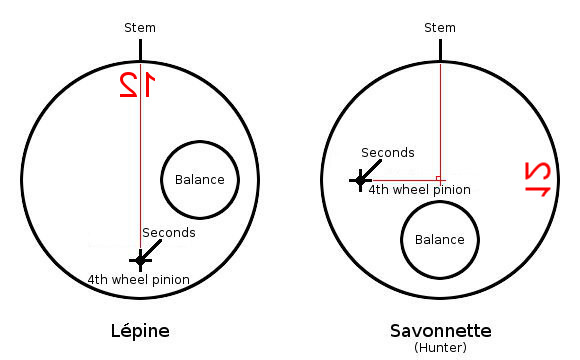
Lépine and Savonnette Movement Layouts
Pictured from the back/top of the movement
The figure here shows how to distinguish between savonnette and Lépine movements. The movements are shown from the top, as if looking into the back of a watch, and the stems are at the top. This is the standard way that movements of any layout are illustrated in catalogues and movement identification books, and it makes it much easier to recognise movements if they are presented in this way. The red 12s show where the 12 would appear on the dial; they are reversed because the dials are on the opposite side of the movements in these images.
- If the balance is off to one side (it doesn't matter which side) from a line projected from the stem, it is a Lépine movement. The fourth wheel is directly on a line projected from the stem.
- If the balance on the opposite side of the movement to the stem, (it doesn't matter exactly where) it is a savonnette movement. The fourth wheel on a line is at 90° from a line projected from the stem.
The critical item is, of course, the location of the fourth wheel whose arbor carries the seconds hand, which determines where the small seconds will appear on the dial, but it is much easier at a quick glance to locate the balance.
Distinguishing between savonnette and Lépine watches is, of course, simple. If the case has a lid, it's a savonnette or hunter; if it doesn't have a lid it's an open face Lépine. But what about an open face wristwatch with the crown at three and the small seconds at six; is it a Lépine or a savonnette? In fact it's neither; it's simply a wristwatch!
Lépine Meanings
There are several meanings for Lépine in watch terms:
- A bridge or bar type movement with the balance in the same plane as the train wheels.
- An open face watch.
- A watch movement with the arbor of the fourth wheel in line with the projected axis of the stem.
- A movement layout where the small seconds is at 6 o'clock and the pendant or crown is at 12.
When the wristwatch was created it was natural to arrange the dial with the 12 at the top and the crown at 3 o'clock for both convenience of access for winding and for attaching the strap. This of course is a savonnette layout. But giving a wristwatch a lid would have defeated one of the principal benefits of a wristwatch, that it was possible to look at the time without using both hands, so wristwatches were almost universally open face.
The key to the successful wristwatch was therefore the paradoxical use of a savonnette movement in a Lépine case.
Back to the top of the page.
Watch Cases with Two Backs
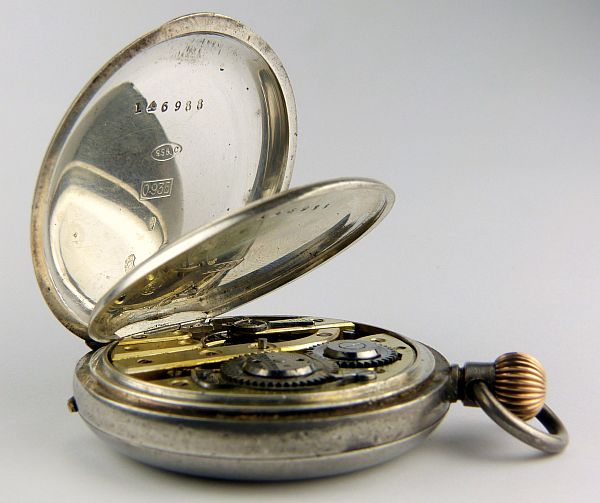
Double Case Back in a Dome Case
Click image to enlarge
A dome case has two backs; a jointed (hinged) outer back that opens to reveal an inner back or cover, called by English watch and case makers the dome and by the French and Swiss a cuvette, which is also jointed and can be be opened to reveal the movement.
This case design goes back to watches that were wound from the back, and some set from the back, with a key. Each time the watch needed to be wound or have the time set, the back was opened and a key with a hollow square end was applied to a square end on either the mainspring barrel arbor and turned to wind the mainspring, or to a square on a friction post that ran through the centre arbor and carried the minute hand and was turned to set the hands. If there were no protection for the movement, then a clumsy person could accidentally press the key into the watch mechanism and damage it.
In the earliest watches, the movement was set into a case or “box” that had a hole in the back for the winding key. Sometimes this hole was covered by a shutter to prevent dust entering, which was pushed aside to allow winding. This was not an entirely satisfactory arrangement, and watches usually had a second out case to protect the inner case. This arrangement was called a “pair case.” The inner case of a pair case has a hole for the key to pass through to wind the spring, and the outer case then covers this hole.
The style conscious French nobility were never particularly fond of the bulky pair case, and the fashion that began in France around 1775 for close fitting waistcoats resulted in them abandoning it altogether. Jean Antoine Lépine fitted his watches with single cases with no hole in the back. The watch was wound through the dial, which spoiled its appearance and exposed the enamel to damage by the key of a clumsy owner.
To avoid the need for a winding hole in the dial, Lépine designed a case with a middle part to which the movement was fixed. A bezel carrying the crystal was fixed to the front of the band, and to the back were hinged two covers, an outer and inner. The outer cover is usually called the bottom or back, the inner cover the dome or cuvette. The dome has one or two holes for the key; one offset from the centre for winding the mainspring, a second in the centre if the hands were set from the back.
Lépine invented hand setting from the back of the watch, boring the centre arbor so that a centre post that carried the minute hand could be passed through it, driven by friction between the two. The cannon pinion is mounted on the centre post. When the hands were set from the back there was no need for the front bezel to open and it was made to simply snap on, doing away with the need for a hinge at the front for the bezel. The movement was fixed to the band, eliminating the hinge for the movement to be swung out from the front of the case.
The case invented by Lépine, with the movement fixed to the band, snap on front bezel and two hinged backs, is sometimes attributed to Breguet, who later used the same design. Breguet usually made the inner cuvette of gilt copper or brass, and only made it of gold in watches of his top quality, ‘ouvrage premiere classe’. It thus became the standard practice in France to make the cuvette of base metal, except in the best quality work.
In English watches the inner cover, which was called the dome, was regarded as part of the watch case by the assay office, whether it was fixed to the band or jointed to it. Because of this, the dome had to be made of the same standard of metal as the rest of the case, e.g. 18 carat gold or sterling silver, or none of the case would be hallmarked by the assay office.
Like Breguet, Swiss makers did not regard the inner cuvette as part of the case, after all it was only there as a barrier to prevent a clumsy owner damaging his watch and was not seen when the outer back was closed, so they allowed it to be made of base metal. This was often plated with gold or silver to tone with the rest of the case, but marked "metal" or "cuivre" (copper) so that it could not be not mistaken for precious metal.
In later movements that were wound and set by the crown, the holes in the cuvette for the key were not needed, but it was retained for better quality watches. This may have been partly because of tradition, a sign of quality workmanship not found in cheaper watches, and it also gives better protection against the ingress of dust than a single case back.
Back to the top of the page.
Pair Cases


A pair cased English fusee verge watch: click to enlarge
Early pocket watches, particularly verge fusee watches, have “pair cases”; two completely separate cases, one inside the other. The inner case is sometimes called the box, after the continental practice of calling it a boîte, and the outer case is called the case.
The principal purpose of the outer case was simply to cover the hole in the box or inner case through which a key was inserted to wind the watch.
The box is a bowl shaped piece into which the movement is inserted and secured. The bezel that carries the crystal attached to the main part of the box by a joint (the case maker's term for a hinge).
The movement is secured into the box by “bolt and joint.” The joint is at 12 o'clock, the bolt is a spring loaded catch at 6 o'clock. When the bolt is pressed inwards towards the centre of the dial, the movement can be swung out of the front of the box on the joint.
The box has a hole in its back through which a key is inserted to wind the mainspring. The outer case is provided simply to cover up this hole at all other times. When the inner box and outer case were integrated into a single item, the term box was dropped and the whole thing was called a case. On the continent, watch cases were almost always called boxes (boîtes).
Sometimes a second outer case was provided, usually of a non-precious material such as leather. This was to protect the case, which was often richly engraved, chased or enamelled. The inner box was plain, because it was not seen except when the watch was being wound.
The image here shows an English pair cased watch with a verge fusee movement. The bezel of the box, top right, is wide open and the movement is shown partially swung out of the box on its joint. The bolt at 6 o'clock is just visible, as are the cut-outs for it in the rim of the box and bezel.
If you enlarge the image, you should be able to make out the cone shaped fusee between the plates of the movement, on the right behind a pillar. The wheel in the foreground with teeth pointing downwards is the contrate wheel, a sure sign of a verge movement.
The box has London Assay Office hallmarks for 1844 to 1845, the sponsor's mark is the initials JB over WW struck incuse without a surround. This mark was entered on 27 June 1834 by Josiah Barnett & William Walters in partnership at 15 Lower Charles Street, Northampton Square, Clerkenwell.
The outer case on the left is sterling silver and has the same London Assay Office hallmarks as the box, but there is no visible sponsor's mark. The semi-circular cut outs in the rims are for the pendant, which is attached to the inner case. The rusty iron strip is the spring for the catch that normally holds the case closed.
Back to the top of the page.
Consular Cases
An English lever watch is often described as having a “consular” case. The definition of what constitutes a consular watch case is not clearly laid down in any reference that I have found. The name consular is frequently used for any case that has a jointed (hinged) bezel and jointed back, with a second fixed inner back with a hole through it for the winding key. I believe that this is incorrect and that the consular case is a particular version of a double-bottom case.
In “The artistry of the English Watch”, Cedric Jagger says The consular case - which is said, traditionally, to be associated with Napoleon's appointment as First Consul, even if the dates do not actually match up, - seems first to have been introduced by the precision watchmakers in circa 1775. Essentially, it is a single case with a double back, the outer of which is opened for access to the winding and hand setting squares, while the movement swings out from the front." The government of France was called the Consulate after the fall of the Directory in 1799 until the start of the Napoleonic Empire in 1804. Executive power was vested in three consuls. At first these were all equal in authority, but Napoleon quickly consolidated power in himself as “First Consul”.
Jagger's description of a single case with a double back, one that opens and one that is fixed in place with a hole or holes for the key, would apply to the cases of English lever watches, and several sources point in the same direction. Both Britten and de Carle imply that the terms consular and double bottom are synonymous, as does Terence Camerer Cuss in the glossary to “The English Watch: 1585 – 1970”.
However, I noted that David Penney described on his web site that the case of Pennington watch No. 5443 has an “18ct gold case of true consular form, the band and both covers all pivoted on the same joint” [emphasis added]. David told me that in his view the distinctive feature of a consular case is that the front bezel and the case back are connected to the middle part of the case by a single “joint” (the casemaker's term for what is otherwise called a hinge). The tubes or “charnières” of this joint, soldered to the bezel, case back and the case middle part, all sit alongside each other and are all connected by a single pin.
After David explained this to me I went through Terence Camerer Cuss's book again and I noted that all the cases that are described as consular are in the chapter 1775 to 1825 and have the single joint feature, whereas later cases with separate joints for the back and bezel are called simply cases, not consular cases. This confirmed to me that David's description of the single joint being the principal distinguishing feature of a consular case must be correct, although this doesn't appear in any book that I have seen.
The use of a single joint to hold the back and bezel to the middle part of a consular case is quite distinct from the later cases used for English lever watches that have separate joints for the back and bezel. I don't have any watches with consular cases but examples can be found on David's web site at David Penney's Antique Watch Store.
The consular case appears to be the first evolution of the pair case. In a pair case watch, the movement is contained in an inner case that has a hole in the back for winding and a jointed bezel which carries the glass and is opened to set the hands. To prevent dust entering through the winding hole, the inner case is encased in an outer “pair case” which is jointed at the middle so that the watch can be removed for winding. The front of the pair case has no glass, it is just an open ring or bezel.
In a consular case the inner and outer cases of a pair case were combined into one. The bezel of the inner case was discarded and the glass was mounted in the bezel of the outer case. The charnières of what had previously been the joint between the band and the back of the inner case of a pair case watch were integrated into the joint of the outer case. The movement remained attached at 12 to the vestigial inner case, which was now the case middle part with a fixed inner back.
French watches were sometimes wound through a hole in the dial and the hands set by turning them with a key on a square boss of the minute hand or centre arbor, so there was no need for the owner to access the back of the movement, so their cases had a single back or bottom fixed to the middle part of the case. Putting the winding hole through the dial was rather unsightly in itself, and it often resulted in the enamel of the dial being damaged by the key. However, having only a single bottom meant that the case was as slim as it could be, which the current French fashion of the time for tight fitting waistcoats preferred. There doesn't appear to be a well defined name for this style of case, but Jean-Antoine Lépine of Paris was the pioneer of slim watches at the time. Open faced watches are generally known as "Lépine" watches, perhaps the design with a single bottom was the definitive version.
Back to the top of the page.
Double Bottom and Dome Cases
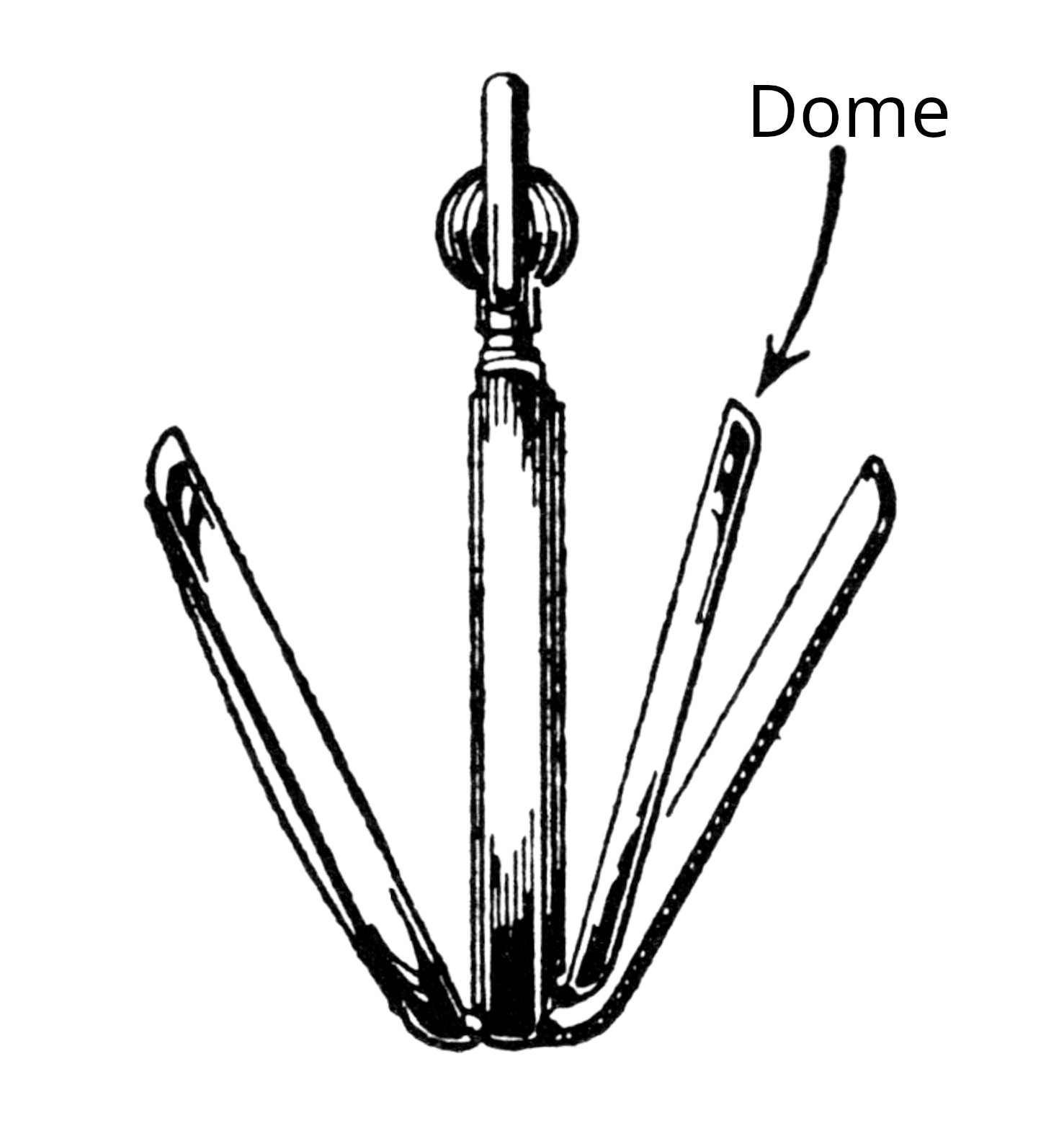
Dome Case
Click image to enlarge
What is the difference between a double-bottom case and a dome case?
Watch cases with two backs, a jointed (hinged) outer back that can be opened and an inner back that is fixed to the middle part of the case and cannot be opened, such as the case of an English lever watch, are called double-bottom cases. The movement is fixed to such a case with a bolt and joint.
Watch cases with an outer and inner back, both of which are jointed to the middle part of the case, are called ‘dome cases’.
Although it is clear that the English watch trade regarded a ‘dome case’ as one with an outer and inner back which both open, the term ‘dome’ was also used for the fixed inner bottom of an English double bottom case, particularly in the context of hallmarking, which can be confusing.
In the Horological Journal of April 1894 are the questions for the 1893 City and Guilds Institute examinations in watch and clock making, to which Mr T D Wright of the BHI added such answers as appeared likely to satisfy the Examiner. One of Mr Wright's answers clarifies the difference between a double-bottom and a dome case.
Question 5. Distinguish between a ‘dome’ case and a ‘double-bottom’ case. For what kind of movement is each case respectively well suited ? And in what manner should either movement be attached to the case?
Mr Wright's specimen answer to question 5. A ‘dome’ case has the inner bottom (in which the wind-up holes of a key-winding watch are made) opening on a joint in a similar manner to the outer bottom. A ‘double-bottom’ case has the inner bottom made solid with the middle, or band, of the case. The double-bottom is suitable for a capped full-plate keywinder, while the dome case is well suited for a keyless watch. With the former, the movement is always attached by a bolt and joint, so that it may be opened by the wearer for regulating. With the latter, the attachment is by means of a pin and dog-screws. With a dome key-winder, a joint is generally used instead of dog-screws, because it makes the firmer fixing and there is no winding pinion in the way.

Martin's dome case: Click image to enlarge
Mr Wright's answer needs a bit of unpicking.
The dome case he describes has two backs, both of which are jointed (hinged) to the middle part of the case and can be opened. If the watch is key wound, the inner back has a hole off centre for the key, and a second hole in the centre if it is key set from the back. These holes are covered when the outer back is closed. This type of case was typically used for Swiss watches, many of which were keyless and therefore have no holes in the inner case back. In this case, the inner back simply provides additional protection to the movement.
The notice here about Martin's dome case was published in 1875 and shows that, at the time, the case backs were called the inner and outer bottoms. The unusual feature of Martins design is that the inner back snaps inside the middle part of the case by its outer edge, instead of snapping over a raised ring on the middle part of the case as is usual. John Martin was a London watch case maker. He appears to have taken over the business at 48 Wynyatt Street Clerkenwell from James Martin, possibly his father, who first entered a sponsor's mark at the London Assay Office in 1822. In 1873 John Martin was awarded an honourable mention for very good specimens of case making by the council of the British Horological Institute.
The double-bottom case is a typical English case, with a jointed outer back that can be opened and an inner back that is fixed solidly to the middle part of the case. The inner back has a hole for key winding, and sometimes a second hole in the centre for hand setting, although many English watches are set from the front. This requires opening the bezel which carries the glass and applying the key to a square boss on the minute hand, with the chance of bending or pulling off the minute hand, or damaging the hands or the dial in the process.
The movement in a double-bottom case is attached to the case by bolt and joint. The bolt is the catch at 6 o'clock that can be released by a thumbnail to swing the movement out of the case on the joint located at 12 o'clock. The movement is detached from the case by pushing out the joint pin. The pin is usually tapered and will only come out one way, usually by pushing from left to right when facing the dial with the 12 at the top. Usually the pin pushes out quite easily; if it doesn't, try looking at the ends of the pin to see if it has been inserted incorrectly. A stiff piece of wire is usually sufficient to push the pin out; this can be mounted in a wooden handle and called a “joint pusher”.
The assertion that the joint makes a firmer fixing than case screws is a spurious attempt to make the English method of fixing movements to their cases sound superior to that of the Swiss method of using screws. In fact, many bare (uncased) English movements are seen where the joint, or the part of the bottom plate to which the joint is attached, is bent, because the movement was simply wrenched from the case by twisting the joint by hand. This is not possible when the movement is held into the case by screws. It is also easier to open the inner case back of a dome case to adjust the regulator than it is to open the bezel of a double bottom case, release the bolt, swing out the movement and remove the cap.
Back to the top of the page.
English Lever Bolt and Joint Cases

English Lever Double Bottom Bolt and Joint Case. Click image to enlarge
English pocket watches are often wound from the back and the hands set from the front, by a key applied directly to the square boss of the centre arbor which carries the minute hand. Because there has to be a hole in the back of the case for the key to enter, English lever watches usually have “double bottom” cases.
Winding from the back necessitates a hole in the case for the key, which must be normally covered to prevent dust getting in. This was the reason for the original pair case where the inner case of the pair had the hole, which was covered between windings by the outer case. Pair cases were not well sealed. The inner case carried the bezel and glass, the front opening in the outer case was open. This meant that dust and fluff could find its way into the outer case and between the two cases round to the winding hole. Nevertheless, pair cases continued to be made, mainly for watches with verge escapements, into the late nineteenth century.
When the English lever movement was developed around 1820, a better design than the pair case was also adopted. Like the earlier consular case, an outer bottom or back was attached to the middle part of the case by a joint. When this outer back is opened, it reveals the inner cover which is fixed to the middle part of the case. This inner cover has either a single hole for winding, or two holes if both winding and hand-setting are from the rear. In this case, the central hole is the one for hand setting.
The glass that protects the dial is held in a metal ring called a bezel, which is also attached to the middle part of the case by a joint.
Unlike the consular case, the joints for the back and bezel of an English lever case are separate and located at different positions around the middle part of the case. This made them simpler to make, with fewer knuckles, which allowed the joints to be made smaller and less obvious.
Bolt and Joint
The movement is attached to the middle part of the case by a bolt (catch) at 6 o'clock, which is circled in red in the image here, and a joint (hinge) below the pendant at 12 o'clock.
If the movement is to be examined or regulated, the movement is swung out from the front of the case by first opening the bezel and then releasing the bolt which holds the movement in place. The bezel is usually jointed to the middle part of the case at the side around 9 o'clock. To fully remove the movement from the case, the joint pin is pushed out, usually from left to right. This method of attaching the movement to the case continued in some high class English watches until about 1870.
When I first bought an English lever watch, I was told that this case was a consular case, but thanks to David Penney I now realise that this is not the correct name. In his book Watch and Clock Making, David Glasgow calls them double bottom cases and says that their cost was part of the reason for the decline of English watchmaking. Glasgow uses the term dome for an inner cover that is jointed (hinged) to the case and can be opened. This usage can also be found in the Horological Journal, so it is evident that at the time they were made this style of English lever watch case was called double bottomed. Here the terms outer and inner case back are used for the two bottoms.
In the photograph, the outer case back is open, showing part of the hallmarks for sterling silver. The inside of the hallmarked inner case back, which is fixed to the middle part of the case, is also visible. In this key wound and set watch the inner case back has a single hole for winding, which is isn't visible in the photograph. The hands are set by opening the front bezel and applying the key to the square boss of the minute hand.
If a gold or silver watch case is to be hallmarked, the inner case back must be made of the same metal because, if it was not, none of the case would be hallmarked. English assay offices would refuse to hallmark an item that was not all of one standard of metal and the inner case back, which was rigidly fixed to the middle part of the case, the case band, was regarded as an integral part of the case.
Opening an English Lever Case
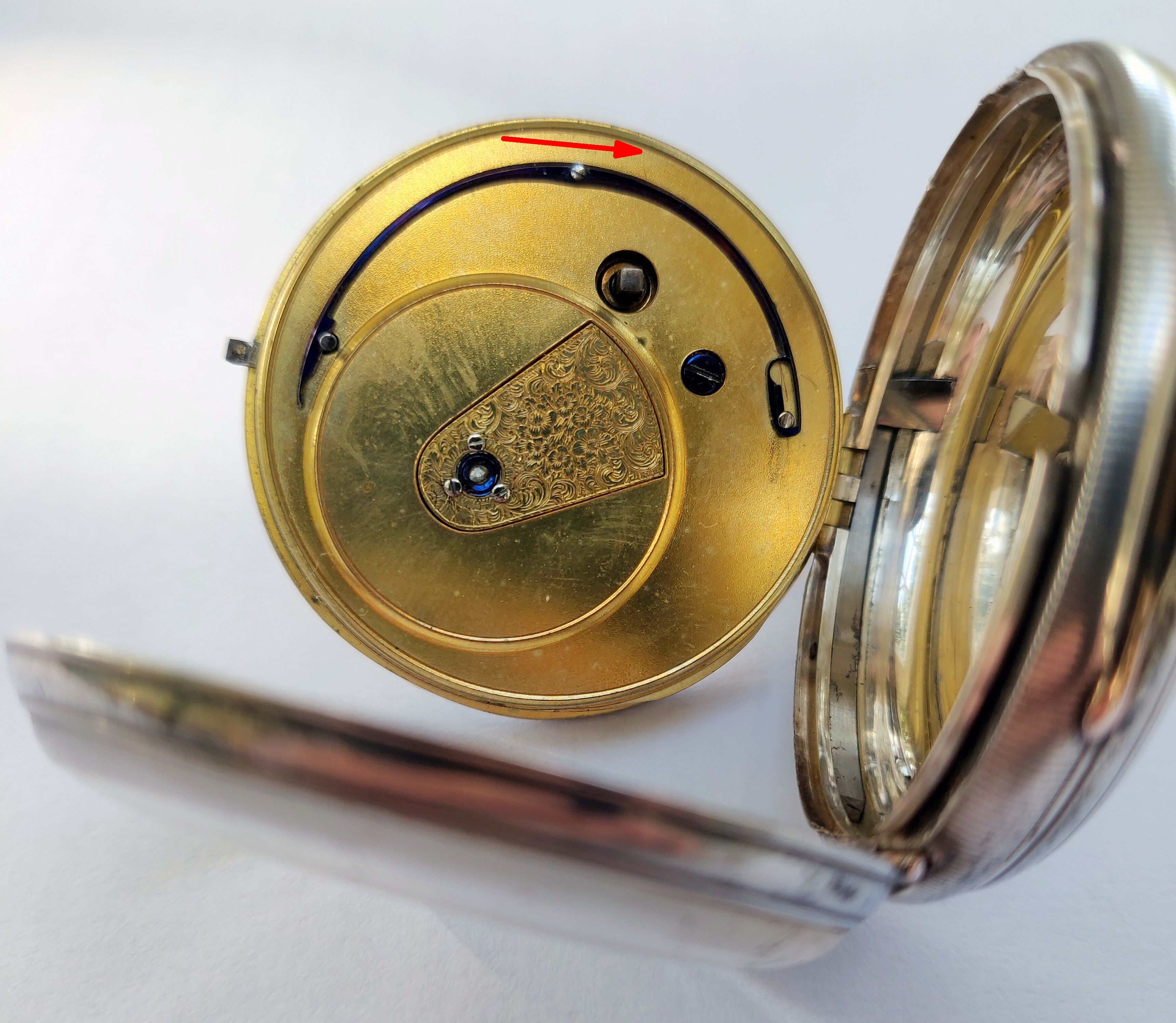
English Lever Watch Cap - Slide the Blue Catch to Release: Click image to enlarge.
To open the case of an English lever watch, start by opening the front bezel, the hinged metal ring at the front which carries the crystal. Once the bezel is open, set the hands to 12 o'clock so that they are well out of the way.
Next, look at the dial below six o'clock. You will see at the edge of the dial a small piece of steel that is normally covered by the bezel. This small projection from the edge of the movement ringed in red in the image above is the bolt (catch) that normally holds the movement in place. It has a horizontal slot on its outer side for a finger nail.
Press the bolt towards the centre of the dial with a finger or thumb nail. Be careful not to slip and catch the seconds hand. A small movement towards the centre of the dial of the bolt will release the movement so that it can be swung out of the case on the joint (hinge) located at 12 o'clock below the pendant.
To release the movement from the case completely, the pin of the joint is pushed out, usually from left to right.
This method of holding the movement in place is called “bolt and joint.”
Removing the Cap
The movement is covered by a gold plated metal cap. It might seem logical to call this a dust cap, but the proper term for it is simply the cap.
The curved blue steel strip engages with two pillars projecting from the top plate of the movement to hold the cap in place. It is fixed to the cap by the central peg, which works in a slot in the cap to allow the strip to slide.
To release the cap, slide the blue steel strip round in the direction shown by the red arrows and the cap will then lift off. There is a peg at the middle of the strip where the red arrow is in the image. Use a finger nail to press against this peg.
Back to the top of the page.
Swing Ring Cases
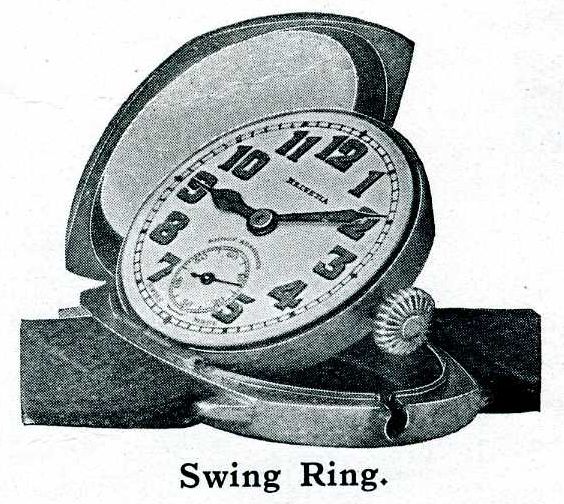
Swing Ring case 1931
The swing ring case was invented by Ezra Fitch in 1879 as part of the design of a waterproof case, see Fitch Swing Ring Case. Fitch's case had a carrier for the movement that was hinged to the case so that the movement could be swung out from the front and there was no need for a separate case back. This is the swing ring element. A screw down front bezel made the remaining front joint watertight. The entrance to the case for the stem was sealed by the simple expedient of a cap that completely enclosed the crown and stem and screwed down onto the end of the pendant.
The swing ring part of Fitch's design proved to be surprisingly long lasting. The image here is taken from Robert Pringle & Sons "Wilderness" catalogue for 1932. It is from a page marked "Special Dust and Waterproof Watches". The page includes Borgel, screw back and bezel and hermetic watches, and also a cushion shape watch by Helvetia with "a patent device for rendering the stem watertight".
The swing ring watch is also marked Helvetia on the dial and has a 15 jewel lever movement with shock absorber. However, there is absolutely no provision for sealing the slot in the case side that the stem drops in to, and because the case is a cushion shape the bezel snaps on. This watch has no waterproof features and should not have been on this page.
Watches with swing ring cases are sometimes called "semi-hermetic" because they often have a fluted screw down bezel and look superficially like some watches with waterproof cases such as the Borgel screw case or the Finger/Gruen Hermetic. But if they don't have any means of preventing water entering the case where the stem passes through they are not even remotely hermetic and should not be called such.
Back to the top of the page.
Curved and Straight Fixed Lugs
Curved and Straight Fixed Lugs
Click image to enlarge
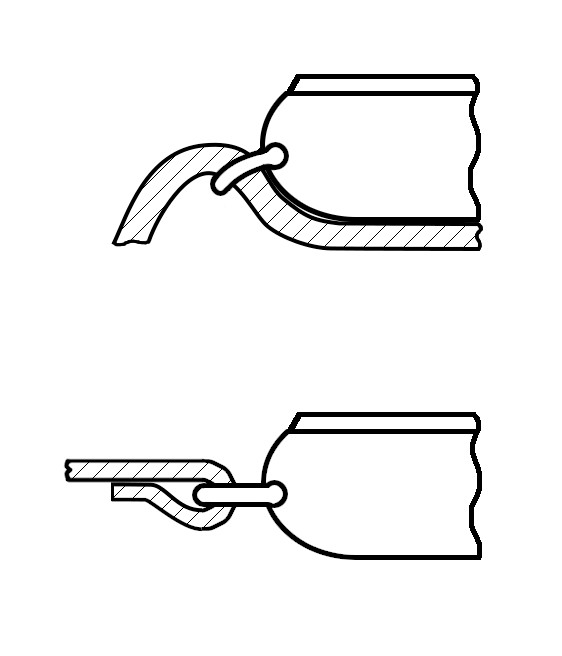
Fixed lugs come in two general types, curved lugs that droop down from the middle part of the case, and straight lugs that project horizontally from the middle part of the case, as shown in the sketch.
Trench watches usually have curved lugs. The design of these was registered in Britain and Switzerland by Dimier Brothers in 1903. Curved lugs are usually suitable for a one-piece pull through leather strap.
Straight lugs appear to be earlier than curved lugs. Mr W. E. Tucker, managing director of the firm of H. Williamson Ltd., stated that the company had fitted wire lugs to an officer's watch during the Boer War. H. Williamson Ltd. registered a design of wristwatch with straight lugs with the British Board of Trade in 1901, making it the earliest known example of a wristwatch with a leather wrist strap attached directly to the case for which there is indisputable evidence.

Two Piece Open Ended: Click to Enlarge.
Straight lugs were not designed for a one-piece pull through leather strap. When fasted around the wrist, a one-piece strap would put downward pressure on straight lugs, which would tend to bend them downwards.
Straight lugs are generally fitted with a two piece open ended strap, where the open ends wrap around the wire lugs and are fastened together either by stitching in place or metal strips called ‘tin tabs’ that are fixed in the outer part of the strap and pass through slots in the open end and are bent over to hold it in place.
Back to the top of the page.
Dimier Brothers Déposé No. 9846

Curved lugs or "handles"
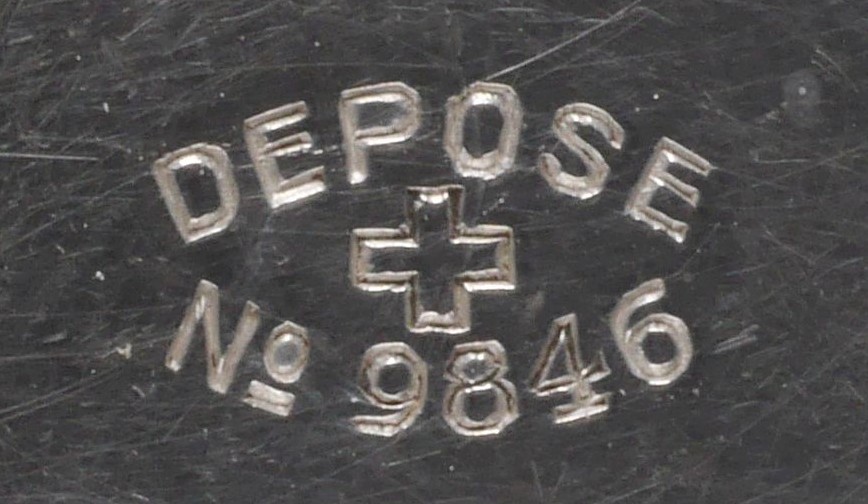
Déposé No. 9846 stamp in wristwatch case back: Click image to enlarge
In 1903, the Anglo-Swiss company Dimier Brothers registered a design of a wristwatch with fixed wire lugs and a leather strap. This is the earliest documentary evidence seen of watches with wire lugs and one piece leather straps.
Dimier Frères & Cie had offices in la Chaux-de-Fonds and London. The London company, Dimier Brothers & Co., from 1868 were important watch importers, You can read more about the London company of Dimier Brothers on my Sponsors Marks page at Dimier Brothers & Co. .
Evidence for this involvement of the Dimier Brothers company in the early development of the wristwatch is the legend ‘Déposé No. 9846’ (sometimes ‘DEPOSE 9846’, or even ‘DÉPOSÉ 9846’) seen in the case backs of early wristwatches as shown here, sometimes with the Swiss Federal Cross symbol.
Déposé is short for Modèle Déposé, which is Swiss/French for ‘Registered Design’, a design that was registered with a government office in order to provide copyright protection.
An author's or designer's legal copyright exists for designs whether they are registered or not, but it can be difficult to prove without evidence of the date the design was created; hence, an entry in a register is a useful official record. A modèle déposé is a register of a design, a pattern or appearance of an item. It is not a patent, a patent is granted for a novel concept which does not have a specific embodiment.
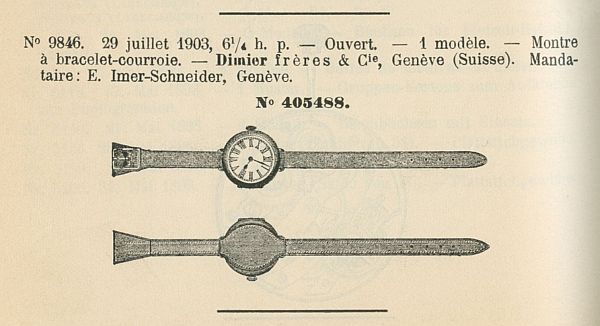
Swiss Modèle Déposé No. 9846, July 1903: Click image to enlarge
The picture to the right here shows the official Swiss record for Modèle Déposé No. 9846. It is dated 29 July 1903. The description is very short compared to that of a patent, because it is the representation of the design that is being recorded. The description simply says ‘Montre à bracelet-courroie’ or ‘Wristwatch with bracelet-belt’ and shows a picture of the design.
The exact translation of Montre à bracelet-courroie is important. A montre is a watch, à means with, and bracelet is something that goes around a wrist. The term montre-bracelet had been used for wristwatches, particularly ladies' wristwatches, since they had become fashionable and accessible to the general public, rather than just wealthy aristocrats, in the 1880s. The important word in this registration is courroie, a belt. The addition of courroie or belt, implying a leather strap, is clearly intended to distinguish this design from a montre bracelet, a watch on a metal bracelet which ladies had been wearing for hundreds of years.
So it can be said that the specific design features being registered were the use of a leather wrist strap, somewhat like a belt, and by implication the ‘anses’, the handles or wire lugs, that attach the watch case to the leather wrist strap.
An interesting feature of the strap design is the flared centre section. This approximately covers the same area as the watch case. Since there is no description its purpose can only be guessed at. It might have been to prevent any part of the watch case from touching the wrist for some reason, perhaps concerns about allergies, or about perspiration tarnishing silver watch cases. Or, which seems more likely, it would not have been possible to register a design that was just a straight leather strap, because that would be too simple and obvious, so this more elaborate design was conceived just so that it could be registered. Once a registered design number had been secured, that fact could be used in advertising and to gain a hold over wristwatch manufacturers.
Registered Design 405488

British Registered Design 405488, February 1903
Crown © Copyright, use allowed for non-commercial research
There is a second number in the picture of the Swiss Modèle Déposé 9846, the number 405488, underneath the main block of text containing the registration number 9846.
No 405488 is the number of a British Registered Design, a design that was registered in Britain for the purposes of copyright protection in the same way as the Swiss/French Modèle Déposé discussed above.
The picture here shows the entry in the British Board of Trade register. With the exception of a flared section of the strap behind the buckle, it is identical to the Swiss Modèle Déposé 9846. The watch shown mounted on the strap in the picture is crossed out to show that it is not part of the Registered Design. This is the full entry from the ledger of representations; in common with all registered designs, there is no text description.
The design was registered by Georges Dimier, trading as Dimier Brothers and Company at 46 Cannon Street, London.
Design No 405488 was registered on 20 February 1903, six months before the Swiss register entry for Modèle Déposé No. 9846 in July 1903. This suggests that it was the London branch of Dimier Brothers that came up with the idea, had it registered in London and subsequently in Switzerland. The company was no doubt reacting to the demand for wristwatches from British military officers and ladies.
The period of copyright protection afforded by the British registration was initially five years. This was twice extended, as allowed under the section 53 of the Patents and Designs Act 1907, on 23 January 1908 and 17 May 1912, for two further periods of five years each, taking the period of protection up to May 1917.
Dimier Frères notice 1906
By 1906, the market for men's wristwatches with wire lugs and leather wrist straps was starting to accelerate and Dimier Frères felt they needed to reassert their rights. The announcement shown in the next figure was published in October 1906. It translates as:
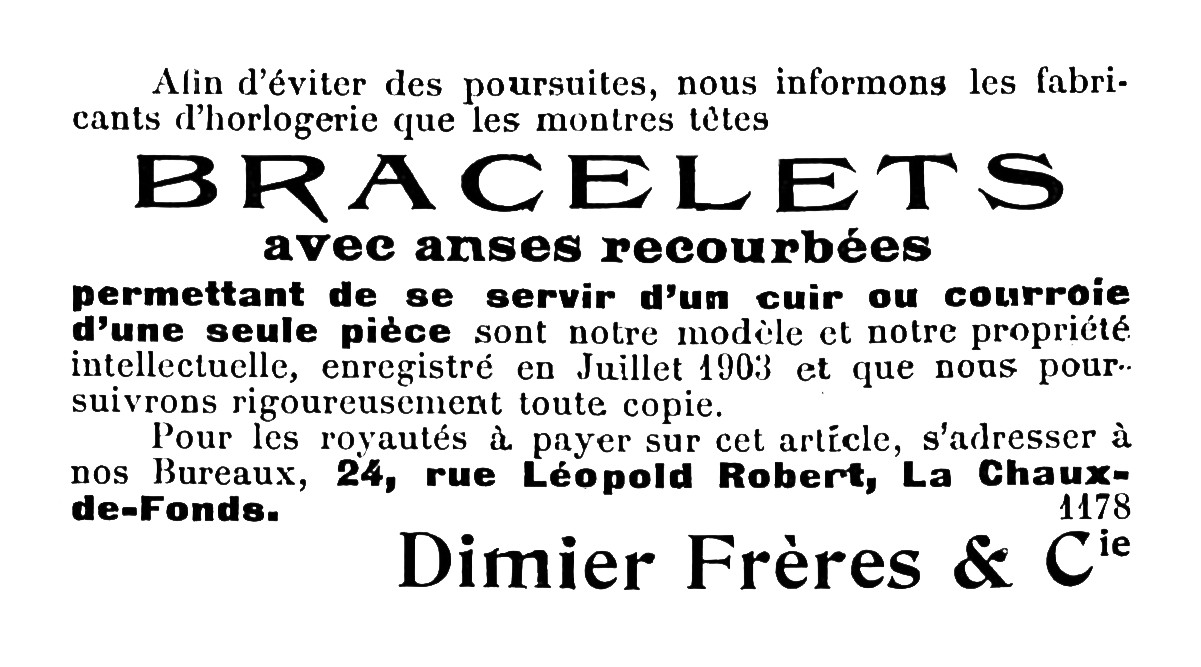
Dimier advert 1906: Click image to enlarge
In order to avoid prosecution, we inform watch manufacturers that the watches with heads BRACELETS with curved handles allowing the use of a single piece of leather or strap are our model and our intellectual property, registered in July 1903 and that we will rigorously pursue any copy.
For royalties to be paid on this item, contact our Offices, 24, rue Léopold Robert, La Chaux-de-Fonds.
Dimier Fréres & Cie
This notice gives more details of Dimier Frères claim than the registered design. The wire lugs (‘anses’ or handles) are designed to be curved (recourbées) or bent downwards, allowing the use of a wrist strap of a single piece of leather pulled through the lugs. The downward curving lugs makes the path of the strap around the back of the watch case follow a natural curve.
Judging from the very large number of early wristwatches that are stamped in their case backs with the legend "Déposé No. 9846", the claim that Dimier Brothers originated the design and the threat of action against anyone who didn't pay them royalties for making wristwatches with fixed wire must have been taken seriously by Swiss watch manufacturers at the time.
RD 499803 buckle design

British Registered Design 499803, April 1907
Crown © Copyright, use allowed for non-commercial research

Underside showing how the strap fits
Watch straps with the same flared centre shape as the British and Swiss Registered Designs are sometimes seen with the British Registered Design number ‘No. 405488’ stamped onto the leather strap, and with another British Registered Design number, ‘No. 499803’, stamped on the buckle.
Buckles stamped with the Registered Design number 499803 are an unusual design, with two centre bars instead of the more usual single bar.
The British Board of Trade records show that this unusual design of buckle was registered on 11 April 1907 by Georges Dimier trading as Dimier Brothers and Company, 46 Cannon Street, London.
The purpose of the two centre bars is to allow the buckle to be fitted to the strap without being stitched into it.
The Dimier design from 1903, Modèle Déposé No. 9846, Registered Design No. 405488, shows a strap with a circular section the same size as the watch case in the centre. There are only two ways such a strap could be fitted to a watch with fixed wire lugs, either the buckle would have to stitched to the strap after the strap had been fitted to the watch, or the buckle would have to be designed to fit to the strap without stitching, which is exactly what the Registered Design No. 499803 buckle does. The photograph here shows how it fits to the strap.
The same design was registered by Georges Dimier in Switzerland on 15 June 1910 as Modèle Déposé No 18217, ‘Boucles de courroies’. Interestingly, the record shows that there were two designs registered, but unfortunately there are no other details showing the second design.
When a design was registered, the registered proprietor had copyright during five years from the date of registration under section 53 (1) of the Patents and Designs Act, 1907. Section 52 (2) allowed an extension for a second period of five years and the copyright of Registered Design number 499803 was extended on 13 March 1912. Section 52 (3) allowed a third extension of five years and the copyright was extended in November 1916 by Georges and Amalia Dimier trading as Dimier Brothers and Company, 46 Cannon Street, London, watch importers and exporters.
Back to the top of the page.
H. Williamson Wristwatch
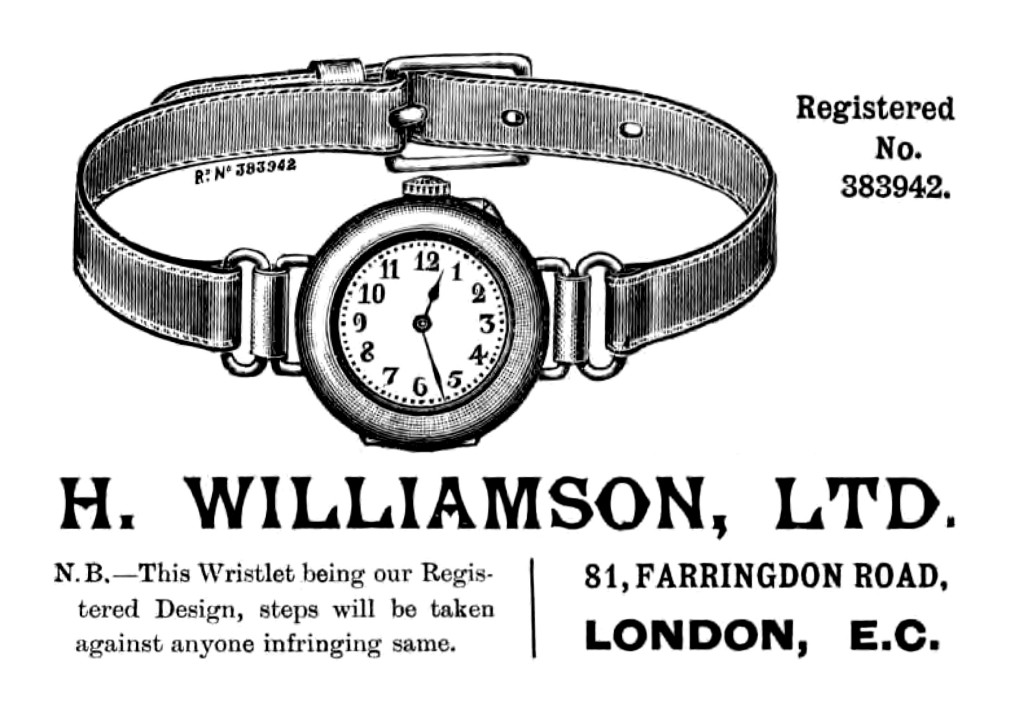
Design 383942 registered 1901, Williamson advert January 1906: Click image to enlarge
Although wristwatches had been used by British military officers since the 1880s, these were usually in the form of small pocket watches in leather holders called wristlets. H. Williamson Ltd. was one of the first manufacturers to make a wristwatch with a leather strap that attached directly to the watch by the means of lugs attached to the case.
Mr W. E. Tucker, managing director of the firm of H. Williamson Ltd., made an interesting statement about the origin of the wristwatch. In an interview in 1933 he said:
During the Boer War we received a 12 size watch belonging to an officer in South Africa which he said he wanted to wear on his wrist. I suggested putting loops on the case and sewing straps onto them. This was done, and we were struck with the idea and had it registered. It was some time before the idea took on, but eventually it became extremely popular. Prior to that there had been a strap which went round the wrist, and contained a pocket in which an ordinary watch was kept.
The design was registered with the British Board of Trade in 1901, making it the earliest known example of a wristwatch with a leather wrist strap attached directly to the case for which there is indisputable evidence. The registered number of the design is 383942.
The exact date of registration is not recorded, but the volume in which it was recorded is dated runs from 21 September to 12 December 1901. If the 4,157 designs that were registered over the 83 days covered by the volume came in at a steady rate, that would put the date of registration at 1 December 1901.
The strap is a two-piece open ended design with the open ends sewn together, exactly as described by Mr Tucker. There is one feature of the registered design that is immediately notable; the strap is not attached directly to the wire lugs of the case but to an oval loop of wire that is itself coupled to the wire lugs on the case by a flattened metal tube. Unlike patents, registered designs have no accompanying text description; the only only thing that is recorded is a representation, one or more illustrations of the design, so there is no explanation given of the reason for this feature.
The registered design shows that the lugs project horizontally from the case rather than drooping down as is the case for lugs designed to take a one-piece pull thorough strap. It might be speculated that the strange design of the lugs, with the attached flattened metal tube and oval loop of wire, was to form a hinge to relieve bending strain from the strap when tightened around the wrist. But a strap stitched directly to directly projecting metal lugs would put little bending strain onto the lugs and this explanation seems implausible. It might be that a simpler design with the strap directly attached to the lugs would be so obvious that it could not be registered, so this more complicated design was conceived purely to allow a registration of a design to be secured. The fact of registration, evidenced by the registered design number, could be used to warn other manufacturers off, and the lack of any textual description would make it difficult for them to mount a challenge.
It appears that Williamson did not immediately begin in 1901 to manufacture large numbers of wristwatches with leather straps. The first known advertisement by Williamson for wristwatches with leather straps was published in January 1906, as shown here.
Back to the top of the page.
Cushion Cases and Wide Lug Cases

Cushion case wristwatch fitted with a strap that is too narrow so that a back pad can be used. This looks wrong and doesn't wear well.
Cushion cases and wide lug cases with lugs that are a significant proportion of the width of the case, like the wristwatch shown in the photo from eBay, are not fitted with straps that have back pads for exactly the reason illustrated by the watch in the image.
The strap is much too narrow for the lugs and is clearly wrong. During wear, the narrow strap does not hold the watch in place and allows it to constantly wander off to one side or the other, which becomes very annoying.
To stop the watch wandering about, a wider strap that fills the width of the lugs is needed, but then the back pad would not be too narrow for the strap - there would only be very narrow strips of leather either side of the holes that the strap comes through. To correct this, the back pad would have to be made wider, much wider than the watch, which would look very bulky and in practice just doesn't look right.
Whether the case is a cushion case or any other shape with lugs that are wide compared to the case, the principal problem for a strap with a back pad remains the same. In order to look right, a back pad needs to be 20mm or more wider than the strap. This means that 10mm of the back pad is visible on either side of the strap. Any less than this and the strap looks too wide for the back pad.
Cushion cases usually have 16mm, 18mm or wider lugs and were originally fitted with a strap without a back pad. A strap of 16mm or greater width generally looks and feels fine on a man's wrist, so I recommend that you use a simple one or two piece strap without a back pad on a cushion cased watch.
Back Pads for Small Watches
There is a natural tendency to think that a strap with a back pad might make a small watch “look” larger, which is more wearable today. However, this doesn't work. The end result looks like what it is; a small watch on a back pad that is too wide for it. For the best appearance, the overall design of the strap and back pad need to be in harmony with the watch.
With cushion cased watches, it is obvious to think that if, in general, a back pad needs to be 20mm wider than the lugs, then just add 20mm to the width of the strap and make a back pad that width. This simply doesn't look right.
If you are thinking along these lines, try making a mock up to see how it would look. This doesn't have to anything elaborate, a couple of strips of appropriately coloured paper are quite adequate, one cut to the width of the lugs to represent the strap and the other cut 20mm wider to represent the back pad. You will soon see that it just doesn't look right, the back pad is out of proportion to the watch and dominates it, making it look smaller than it really is.
Curved Lugs
There is an added difficulty if the watch has curved lugs or bars. Because the ends of a two piece leather strap are square, they are not easy to fit to curved lugs, and the curvature of the lugs means that the stress in the strap is carried at the outer edges, which which can cause it to split or tear from the edges inwards.
Curved lugs often show that the watch was designed to be worn with a fabric or silk strap, often silk moiré which was very fashionable at the time.
Strap Options for Cushion Cased Wristwatches
Men's size cushion case watches were originally fitted with two piece straps, either stitched on or open ended with tin tabs to secure the open ends closed.
Ladies's size cushion cases usually have the lugs very close to the case and curved. These were designed to be worn with a fabric or silk strap, often silk moiré which was very fashionable at the time, and that is the best option.
Usually, the lugs of a cushion case are too close to the case for a pull-through leather strap.
Back to the top of the page.
Fitting Unbreakable Glasses
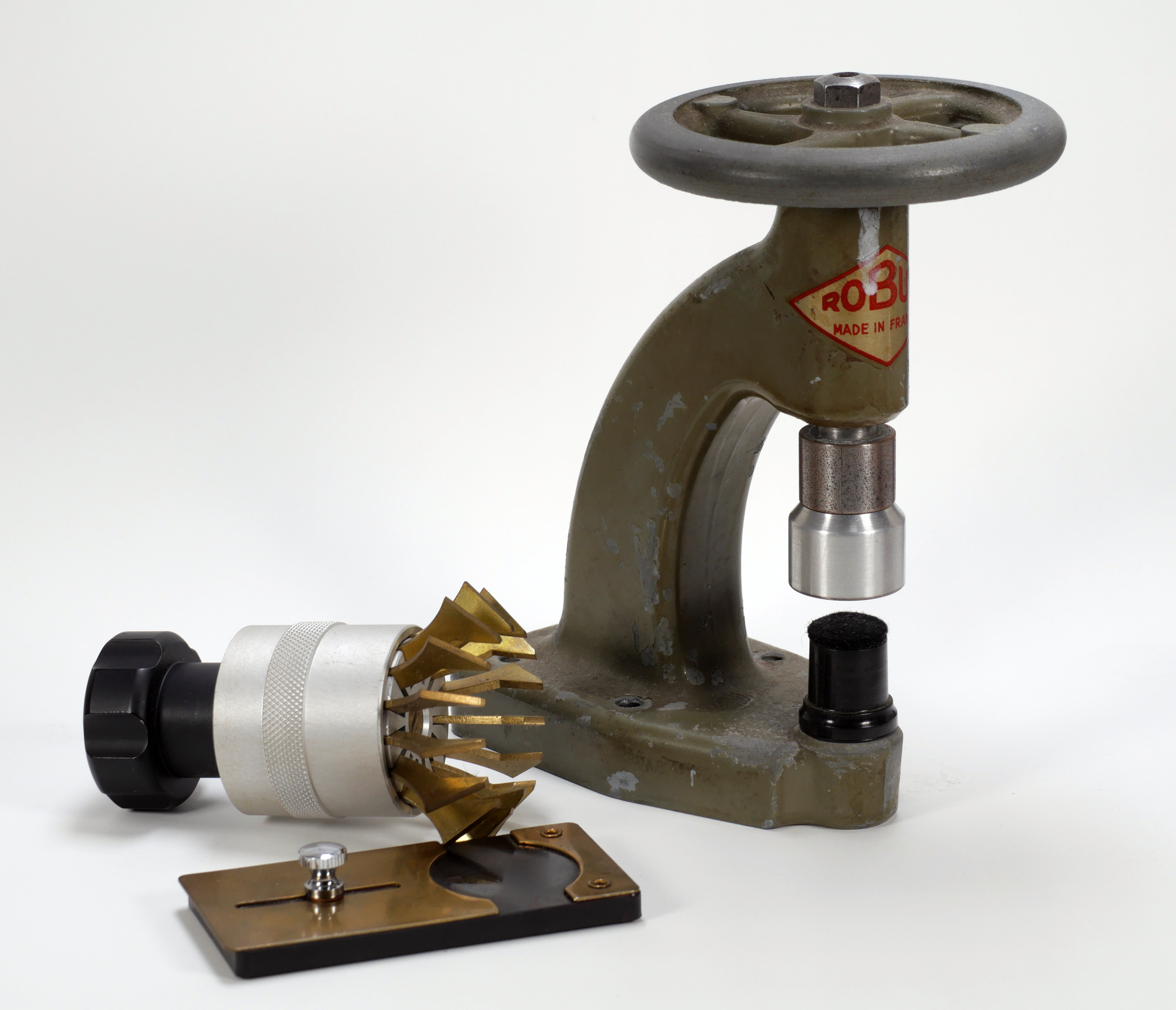
Glass Fitting Tools: Click image to enlarge
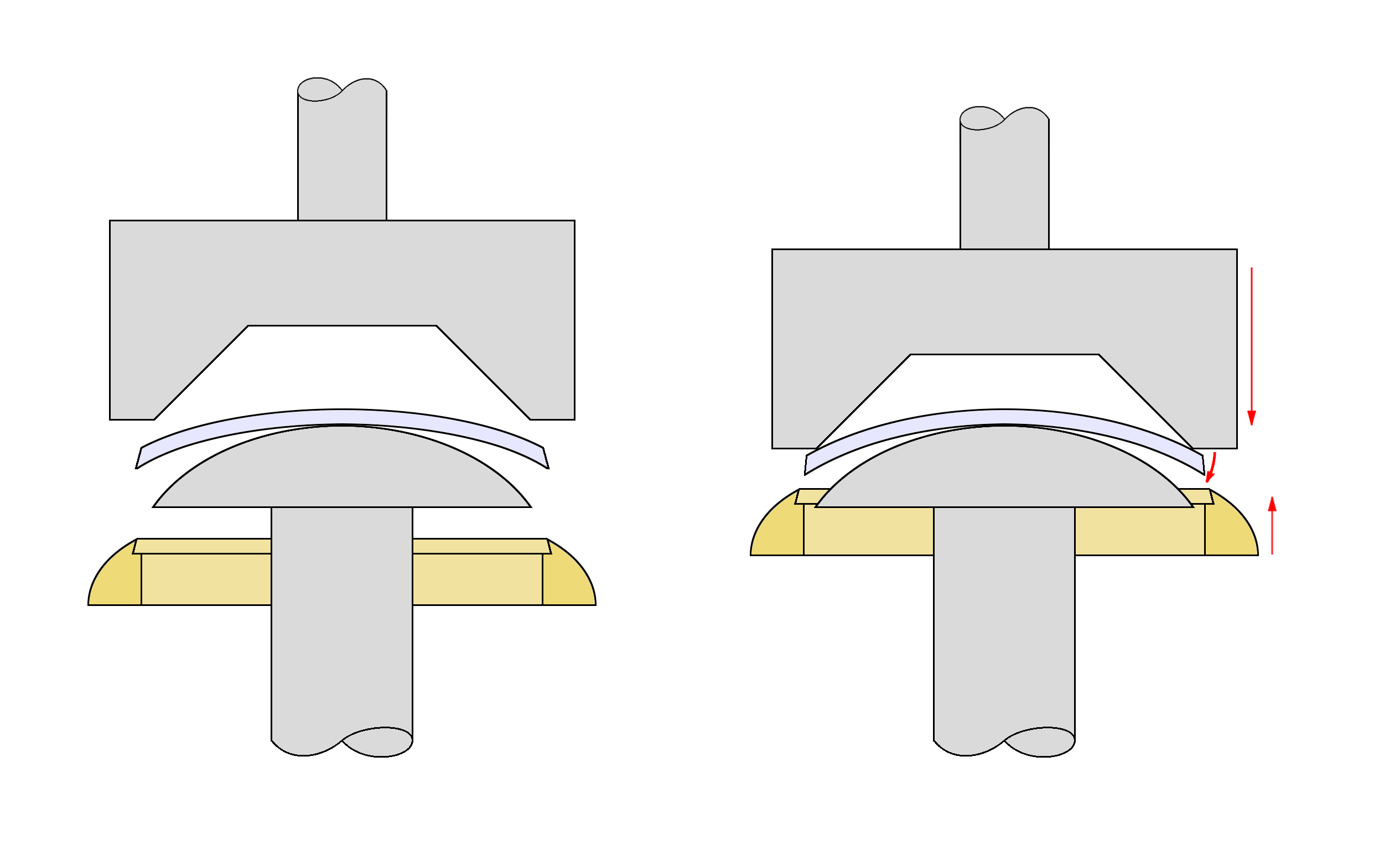
Fitting Plastic Crystal: Click image to enlarge
Unbreakable watch glasses came into use during the First World War, patented in Switzerland and America at about the same time. The first were cut from a flat plastic sheet. A flat piece of plastic material such as celluloid sheet cannot be used directly in place of mineral glass because it is not as dimensionally stable and can shrink over time or in cold weather, which could result in it falling out from the bezel.
To overcome this problem, the technique of fitting plastic glass to the bezel under tension was developed. This involves cutting out a circle of material slightly larger than the bezel with a bevelled edge, then deforming it with a press into a dome shape, allowing it to enter the bezel. When the press is released, the glass tries to flatten, and its edge springs into a groove in the bezel. The glass is sized so it does not flatten entirely and is held in the bezel by residual tension. Bliss C. Ames described this method in a US patent granted in 1915.
At some point, moulded glasses with a similar cross-section to mineral glasses became available, although it was not discovered when this was. Moulded glasses are made by injection moulding, where molten plastic is injected into a mould and takes the shape of the mould when it cools and hardens. Injection moulding was invented in the nineteenth century, but in 1919, Arthur Eichengrün advanced the technique by developing the first injection moulding press. Cellon-Werke produced a powder form of cellulose acetate that could be injection moulded. Although Cellon Werke did not make watch glasses, they would have made their customers aware of the new process and the availability of the powder to carry it out. It is possible that injection moulded unbreakable glasses were made during the war or shortly after.
The tension method described by Ames is still used today when fitting plastic glasses. The sketch shows how a plastic glass is fitted using a glass press. The glass, slightly larger, by about 0.2 millimetres, than the front opening of a bezel, is placed on an anvil, and a die is pressed down onto it to increase its curvature. This reduces the diameter of the glass until it is smaller than the front opening of the bezel. The bezel can then be lifted so that the glass enters the groove in the bezel. Withdrawing the die allows the glass to spring back towards its original curvature and fit tightly into the bezel.
Low Dome Crystal: Click image to enlarge

High Dome Crystal: Click image to enlarge
The availability of the cheap “crystal lift” tool shown in the foreground of the glass fitting tools enables plastic glasses to be fitted without removing the bezel from the case. However, so that the tool can grip the edge of the glass, high or medium dome crystals are usually used with this tool. Because of this, wristwatches are sometimes fitted with ugly high-dome glasses.
The large clearance between a high dome crystal and the hands is rarely needed, and the appearance of watches fitted with high dome glasses can be considerably improved by fitting a low dome glass. This requires the bezel to be removed from the case and the use of a glass press such as the Robur shown in the background of Figure 22. Cheaper alternatives that look a bit like potato ricers are available, although not quite so easy to use.
Back to the top of the page.
Secrets

1883: Louis Juillerat, maker of secrets: Click image to enlarge

1906: Ecabert-Ziegler, manufacture of American secrets: Click image to enlarge
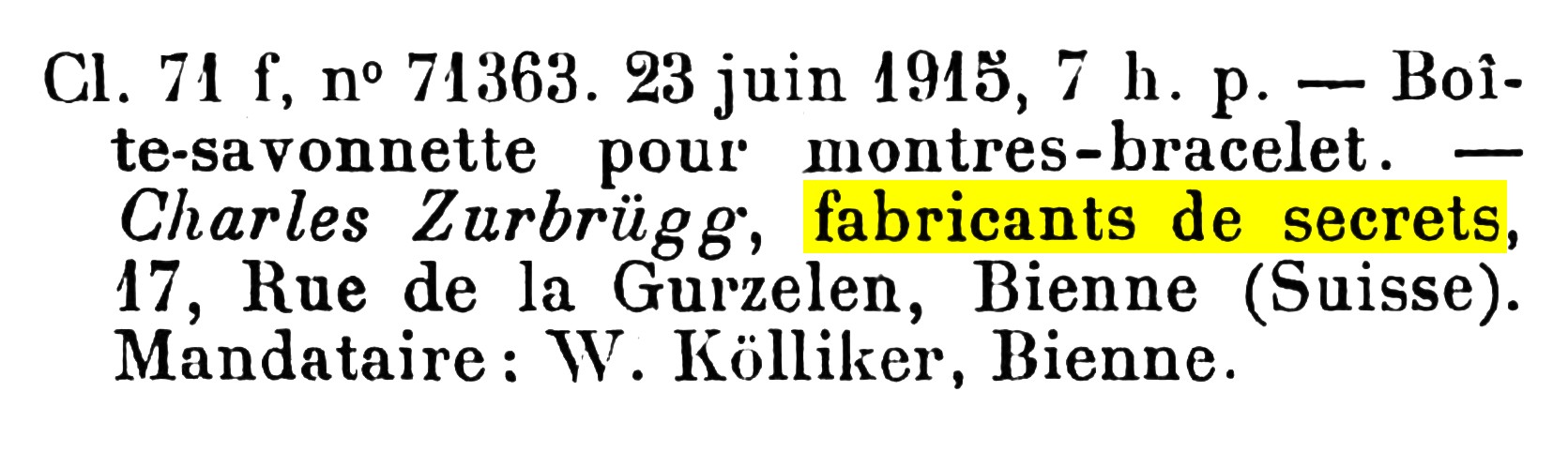
1915: Zurbrügg, ‘fabricants de secrets’: Click image to enlarge
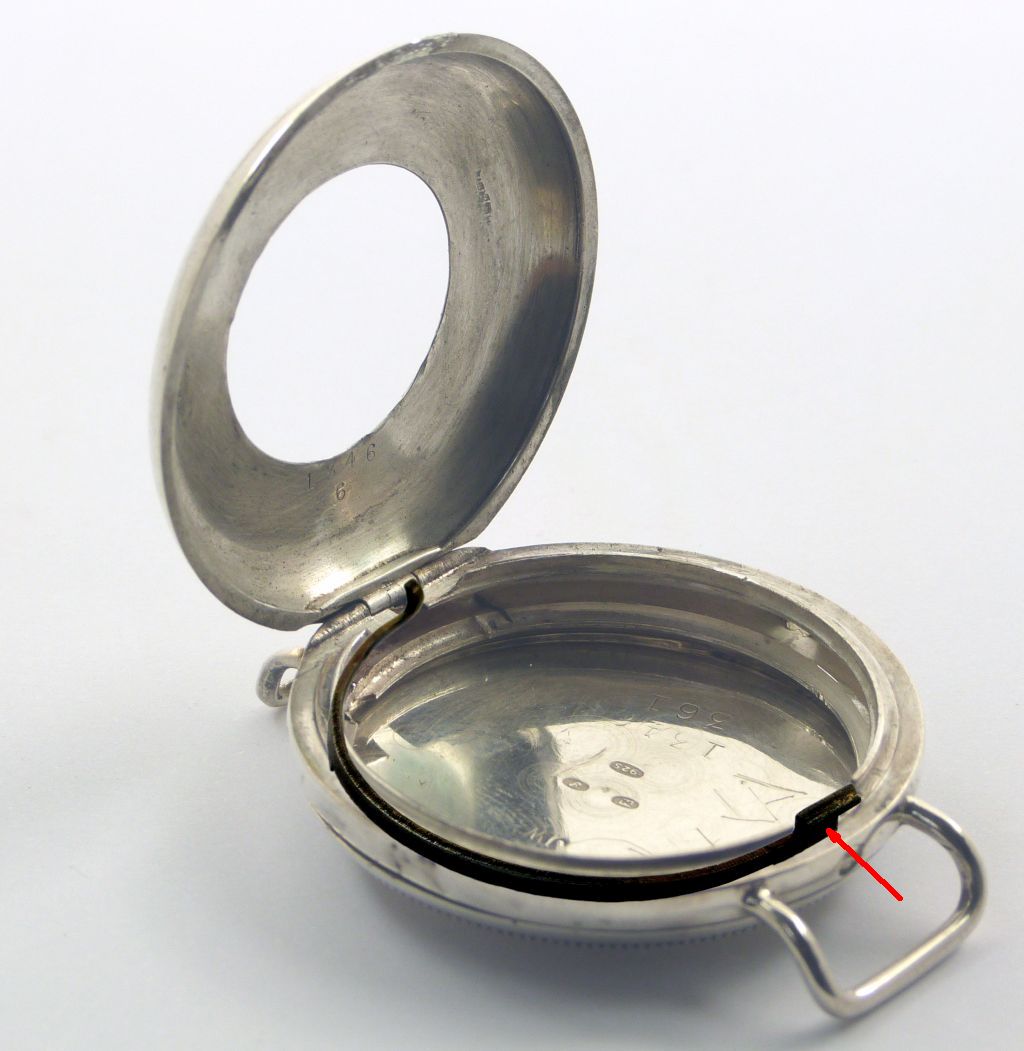
Zurbrügg half-hunter wristwatch case: Click image to enlarge
Pocket watch cases, and some wristwatch cases, have springs concealed inside the case for convenience. For example,
- Key-wound watches have a spring that opens the back of the case when a button on the pendant is pressed, so the wearer can apply the key to the arbor of the mainspring barrel and wind the spring.
- Hunter watches have a spring that opens the front lid of the case when a button on the pendant is pressed so that the time can be read.
French and Swiss watch case makers called these springs ‘secrets’, and makers of these springs called themselves, rather mysteriously to English ears, ‘faiseur de secrets’ or ‘fabricants de secrets’ (‘maker of secrets’ or ‘manufacturers of secrets’).
The springs are hidden within the case band and not visible on casual inspection or to the wearer of the watch, so it is not surprising that they are called ‘secret’, but it is surprising that the word is used on it own.
In French, springs are ‘ressorts’, so it would seem logical to call hidden springs ‘ressorts secret’, but they weren't; they were simply called ‘secrets’. Watchmaking has its own vocabulary with some funny word usage, but this must be the most unusual and obscure.
The first notice reproduced here dated 1883 about the ownership of the company called Louis Juillerat in Le Locle shows that the nature of the business was ‘maker of secrets’.
The advertisement dated 1906 by Ecabert-Ziegler of Les Bois shows that they were a manufacturer of ‘American secrets’ for silver watch cases.
The notice dated 1915 is about Swiss patent 71363, which was granted to Charles Zurbrügg on 23 June 1915 for a "Boîte-savonnette pour montres-bracelet" or hunter case for wristwatches.
The type of secret usually used in Switzerland was made in two parts. This was explained by Chevallier and Dubois in 1890 in their article ‘L'emboîtage de la montre - Du secret et de son fonctionnement’.
In hunter-case pieces, casing is more complicated, in that there is a secret to be set in motion. The closing springs consist of two parts held to the case band by screws; these are the head and the lever. The first, when pushed, causes the back or cover to detach, while the second places the back at right angles.
So, standard secrets have two separate parts; the head which forms the catch, and the lever that opens the lid. An alternative form called an ‘American secret’ has the head and the lever formed as a single piece.
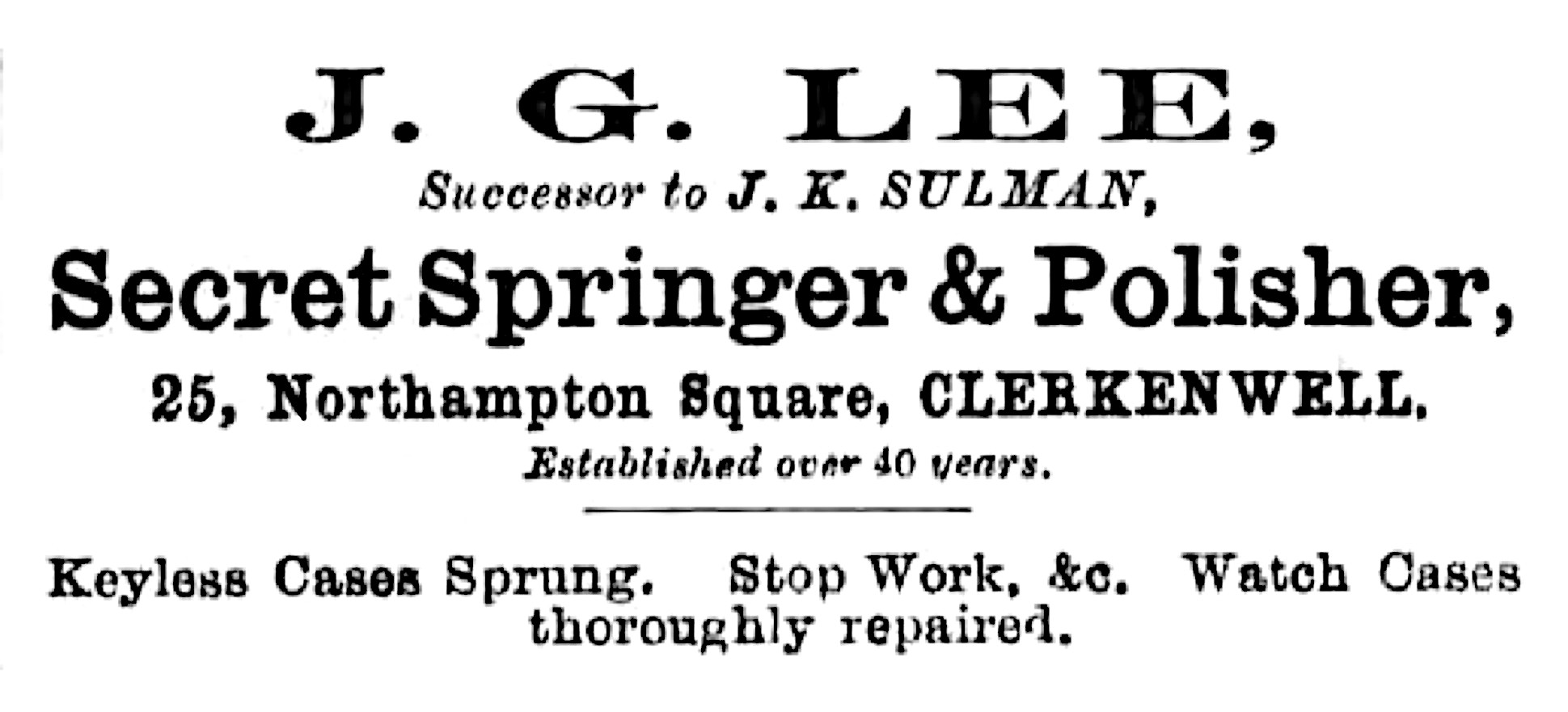
1899: J G Lee, Secret Springer: Click image to enlarge
On 25 November 1912, IWC was granted Swiss patent CH 62178 for a ‘Gehäusefeder für Uhren’ or case spring for watches. The spring is an improvement on the usual one piece lever spring, in that the spring and the part that is screwed to the case are separate items. This allows the spring part to be more easily replaced if it breaks.
The composite image shows a Zurbrügg half-hunter wristwatch case with the steel secret spring superimposed to show its location inside the case.
The spring has a catch for the lid at one end and a lever at the other end that forces the lid open when the catch is released. This makes it an ‘American secret’. The red arrow indicates where a shaft attached to a small release button passes through the hole in the case between the sides of the strap lug and operates the end of the spring with the lid catch.
This term passed into the English watch trade. Tradesmen who fitted springs to watch cases were known as ‘secret springers’, such as J G Lee, who advertised as a Secret Springer over many years.
If you have any comments or questions, please don't hesitate to get in touch via my Contact Me page.
Copyright © David Boettcher 2005 - 2026 all rights reserved. This page updated December 2025.
Back to the top of the page.