
Blog: Enamel Dials
Copyright © David Boettcher 2005 - 2026 all rights reserved.First published: 31 October 2018, last updated 12 March 2026.
I make additions and corrections to this web site frequently, but because they are buried somewhere on one of the pages the changes are not very noticeable. I decided to create this blog section to highlight new material. Here below you will find part of one of the pages that I have recently either changed or added to significantly.
This section is from my page about Swiss marks that can be found at Dials and Hands.
If you have any questions or comments, please don't hesitate to contact me via my Contact Me page.
Enamel Dials
Porcelain Dials?
Sometimes enamel dials are incorrectly described as “porcelain”: this is wrong. Porcelain is made from clay and is not suitable for watch dials; it is used for tableware such as plates and bowls. Watch dials are made using vitreous enamel, a type of glass. In the USA this is called “porcelain enamel”. This is often shortened to just “porcelain”, which is inaccurate.
In the eighteenth century, the process of using vitreous enamel to make high quality dials with white, cream, or sometimes black, backgrounds, with hour numbers, minute tracks and other other details in vitreous ink, was developed. These superseded the metal dials that had been used previously.
The word “enamel” refers to any hard shiny coating such as tooth enamel, enamel paint, or even nail enamel (nail varnish). However, when used in the context of watch dials, enamel refers to an opaque or semi-transparent hard, glass like, surface applied to a metal dial plate by vitrification. Vitrification (from Latin vitreum (glass) via French vitrifier) is the transformation by melting of a substance into a glass. The full name of the substance used for watch dials is vitreous enamel.
Vitreous enamel dials have a very hard surface which is usually shiny and reflective like glass, but the surface can be made matt by rubbing with abrasive after firing.
Vitreous enamel is made from powdered glass. Tin oxide is added to make it opaque white, other chemicals are used for other colours. To make a dial the enamel is fused onto a copper dial plate by firing in an oven at high temperature, melting the glass and causing it to run together to produce a smooth glassy surface. First the overall white or black background is made, which might take four rounds of firing and smoothing to get the desired finish. Then the numbers and tracks are drawn on in black or white enamel ink, which is then also fired, at a lower temperature, to fix it to the white background.
After firing, vitreous enamel is invulnerable to ageing or fading and can be easily cleaned; an enamel dial will happily go through an ultrasonic clean. Vitreous enamel will be cracked if the dial is flexed, e.g. by being handled clumsily or levered off the movement without releasing the dial screws fully first, but apart from this kind of physical damage they will last forever.
Enamel dials are expensive to make, so in the twentieth century cheaper materials were used, usually by printing the details onto a metal base and then covering with clear lacquer. Such dials are prone to discolouration, fading, and spotting, but are are extremely delicate and cannot be satisfactorily be cleaned.
To make an enamel dial, a sheet of copper is cut to the correct size and shape, with holes for the hand arbors, and "dial feet" attached to its underside. Dial feet are small copper rods attached to the underside of the dial, usually by welding or soldering. They enter holes in the movement bottom plate, where they and are gripped by screws or clips. Over tightening the dial feet screws is a frequent cause of distortion to the dial plate, causing the enamel to crack.
In manufacture, the copper dial plate is coated with crushed and finely powdered glass. It is then heated in a furnace to about 800°C until the powder melts and becomes liquid, bonding to the copper and fusing together to form a coating of glass with a smooth glassy surface. This process is usually repeated several times, with the dial being cleaned and rubbed down between each layer, to get a perfectly smooth and opaque surface.
The numerals and minute and seconds tracks are then added in vitreous painting enamel, sometimes called vitreous ink, either hand painted or transferred with a stamp, and the dial is fired again. This melts the enamel of the numbers and other details and bonds them into to the base layer of enamel. In the cross section I have shown a white enamel dial with red ink on it, say a red number 12. When the enamel of the numbers and other details melts and bonds with the underlying enamel it becomes virtually flat with the dial surface as the cross section shows. The numbers and tracks become as much a part of the dial as the underlying enamel and cannot be removed.
Initially the numbers and tracks were painted by hand, but later an engraved copper block was used. The engravings were filled with vitreous ink and a gelatine pad used to pick up the ink and stamp it onto the dial. In this way many dials could be made accurately and quickly.
Back to the top of the page.
Mappin Campaign Enamel Dial
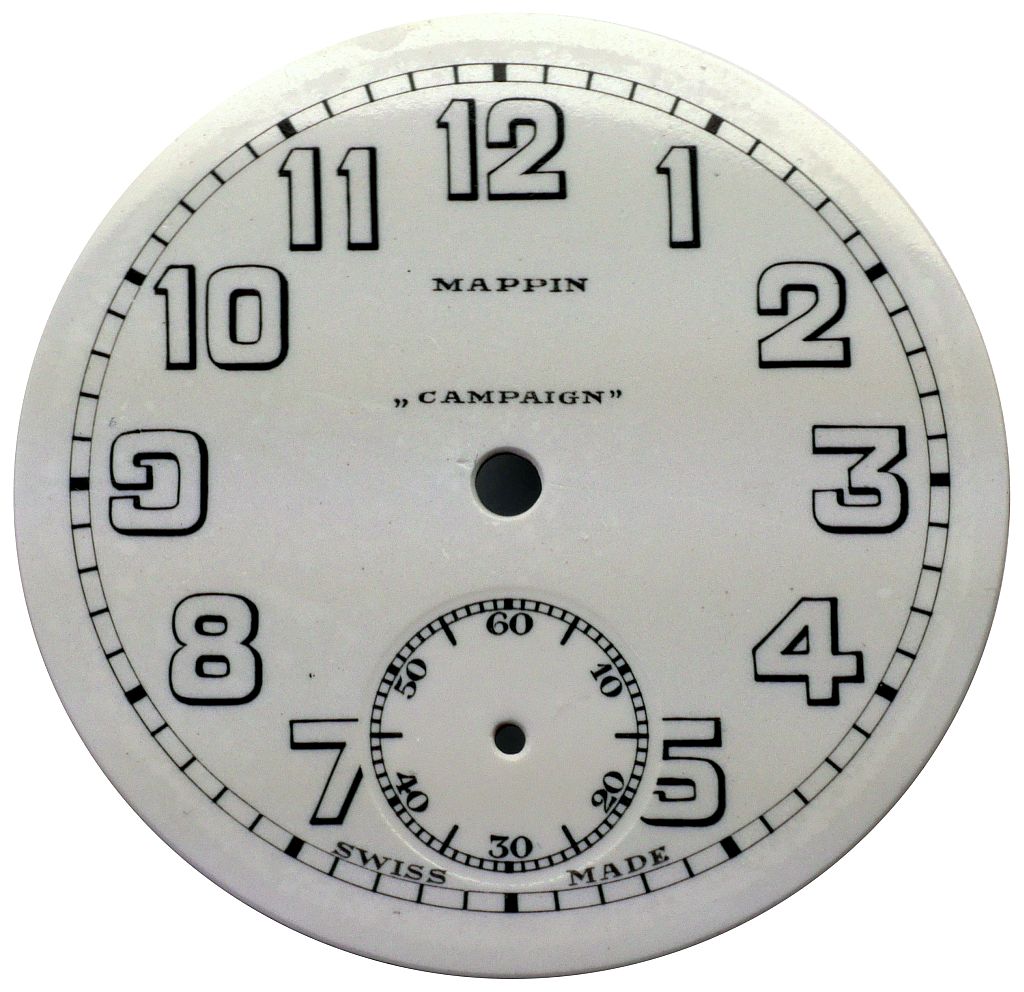
Mappin „Campaign” in Vitreous Enamel: Click image to enlarge
The dial shown here is from a Longines wristwatch. This dial has been through an ultrasonic clean, which is interesting because the name words Mappin and „Campaign” have not been affected. This is because the words are vitreous enamel fired into the enamel of the dial, the same as the tracks and numerals, not painted on later with enamel paint as is usually the case with British retailer's names, and which don't survive a trip through the ultrasonic tank.
Together with the opening low quote mark „ which is not used in English, shows that the name was put on in Switzerland by the dial maker as the dial was being made.
Longines confirmed that the requirement for the Mappin name on this dial is recorded in their archives, showing that the watch left the St Imier factory in 1916 with this branding on the dial – but note, not the name Longines or the Longines logo.
Longines watches supplied to other countries at the time often, or perhaps always, had Longines fired onto the dial in vitreous enamel. From about the mid-1920s this began to be accepted in Britain.
The earliest British imported Longines wristwatch that I have with a genuine Longines logo on the dial has London Assay Office import hallmarks in the case for 1928 to 1929. The Longines name is semi-circular around the top of the sub-seconds track. This of course still left the space between the 12 and the central hand boss available for a retailers name.
Back to the top of the page.
Enamel Paint

Dial Cross Section (not to scale).
The drawing of an enamel dial cross section shows how enamel paint can be added to a vitreous enamel dial. Unlike the vitreous ink used to make the markings and numerals on the dial, the enamel paint cannot be fired - the paint would just burn. This means that the enamel paint does not form a strong bond with the underlying vitreous enamel, it just sits proud of its surface as shown in the drawing.
Enamel paint was often used to add a British retailer's name to an enamel dials of watches that were imported into Britain before the mid 1920s. Before the mid 1920s British retailers would not buy watches with a manufacturer's names or brand on their dials. If there was any name on the dial, it was that of the retailer. A small number of retailers were large and important enough to have their names or brands put onto dials in fired vitreous ink as they were made, but most did not, so enamel paint was used.
This means that Rolex, Longines, Omega, etc. watches sold in Britain before the mid 1920s didn't have their brand on the dial, and sometimes there was no name to be found anywhere. Nowadays most people expect to see a name on the dial, so some unscrupulous people have names painted on to make the watch more saleable (read "valuable"). It looks wrong.
Rolex is the most faked watch brand, so this addition of a name onto a dial in enamel paint happens most often with the Rolex name. Needless to say, just painting Rolex onto a dial does not really transform a watch into a Rolex watch. Sometimes the name is added to a genuine Rolex watch because the owner expects to see it there, but often watches that were never Rolex watches in the first place receive a new name.
Enamel paint is a totally different material from vitreous enamel, it is called enamel because it forms a glossier surface than other paints such as oil paint. However, enamel paint is not as durable as the vitreous enamel of the dial itself. Unlike vitreous enamel, enamel paint can be easily dissolved by a solvent such as acetone or isopropyl alcohol.
Unlike the fired vitreous ink of the numerals and tracks, enamel paint doesn't bond into the underlying vitreous enamel but remains on its surface. It can usually be easily distinguished from the fired numbers and tracks by looking obliquely across the dial with a lens when it can be seen standing proud of the surface as illustrated. Because the vitreous enamel of the dial is very shiny, enamel paint has difficulty sticking to it and the added names have often become badly worn, or disappeared altogether.
If you look carefully at a vitreous enamel dial and detect that a name has been added in enamel paint, but the name doesn't show any signs of ageing, chipping or flaking, then the name has been added recently.
Fired or Painted?
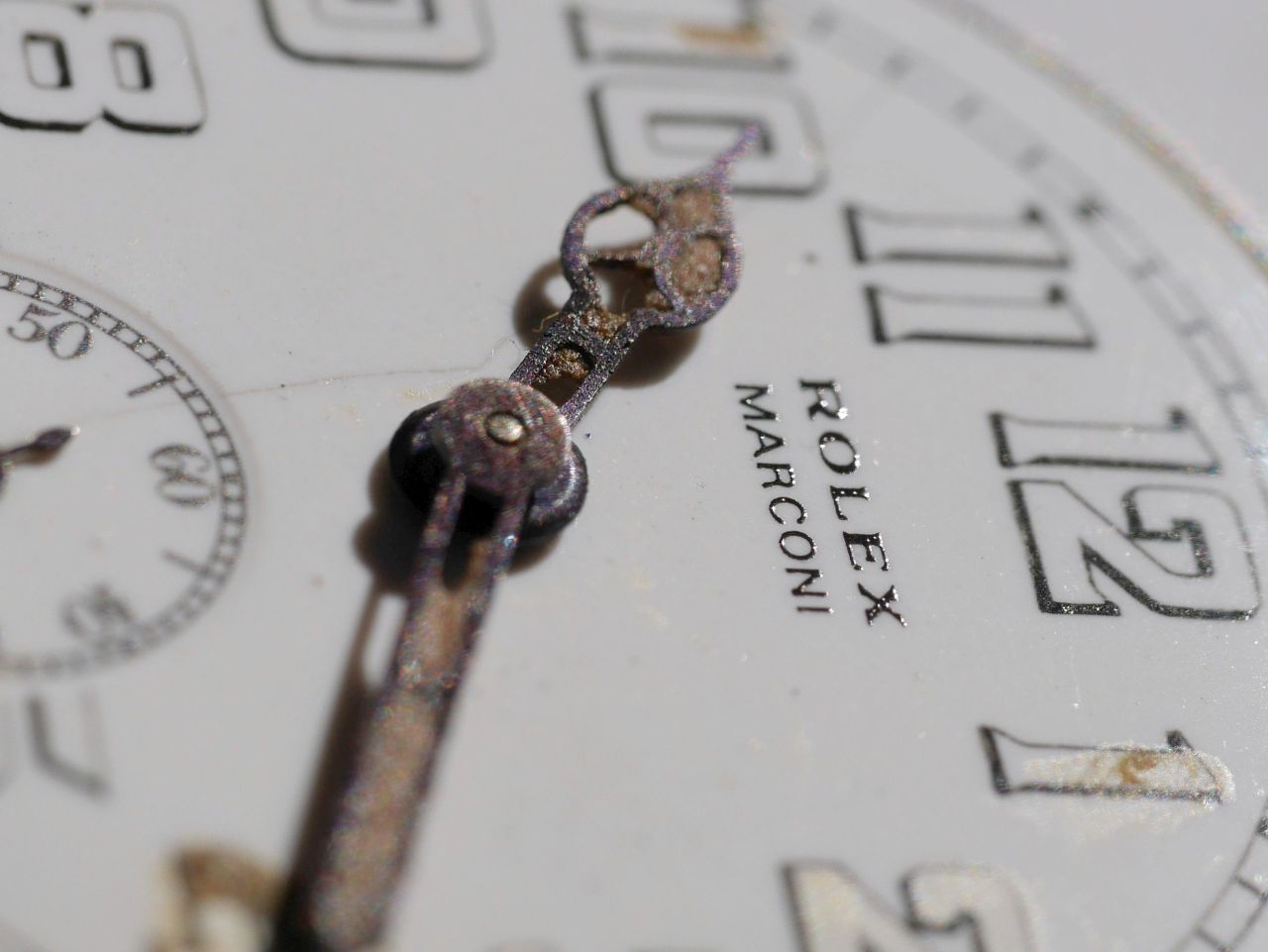
Fake “Rolex Marconi” logo painted onto dial: Click image to enlarge
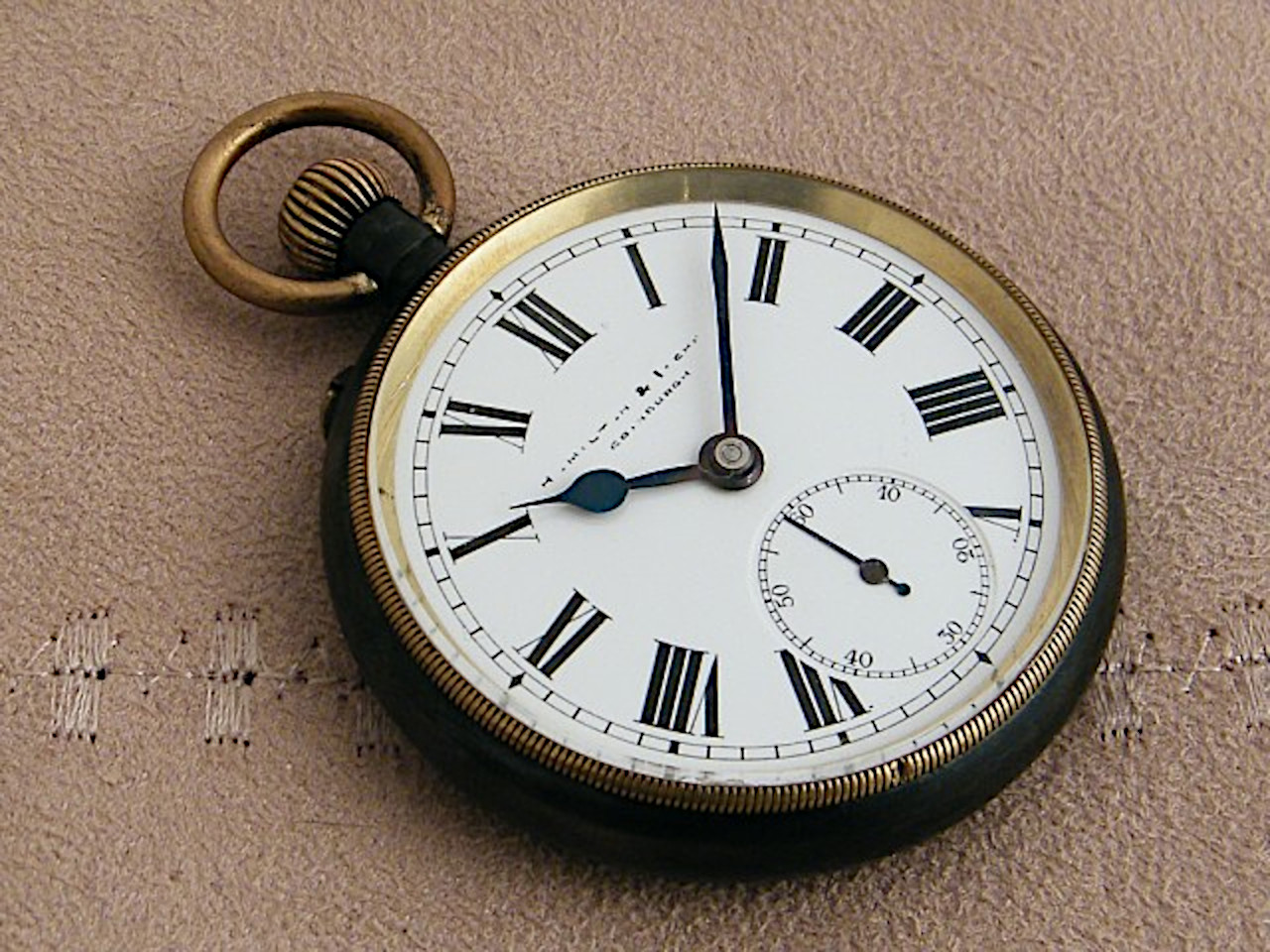
Hamilton & Inches, Edinburgh, painted onto dial: Click image to enlarge
How can you tell whether the name or logo was fired into the enamel, and is therefore original, or has been painted on later? Enamel paint is quite different from vitreous enamel and nothing like as durable. It is a solvent based paint applied cold with a brush, just like any other paint. Enamel paint does not stick well to glass, which is essentially what a vitreous enamel dial is made of. Names painted onto enamel dials 100 years ago have flaked off partially or even completely in the intervening years.
When a retailer's name was painted onto a dial in enamel paint, by now it has partly or almost completely worn away or flaked off over the years, whereas the rest of dial markings in fired vitreous enamel are still crisp and sharp. The image of a Borgel pocket watch here shows exactly this. The watch is an IWC in a black oxidised steel case that was imported by Stauffer & Co. in 1908 and supplied to Hamilton & Inches in Edinburgh who retailed it. The Hamilton & Inches name and Edinburgh can still just be made out, although it helps if you already have an idea of what you are looking at, but the paint has dulled to matt and mostly flaked off the otherwise pristine enamel dial. This is an easy indication that the name was painted on after the watch was made.
The fake “Rolex Marconi” logo painted onto the dial in the larger photo is also easy to spot. See how the numbers and tracks are flat and dull against the white enamel of the dial. This is because the vitreous ink melted into the white enamel base when the dial was fired. The “Rolex Marconi” logo stands up against the flat dial, showing that it was painted onto the dial in enamel paint. The paint is so shiny, it's obvious that this was done quite recently, probably a few months ago rather than years ago.
When you have looked at a lot of original early twentieth century watches without a manufacturer's name or brand on the dial, seeing one immediately looks wrong and not original. However, these days people like to see a brand name so sometimes well known names are added to the dials of watches in an attempt to boost their value. A name painted on recently using enamel paint can be difficult to identify, but there are several ways in which such an addition can be identified.
- Look carefully across the dial at an oblique angle with a lens in good light. As the cross section shows, enamel paint stands up proud of the surface unlike the fired enamel numbers which are virtually flat. If you can see the name standing up like this it has definitely been added, but a very skilful painter will make the letters very flat so some painted names can be difficult to detect by this method.
- If the writing looks crisp and sharp, it is not original. Original paint has partly or almost completely worn away or flaked off over the years. It is possible that original writing has been renewed, but without a record of what the dial looked like before this was done it is impossible to know what was there originally, if there was anything at all. If the writing makes the watch more valuable by adding the name of a famous maker that is not found anywhere else on the watch, then it is often fake.
- Wipe the suspect lettering with a solvent that dissolves paint such as acetone. Names fired into the enamel will not be affected by the solvent whereas names painted on later will dissolve and wash off, leaving the original enamel details of the dial intact.
If you have any comments or questions, please don't hesitate to get in touch via my Contact Me page.
Copyright © David Boettcher 2005 - 2026 all rights reserved. This page updated March 2026.
Back to the top of the page.