
Blog: The Q Factor
Copyright © David Boettcher 2005 - 2026 all rights reserved.First published: 11 November 2025, last updated 15 November 2025.
I make additions and corrections to this web site frequently but, because they are buried somewhere on one of the pages, the changes are not very noticeable. I decided to create this blog to highlight new material.
Note that these articles also get updated, especially soon after they are posted when additional information may be added. Check the “last updated” date to see when the article was last updated.
The section below is from the page About Watch Movements (2).
As always, if you have any comments or questions, please don't hesitate to get in touch via my Contact Me page.
The Q Factor
If you are interested in the more technical and theoretical aspects of watches and clocks, you will no doubt have heard of the Q factor. You may also have heard or read Q referred to as a ‘quality factor’. This is a misnomer that seems to have arisen simply from the use of the letter Q, even though the factor itself has nothing to do with quality.
The Q factor is a measure of how much energy is lost by a resonant system during each cycle compared to the amount of stored energy. A high Q factor means that only a small proportion of the stored energy is lost. A higher Q factor is desirable in a resonant system, as less energy needs to be added during each cycle to maintain resonance.
Resonant Systems
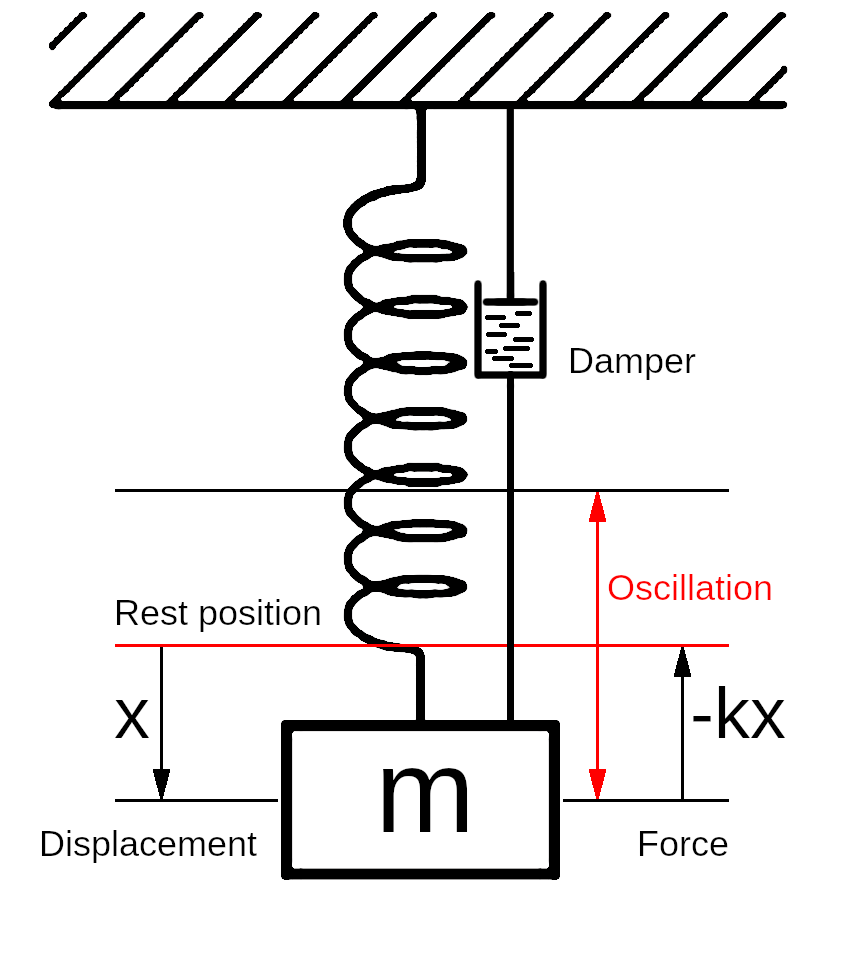
Mass suspended on a spring

Damping modes
Mechanical timekeepers depend on the phenomenon of resonance, the property of having a resonant or natural frequency at which a system vibrates. Resonant systems can be modelled by the concept of simple harmonic motion, the simplest example of which is a mass on a spring oscillating around its rest position, as shown in the figure.
In real systems, damping due to air resistance or friction causes the oscillations to die away and the mass comes to rest. These forces are represented by the dashpot damper in the figure. This is called a damped system or damped harmonic motion.
In a damped system where the energy losses are low, the oscillations die away slowly and the system is said to be under damped. If the system is heavily damped and energy losses are high, the mass does not oscillate at all, but returns slowly to the rest position, which is termed over damped. If the damping is such that the mass does not oscillate but returns to the rest position in the shortest possible time, that is, it only just fails to oscillate, the system is said to be critically damped.
The amount of damping present is quantified by the damping coefficient. The damping ratio ζ (zeta) is defined as the ratio of the actual damping coefficient to the critical damping coefficient. In a critically damped system, ζ is 1; in an over damped system it is greater than 1, and in an under damped system, less than 1.
The graph here shows the four damping regimes of undamped, under damped, critically damped and over damped simple harmonic motion. For under damped motion, the damped natural frequency \( \omega_d \) is lower than the undamped natural frequency \( \omega_n \), as shown by the slight lag of the red curve behind the blue curve.
The damped natural frequency for the under damped case 0 < 𝜁 < 1 is given by:
\[ \omega_d = \omega_n \sqrt{ 1 - \zeta^2 } \]What Q Measures
The Q factor works in the opposite direction to the damping ratio. In an over damped system, Q is low; in an under damped system, it is high.
Expressed mathematically, the Q factor is:
\[ Q = 2π \times \frac{energy \ stored}{energy \ lost \ per \ cycle} \]The Q factor is related to the damping ratio ζ by:
\[ Q = \frac{1}{2 \zeta} \]From this it can be seen that in a critically damped system when the damping ratio ζ is 1, Q = 0.5. In an under damped system when ζ is less than 1, Q is greater than 0.5, and in an over damped system when ζ is greater than 1, Q is less than 0.5.
The Q factor expresses how strongly, or how sharply, the system resonates. A low value for the damping ratio ζ and a large Q value means the system will oscillate for many cycles before stopping. A small Q value and high damping ratio means the system will oscillate for only a few cycles, or may not oscillate at all.
In real systems, the resonant frequency is always below the undamped natural frequency. The higher the Q and lower the damping ratio, the closer the resonant frequency approaches the undamped natural frequency. The sharpness of resonance indicates how closely the resonant frequency of a damped system approaches the undamped natural frequency; a higher Q corresponds to a closer approach and a narrower resonance peak.
Having described how the damping ratio ζ and the Q factor affect oscillation, it appears that ζ is an adequate quantification and Q is rather unnecessary, so is natural to ask how and why the symbol Q originated.
The Origin of Q
The concept of damped harmonic motion and the damping ratio existed a long time before Q, so where did Q come from?
The Q factor was defined in the early 1920s by the American engineer Kenneth Simonds Johnson when analysing filter circuits based on capacitors and inductors for telephone systems. One of the parameters Johnson used was the coil dissipation constant \(d\), the ratio of resistance to reactance in a coil or inductor, defined by \( d = R / L \omega \) where R is the resistance, L is the inductance in Henries and \(\omega\) is the angular frequency in radians/second, equal to \( 2 \pi f \), where f is the frequency in hertz.
The coil dissipation constant in a resonant circuit is small, and becomes smaller as the resonance becomes stronger. To make the value of the constant easier to write, Johnson defined Q for an inductor at its resonant frequency as the inverse of the coil dissipation constant. This meant that a coil dissipation constant of 0.004 could be more simply written as a Q value of 250. Of course, 0.004 can also easily be written in engineering notation as 4e-3 or \( 4 \times 10^{-3} \).
Johnson is thought to have chosen the letter Q for the inverse of the coil dissipation constant simply because other letters had already been assigned to other parameters; the concept of ‘quality’ did not come into it.
Although Johnson’s Q has nothing to do with quality, later writers, perhaps perhaps because the word ‘quality’ begins with Q, mistakenly assumed it did, and the term ‘quality factor’ became entrenched. However, this is misleading because Q is a purely quantitative characteristic.
Knowing what Q really quantifies, it is worth looking at its relationship to quality.
The Q Factor and Quality

A skip hanging from a tower crane has a high Q
The following examples illustrate how the Q factor relates to the quality of some systems.
- A skip hanging from a tower crane has very low damping and high Q. If the crane operator moves the jib quickly and stops it suddenly, the skip will continue swinging in a wide arc for a long time. This is a dangerous situation, and crane operators are trained to avoid it. Does the high Q mean that this a high quality system? No, of course it doesn't.
- The suspension of a motor car is heavily damped to prevent oscillations that make passengers feel sick. The suspension of, say, a Rolls Royce motorcar therefore has a low Q. Does this mean that a Rolls Royce motorcar is a low quality system? Definitely not.
- Speakers and microphones are designed to avoid high-Q resonances that would create sharp peaks at specific frequencies. Instead, they aim for a flat frequency response with equal amplification across all audible frequencies. A high-Q resonance would make some notes much louder than others, creating unnatural reproduction, which would be very Lo-Fi instead of Hi-Fi. Does this mean that high quality audio equipment that suppresses high-Q resonances through careful design is actually low quality? Of course not.
The lesson of these examples is that a high Q value is not always desirable. In the case of the tower crane, the high Q value is dangerous, and tower crane manufacturers would pay highly for an invention that reduced Q to 0.5. In the case of the Rolls Royce motor car, the suspension system is designed to have a low Q so that the car's occupants feel they are gliding along rather than bouncing up and down.
The right level of Q, like the damping ratio, depends on the purpose of the system. Sometimes a high Q is desirable; sometimes a low Q is more appropriate.
The Q factor is not a measure of ‘quality’, which is not a quantifiable concept. Q does not measure craftsmanship, materials quality, precision of manufacture, reliability, or any of the other things meant by ‘quality.’ A long-case pendulum clock with a cheap, mass-produced, movement has a much higher Q than the finest marine chronometer ever made. But which is the higher quality?
It is unhelpful to call Q the quality factor, because that conveys no meaning about what is being measured, and suggests that a system with high Q is in some way high quality, which, as the examples show, is not true. If the Q factor must have a name based on the letter q, it would be more helpful to call it the quizzle factor, rather than the more loaded and prejudicial quality factor.
However, a much better term for Q would be ‘resonance factor’. Resonance and damping are closely related concepts. Heavily damped systems with a high damping ratio have a low Q, whereas lightly damped systems have a high Q. The Q factor is inversely related to the damping ratio ζ (zeta) in the same way that a resonant system is inversely related to a damped system.
Q is a perfectly valid concept — but remember, it has nothing whatsoever to do with quality.
The Q Factor and Watches
In mechanical systems, the Q factor is a quantification of how much energy is lost by a resonant system such as a watch balance or a clock pendulum during each cycle, compared to the amount of energy stored in the resonator. A low Q factor means that a large proportion of energy is lost per cycle, and a high Q factor means that a small proportion of the stored energy is lost per cycle. A higher Q factor is desirable in a resonant system, because it means that less energy needs to be added during each cycle to replace that which is lost.
In a mechanical watch, energy is stored in the balance and spring, as kinetic energy in the motion of the balance and potential energy in the coiled spring. As the balance swings, energy moves backwards and forwards between the spring and the balance. Some of this energy is lost during each cycle due to friction at the pivots and air resistance. The lost energy has to be replaced to keep the balance swinging.
Although it is intuitive that the amount of friction should be minimised in a high quality system, there is also a technical reason for reducing the amount of energy lost per cycle in a watch. The lost energy is replaced by the impulse given to the balance during the action of escaping. The impulse disturbs the balance, which is detrimental to timekeeping. A smaller impulse disturbs the balance less than a larger impulse, so is better for timekeeping. It also means that the total power consumed by the watch is lower, and a smaller mainspring exerting less torque can be used.
Reducing friction is always a good principle, because it reduces wear and the driving force needed. Coincidentally, it also increases Q. However, increasing Q by increasing the moment of inertia of the balance, by increasing its radius and the mass of its rim, has drawbacks as well as benefits. A more massive balance is subject to greater gyroscopic forces when a watch, particularly a wristwatch, is moved. The inertia of a watch balance must be high enough to store adequate energy relative to losses, but low enough to avoid disturbing gyroscopic effects.
However, because of the small size of watches, the Q value of a watch’s regulating system, the balance and spring, is never large, usually measuring in the hundreds rather than thousands. Typical Q values are:
- A mechanical watch with a sprung balance: 200–300
- A marine chronometer with a larger balance: 500–1,000
- A long-case pendulum clock: several thousand
Is a High Q Factor Better?
Although small clocks suffer from the same constraints as watches, pendulum clocks, especially long-case clocks, inherently have much higher Q values. The Q value of a simple long-case clock is in the thousands, and can easily be made much higher by increasing the mass of the pendulum.
There is a well-known graph by Douglas Bateman that plots timekeeping accuracy against Q values. This shows a strong correlation between increasing Q value and accuracy. From this, it appears that to increase the accuracy of a clock, all that is needed is to increase the Q value of its oscillator.
However, a problem with increasing Q values to very high levels is that a clock with a massive pendulum takes a long time to recover from an external shock. Followers of John Harrison's work argue that a lower Q value is better if it is accompanied by natural error-correcting characteristics built into the design of the clock, so that it can quickly recover from external shocks. The performance of Martin Burgess's clocks lends weight to this argument.
The argument has been debated for many years, but it appears that both methods are valid ways of producing very accurate clocks.
Conclusion
The Q factor does not measure craftsmanship, materials quality, precision of manufacture, reliability, or any of the other things meant by ‘quality.’ It is worth remembering this when showing off your latest horological creation with a high Q value. If you say it has a high Q value and is, therefore, high quality, someone might ask ‘Does that mean high quality like a skip full of scrap iron hanging from a crane?’
Like the damping ratio, Q is a parameter of a system. A better term for the Q factor would be ‘resonance factor’.
If you have any comments or questions, please don't hesitate to get in touch via my Contact Me page.
Copyright © David Boettcher 2005 - 2026 all rights reserved. This page updated November 2025.
Back to the top of the page.