
Hans Wilsdorf and Rolex
Copyright © David Boettcher 2005 - 2026 all rights reserved.I became interested in wristwatches, and watches in general, as a result of inheriting my grandparents' Rolex wristwatches. They were made around 1917/1918, the time of the First World War. It was through hunting for a strap suitable for my grandfather's watch that I got interested in trench watches, wristwatches worn in the trenches during the First World War, and early wristwatches in general. For this reason, most of my collection of watches and historical interest centres on the era between 1900 and 1930 and a decade or so either side.
What this page is about: In broad terms the history of the Rolex Watch Company can be divided into two parts: an early phase when they were trying lots of different ideas, and a later phase when they had hit upon a successful course. The boundary of the two phases is pretty well delineated by the Second World War, 1939 to 1945. After the war, Rolex created many iconic models of watches under a single brand, Rolex. Before the war, the situation is much less clear cut and there were attempts to create other brands that were separate from, but somehow associated, with the Rolex name. I am interested in the first phase, the creation of the Rolex brand and the pre-war history of the company, and that is what this page is about. I hope you find it interesting.
Material about the brands other than Rolex created by Wilsdorf, e.g. Marconi, RolCo, Unicorn, Tudor, Marguerite, etc., etc. can be found at Wilsdorf's Other Brands
If you have any questions or comments, please don't hesitate to get in touch via my Contact Me page.

Hans Wilsdorf

The four volumes of the Rolex Jubilee Vade Mecum: Click image to enlarge.
The story of the Rolex watch is inextricably entwined with the story of Hans Wilsdorf, who co-founded and personally drove forward the progress of the company. Wilsdorf was not a watchmaker, but he was a marketing genius. This is the secret behind the success of Rolex. Wilsdorf concentrated on sales and marketing, advertising directly to the public, something that watchmakers didn't do at the time.
The watches sold by Wilsdorf, and later Rolex, were made by separate Swiss watchmaking companies, principally Aegler. This separation of marketing and production allowed each company to concentrate on its own specialist area, the job it did best.
Rolex Jubilee Vade Mecum
The picture of Hans Wilsdorf is from the Rolex Jubilee Vade Mecum published by the Rolex Watch Company in 1946, when Wilsdorf would have been age 65. The Vade Mecum takes the form of four small booklets in a slip case shown in the smaller image, which you can click to enlarge. It was printed in a limited edition of 1,000. The booklets are:
- Step By Step – this was written by Wilsdorf himself.
- The Evolution Of The Wrist Watch Chronometer
- How The Waterproof Watch Came Into Being
- The Story of the Self-Winding Watch
I have copy number 619, except for volume three which is from copy number 270. All four booklets are stamped ‘Rolex Watch Division, C.P.O. Box 721, Tokyo, Japan’ so I guess the two versions must have all been in the same office at one time and one got switched around. If the owner of Rolex Vade Mecum number 270 reads this and wants to swap volume three from copy 619, then please get in touch!
I have to say that the Rolex Jubilee Vade Mecum is disappointing to researchers; it is a poor source of information and doesn't contain any details about the watches, and there are very few dates quoted, no technical information and no references. Volume 1 contains Wilsdorf's general recollections about his business life and without much in the way of detail. The other three volumes very clearly written by advertising copy writers and are lacking in detail and very poor.
Back to the top of the page.
Histoire de Rolex
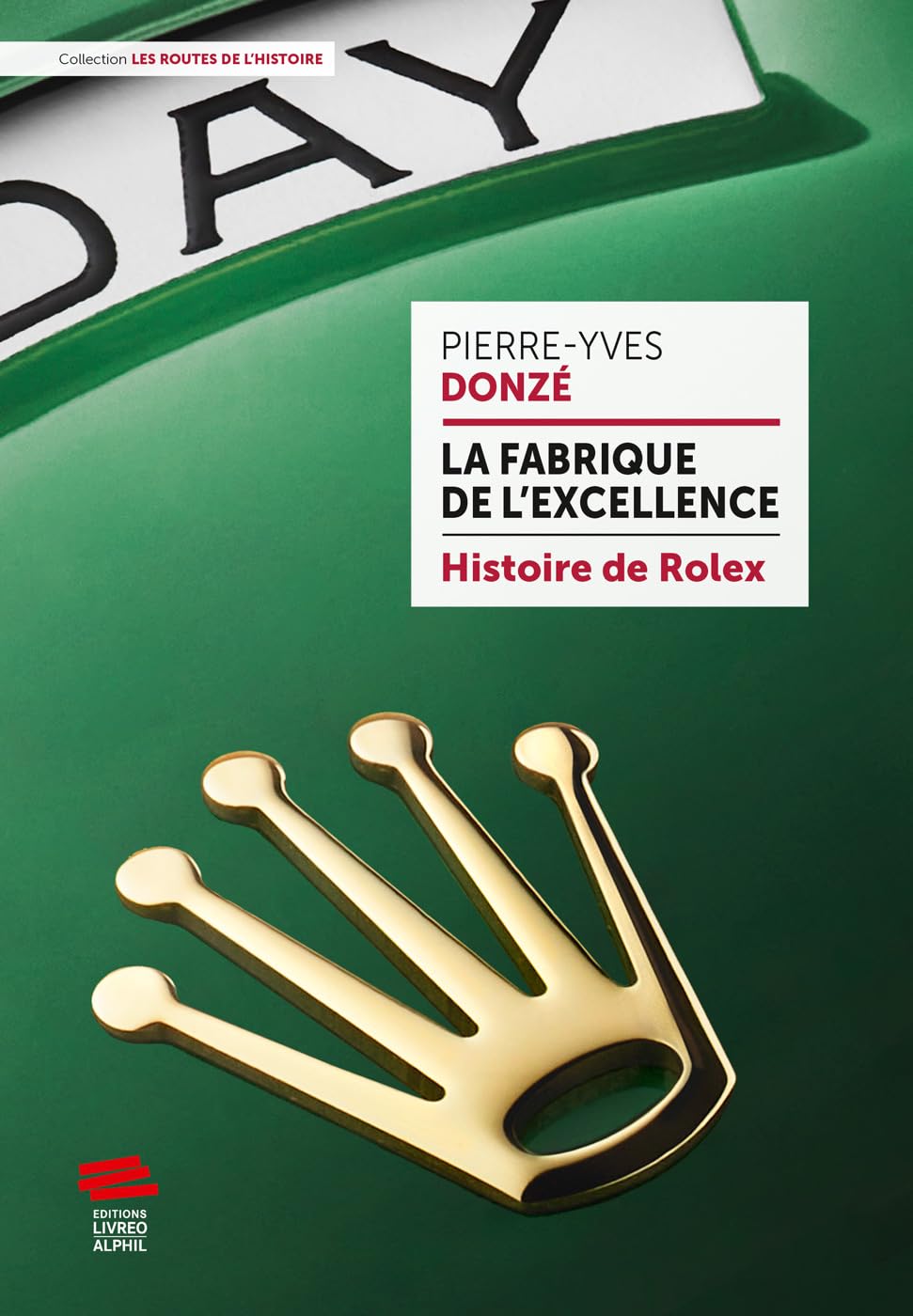
Histoire de Rolex by Pierre-Yves Donzé: Click image to enlarge
In March 2025, a history of Rolex was published under the title La fabrique de l'excellence - Histoire de Rolex (The Factory of Excellence - History of Rolex) by Pierre-Yves Donzé, an associate professor of business history at Osaka University.
The book is published by Editions Livreo-Alphil and carries no official endorsement by Rolex.
Donzé has published a number of books about the Swiss watch industry, including Histoire de l'industrie horlogère suisse, XIX-XXe siècle: Aux origines d'un succès industriel et commercial (History of the Swiss watch industry, 19th-20th century: At the origins of industrial and commercial success). Most of his books are translated in English, and many are available on Amazon.
This Histoire de Rolex is a slim, paperback, volume of 298 pages with a relatively small number illustrations, all in black and white. It is text-heavy and very far from a coffee-table book stuffed with photos and little else. This is a serious history of the Rolex company from the founding days of Wilsdorf and Davis.
I was pleased to note a number of references to my work. In particular, my article on the development of the Rolex screw down crown “The Rolex Screw Down Crown and its Antecedents” published in the NAWCC Watch & Clock Bulletin in December 2010, and my research into the maker of the first Rolex Oyster cases published at Who Made the Oyster Cases?.
Back to the top of the page.
Hans Wilsdorf - Early Days
Hans Eberhard Wilhelm Wilsdorf was born in Kulmbach, Bavaria, on 22 March 1881, the second son of a family of three. His father owned a hardware and household goods business in the town marketplace that had been founded by his grandfather. His mother's early death was soon followed by that of his father and, in 1893, when he was 12, his uncles decided to liquidate his father's business and use the proceeds to place the children in a very good boarding school in Coburg. Wilsdorf showed a particular liking for mathematics and languages, which later drove him to travel and work in foreign countries.
After leaving school, Wilsdorf apprenticed at a firm of exporters of artificial pearls in Geneva, whose sales organisation covered the whole world. Wilsdorf said this experience was invaluable throughout his whole career.
Cuno Korten

1899 first record of Maison Cuno Korten: Click image to enlarge

Cuno Korten registration of Arno name: Click image to enlarge

Cuno Korten described as négociant: Click image to enlarge
In 1900, aged 19, Wilsdorf started work at the watch and clock exporting firm Cuno Korten in La Chaux-de-Fonds at a monthly salary of 80 francs. He was employed as an English language correspondent, corresponding with British, Anglo-Indian and American customers. Wilsdorf says that Cuno Korten was a ‘big concern’ exporting about one million francs worth of watches annually. This is an exaggeration; it would have made Cuno Korten one of the largest companies in the Swiss watch industry, which it wasn't.
Outside of the long established watch making centre of Geneva, La Chaux de Fonds and Le Locle formed the hub of the Swiss Jura watchmaking industry at the time. It was a French speaking area of Switzerland so Wilsdorf would have to have spoken Swiss French in addition to his native German and English. In La Chaux-de-Fonds and the nearby Le Locle, Wilsdorf was exposed to the most influential people and companies in Swiss watchmaking, which would later be an important asset in the founding and success of his own business in London, which became the Rolex Watch Company.
Cuno Korten was born in Ohligs in the Solingen region of North Rhine-Westphalia, Germany, in 1872. Cuno Korten is an unusual name. Cuno (or Kuno) is a Germanic name with origins in Old High German. It is derived from kuni, meaning ‘clan’ or ‘family’. It is relatively rare but was been used in Germany in the 19th and early 20th centuries. Both German and Dutch linguistic influences exist in North Rhine-Westphalia and Korten may have roots in either region, possibly derived from kort, meaning ‘short’ in Middle Low German or Dutch, possibly referring to the stature of the first person given this name.
In 1899, Cuno Korten established a company under his own name in La Chaux-de-Fonds. The first image here shows that on 22 June 1899, Cuno Korten, from Ohligs, Germany, but now resident in La Chaux-de_Fonds, was registered as the ‘chef de maison’ or head of the company of the same name. The nature of the business was horology and its office was at 49 rue Léopold Robert.
The second image shows that on 16 October 1899, the company Cuno Corten registered the name ‘Arno’ as a trademark for watches, watch parts, cases and their packaging. The Arno is a large river in the Tuscany region of Italy, suggestion that Korten was anticipating exporting watches to Italy. The registration number of the mark is 11,529. Cuno Korten subsequently registered a number of trademarks as shown in the table.
| Date | Number | Trademark | Struck off |
|---|---|---|---|
| 16 October 1899 | 11529 | Arno | April 1920 |
| 16 October 1899 | 11530 | Skipper | April 1920 |
| 16 October 1899 | 11531 | Thoma | April 1920 |
| 18 October 1899 | 11542 | Rattler | April 1920 |
| 30 March 1900 | 12104 | The Devan | September 1920 |
| 11 June 1900 | 12299 | Metropolitan | December 1920 |
| 08 September 1900 | 12523 | The Era | March 1921 |
| 05 September 1901 | 13860 | The Reliance | March 1922 |
| 31 October 1901 | 14000 | The Chippendale | April 1922 |
| 16 February 1903 | 15533 | Ski Watch | August 1923 |
| 14 August 1905 | 19274 | Geisha | January 1926 |
In the registration shown in the second image, Cuno Corten is described as a ‘fabricant’, that is, a manufacturer. However, there is no known evidence that Cuno Corten had a factory; the only known address is 49 rue Léopold Robert. Rue Léopold-Robert is La Chaux-de-Fonds' main street. When Cuno Korten had an office there at the beginning of the twentieth century, it was a fashionable street on which to stroll, to show oneself and to window shop.
In the registration of mark number 11542, the company is described as a ‘négociant’, that is a trader. It seems likely that this was the true nature of the business, a company that bought items from manufacturers and sold them on. Such companies require very little capital to set up, just an office and some business cards and headed notepaper. It will be seen later that this would have been useful experience for Wilsdorf.
The list of trademarks registered by Cuno Corten shows that the company was active from 1899 until at least 1905. Swiss trademark registrations were valid for a period of twenty years, after which they could be renewed. Marks that were not renewed were struck off the register. None of the registered trademarks was renewed and they were all struck off after twenty years.
On 6 March 1908, it was recorded that the registration of Cuno Korten had been cancelled ‘following the departure of the holder’.
Bechmann & Baer
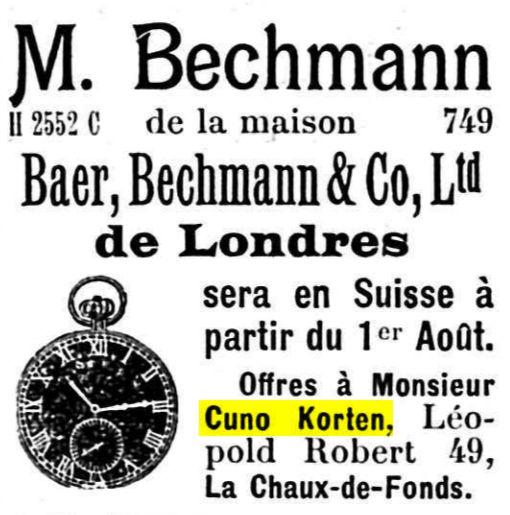
1904: M. Bechmann visit hosted by Cuno Korten: Click image to enlarge
In 1903, Wilsdorf moved to London, where he said that he worked as a representative for an unnamed but ‘good watchmaking firm’ which by 1946, when he wrote the Vade Mecum, had long since closed down. The name of this firm is not mentioned, but it seems likely that rather than being a Swiss watch manufacturer, Wilsdorf being rather young and experienced to take on the role, it was one of the Anglo-Swiss companies that imported Swiss watches and sold them to British retailers. However, in Wilsdorf's obituary, the Journal de Genève says the company was based in Neuchâtel.
The advert from 1904 reproduced here, which says that M. Bechman of the London company Baer, Bechmann & Co. Ltd. will be in Switzerland from 1 August, and that proposals of meetings can be made via Monsieur Cuno Korten of 49 rue Léopold Robert, La Chaux-de-Fonds. This was evidently a trip by Bechmann to find new lines of goods, clocks or watches, to import, and the mention of M. Korten suggests that he was facilitating meetings with Swiss manufacturers and was possibly the Swiss agent for Baer, Bechmann & Co. Ltd. Wilsdorf's English language skills would have been useful in communicating between the English and Swiss offices. Baer and Bechmann themselves would have almost certainly spoken German, but the Swiss watchmaking districts were then still mainly in the French speaking Jura and Geneva.
There is little trace of the many companies that operated in London as import agents for Swiss watch manufacturers in the late nineteenth and early twentieth centuries. Their main tasks were taking samples round to watch retailers, usually jewellers shops, and recording orders, which would be amalgamated and sent on to the watch manufacturers. There were no restrictions on the import of Swiss watches, especially after Gladstone reduced import duties in the 1860s, and before 1907 there was no requirement that gold or silver watch cases be hallmarked.
Today agents for foreign manufacturers often simply send in the orders and receive their commissions, with the manufacturer taking responsibility for delivering the goods and invoicing the customer, but in those days the agent would collect parcels of watches from the shipping agent, paying any import duties, and send the watches on the customers who had ordered them. The appearance of Baer's name in a number of bankruptcies and financial arrangements shows that agents were also responsible for collecting the money from the customer. But it was relatively easy business with little capital involved; all that was needed was an ability to speak English and Swiss French or German, an office, and a working arrangement with one or more Swiss watch manufacturers.
Bernard, or Bernhard, Baer is recorded at 52 Hatton Garden, London, in 1887, where Bechmann & Baer were later listed as clock manufacturers, although they were really importers rather than actual manufacturers. The business was converted into a limited liability company as Baer, Bechmann & Co. Ltd. at 55 Hatton Gardens on 12 March 1902.
By 1913 Baer, Bechmann & Co. Ltd. had disappeared; incorporated into Junghans Brothers Ltd., clock manufacturers, at the same 55 Hatton Gardens address. The London company Junghans Brothers Ltd. went into voluntary liquidation in 1932, no doubt a victim of the severe financial depression that followed the Wall Street crash of 1929.
Given the connection between Cuno Korten and Baer, Bechmann & Co Ltd shown by the advert, it seems possible that Baer, Bechmann & Co was the London company alluded to by Wilsdorf, and the date of the disappearance of that company in 1913 would fit his statement in 1946 that they had long since closed down.
Foundation of Wilsdorf & Davis
Growing in confidence with the experience he gained from this and his previous employment, two years after arriving in London, Wilsdorf set about establishing his own business. In May 1905, at the age of 24, he borrowed some money from his brother and sister. He was introduced by his solicitors, White, Leonard & Co., to Alfred James Davis, who wished to invest some money. The two founded the firm of Wilsdorf & Davis on 22 June 1905 as equal partners, with its address at 83 Hatton Gardens, London E.C.
Alfred Davis married Wilsdorf's sister Anna in 1908. He does not seem to have been involved at all in running the business; he appears to have been a ‘sleeping partner’, a person who provides some of the capital for a business but who does not take an active part in managing the business. Next to nothing is known about him.
Hans Wilsdorf was a citizen of Germany, not Switzerland. He became a naturalised British citizen in 1911, taking the oath of allegiance on 20 November.

Wilsdorf Buying Trip 1906
In the beginning, Wilsdorf & Davis did not concentrate solely, or even at all, on the top end watches that Rolex would later become known for. They imported a wide range of items that could be sold at different price points. In the Vade Mecum Wilsdorf says their first speciality was a travelling watch, called a portfolio watch, cased in fine quality leather. Wilsdorf also says that in 1905 he placed a large order for wristwatches with Aegler, a company that he had become aware of when he was working in La Chaux-de-Fonds.
The wristwatches imported from Aegler by Wilsdorf & Davis were their ‘top of the range’ items. When the name Rolex was introduced it was reserved for use on Aegler lever watches, although even these were sometimes made with only seven jewels rather than fully jewelled with 15 jewels.
Wilsdorf & Davis also bought watches from other manufacturers, and not always of lever quality. Watches with cylinder escapement movements are seen with the W&D sponsor's mark, indicating that they were imported by Wilsdorf & Davis, although these were never branded with the Rolex name. The cylinder escapement was mass produced by the Swiss watch industry in the nineteenth century. It was cheap and robust, but inferior to the lever escapement due to its high friction and dependence on lubrication.
The advertisement reproduced here was published in a Swiss trade journal in January 1906 and documents a buying trip to Switzerland by Wilsdorf to find stock. It says that Hans Wilsdorf is staying at the Hotel Fleur-de-Lys until the 22 or 23 of the month. Located right in the heart of La Chaux-de-Fonds, the Hotel Fleur-de-Lys is only a few feet from the train station, where no doubt Wilsdorf alighted after a train journey that began at Holborn Viaduct station in London.
The advert says that Wilsdorf is especially interested in Nouveautés, that is, novelties, for the English colonies and the Far East. Note there is no mention of wristwatches, or even watches at all; any novelty that might sell in the colonies or the far-east is of interest.
British Import Hallmarks
Wilsdorf & Davis were not watch manufacturers; they purchased watches from Swiss manufacturers and sold them on to retailers, at first with no branding at all.
In 1907, British import customs practices changed, requiring that all imported gold and silver watch cases be hallmarked in a British Assay office before they were offered for sale. Before any item can be hallmarked, the responsible person must register their details and a sponsor's mark with the assay office. If an item does not carry a registered sponsor's mark, it will simply not be received by the assay office. If there is more than one punch, each one has to be separately registered at the assay office. The sponsor's mark is then punched onto items before they are sent in for assay and hallmarking.

W&D Sponsor's Mark entered at the London Assay Office on 25 June 1907
Wilsdorf & Davis entered the sponsor's mark consisting of the incuse initials W&D within an incuse oval surround with points top and bottom at the London Assay Office on 25 June 1907. This was after the British Assay of Imported Watch-Cases Act came into force on 1 June 1907. Many other watch importers were aware that the change was coming, and registered their sponsor's marks before it came into force, so it is odd that Wilsdorf & Davis only registered their sponsor's mark after the change had occurred.
The forced adoption in 1907 of the W&D sponsor's mark, something that also happened to look very much like a trademark, is quite possibly what started Wilsdorf thinking about branding and marketing. It is the first such mark registered by Wilsdorf & Davis, and the same mark is also seen on stamped on to watch movements, which was not required by British law.
None of the items imported by Wilsdorf and Davis before 1907 are known; they were anonymous items with no name or branding. Because they were sold wholesale to retailers they are impossible to trace, there is not even the possibility of a point-of-sale receipt with the Wilsdorf & Davis name on it.
Wilsdorf in all likelihood thought of the items he imported as simple commodities, from the import of which he could take a financial profit but no pride – they could equally well have been grain or sugar or any other commodity. But seeing watch cases stamped with the W&D mark would naturally have caused him some pride, here was some way that the goods that he dealt with would be recognised, which would create a reputation for his business. And a good reputation is valuable, something to be nurtured and cared for.
Wilsdorf realised that building his own brand would be more lucrative than simply acting as an anonymous import agent. He began trying to think of a name for this brand. On 1 November 1907, Wilsdorf & Davis registered in Switzerland the trademarks Lusitania, Mauretania and The Eastern Watch for watches and associated parts. The fact that these registrations occurred nearly five months after the W&D sponsor's mark had been registered is notable.
Wilsdorf and Early Wristwatches
The four volumes of the Rolex Jubilee Vade Mecum: Click Image to Enlarge.
In the Vade Mecum Wilsdorf says that he became convinced that the wristwatch was the way of the future.
He thought there would be a better trade in wristwatches than pocket watches, because they were more prone to damage (and therefore need replacement), and because, unlike a pocket watch that was handed down from generation to generations, wristwatches would be fashionable items that would be personal to their wearer, who would also want to have two or three different wristwatches to go with different outfits.
Wilsdorf freely admitted that he was not a watch maker and was not interested in watches from a technical point of view, he was thinking as a marketing person who wanted to generate maximum sales revenue and profit.
When he was in Switzerland, Wilsdorf had become acquainted with the watchmaking company Aegler in Bienne. Aegler manufactured small lever escapement movements with a reputation for precise time keeping and good availability of spare parts due to the modern precision production methods, making extensive use of machinery and gauges so that parts were interchangeable.
Wilsdorf says that in 1905, soon after founding his firm in London, he went to Bienne to see Hermann Aegler and placed the largest order for wristwatches ever seen at that time. Wilsdorf says that the first wristwatches produced under this arrangement were for men's and ladies' wear in silver cases with leather straps.
However, the Vade Mecum was written in 1945 when Rolex had become famous for its men's wristwatches. In 1905, men were far less likely than ladies to wear a wristwatch and the assertion that the order included men's wristwatches is a little implausible. Indeed, Wilsdorf himself says At that period, the wristlet watch was not at all popular; in fact it was an object of derision, the idea of wearing a watch on one’s wrist being contrary to the conception of masculinity.
If the first order to Aegler did include men's wristwatches, there is no doubt that they would have sold very slowly. James Dowling notes that the majority of Rolex wristwatches with hallmarks prior to the start of the First World War are gold and in ladies' sizes, whereas those with hallmarks after 1915 are mostly silver and men's 13 ligne size.
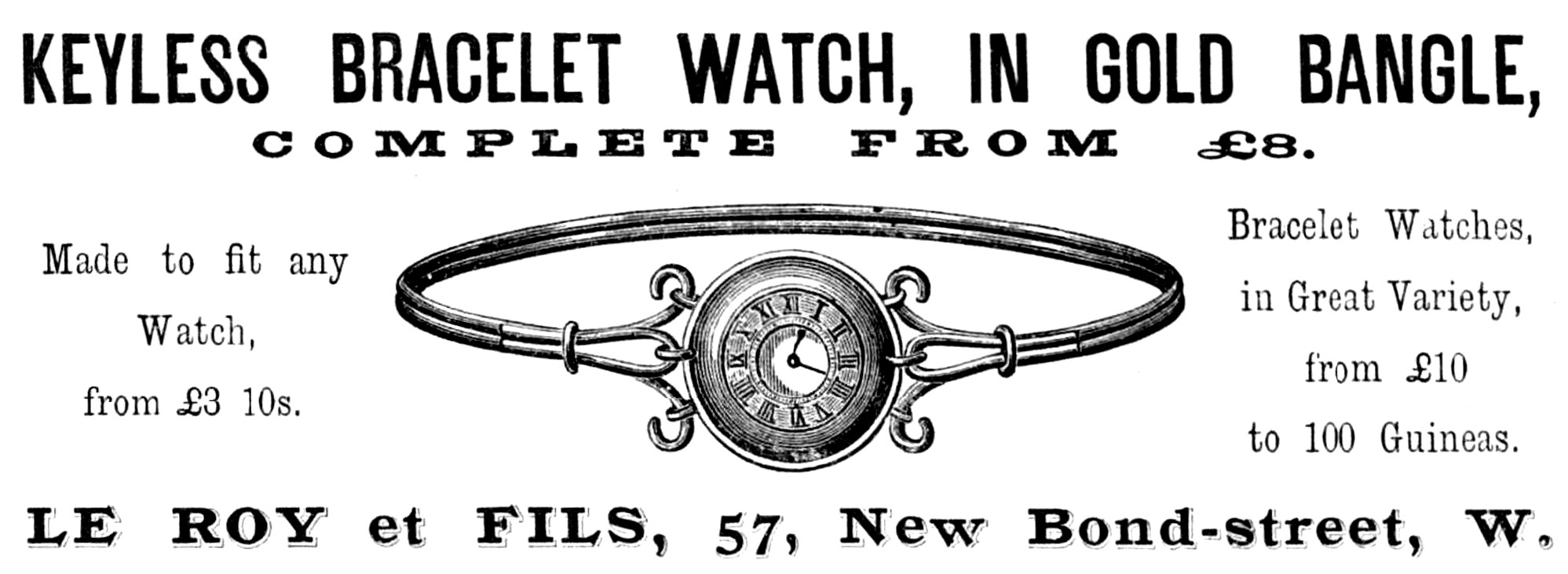
Le Roy Bracelet Watch Advert 1887: Click image to enlarge
There is another a statement in the Vade Mecum which suggests that most of the wristwatches sold by Wilsdorf and Davis at the time were for ladies: Next came the idea of the expanding bracelets, which an important jewellery firm invented and launched in about 1906. This too won the approval of our British clientele. From that time on, our little gold watch became increasingly popular throughout the Empire. Note that not only does he refer to the expanding bracelet described in the next section, which was not a feature of men's watches of the time, but he also calls it ‘our little gold watch’ (emphasis added). Although wristwatches are smaller than pocket watches, it is very unlikely that he would have referred to men's wristwatches in this way.
Wilsdorf says that the immediate sales success of his wristwatches after their autumn launch prompted him to widen the range and introduce a selection of designs in gold cases. Evidently he must have got his sales and marketing techniques right, because the success was not due to a change in fashion; aristocratic ladies had been wearing wristwatches for centuries and wristwatches had become fashionable with wealthy ladies for nearly twenty years, since the late 1880s. The advert by Le Roy from 1887 shows a lady's bracelet watch much the same as Wilsdorf & Davis began to sell in 1905.
Harrop's Britannic Bracelet

In the Vade Mecum Wilsdorf says ‘Next came the idea of expanding bracelets, which an important jewellery firm invented and launched in about 1906. This too won the approval of our British clientele ... [and] became increasingly popular throughout the Empire.’
The ‘important jewellery firm’ that Wilsdorf refers to was Edwin Harrop, who called the expanding bracelet they invented in 1906 the ‘Britannic’ as shown in the advertisement reproduced here. Edwin Harrop was granted patent No. 24396/06 in 1907 for this design. The Britannic bracelet became extremely popular and was made for many years – at least until 1964. They are still seen regularly today on ladies watches; Harrops must have sold many thousands of them.
Wilsdorf rode the success of the Britannic bracelet, remarking that ‘... both a new fashion and a great commercial success sprang from an apparently foolhardy idea. Soon we were placing orders for tens of thousands of pieces ...’ So the early success of Rolex was, in part at least, due to Harrop's Britannic bracelet.
Wilsdorf doesn't say it in the Vade Mecum, but these expanding bracelets were for ladies' wristwatches. An attempt to introduce a similar expanding bracelet branded ‘Army’ during the First World War, emphasising the benefits of a metal bracelet over leather in wet and muddy conditions, fell upon stony ground because of its effeminate appearance, despite the branding.
Very few, if any, of these early wristwatches would have been sold to men. Before the First World War, wristwatches were very much considered a woman's item and many men regarded them, like bracelets, as effeminate. An exception to this were military men who did buy wristwatches, but there is no evidence that Wilsdorf was involved in that area, or even realised at the time that this small, specialised, demand existed.
The Britannic bracelet was guaranteed for five years, and tested in public demonstrations over 110,000 cycles. But they don't last forever, especially in everyday use, and many watches from the pre-war period have had their Britannic bracelets replaced. The lugs that attach the bracelet to the case are very narrow and won't take a leather strap, but they can be adapted for a leather strap by fitting loop ends.
Swiss Office
On 1 July 1907, Wilsdorf & Davis opened an office in La Chaux-de-Fonds at 9, Rue Léopold Robert, the avenue that runs through the very centre of the town. The nature of the business was given as Horlogerie en gros or wholesale horology. This office was evidently intended to be a point of contact between Swiss watch manufacturers and the London import business. La Chaux-de-Fonds was the heart of the Swiss watchmaking industry. It is notable that Wilsdorf chose this location rather than Bienne, where Aegler was based. Evidently, at the time, Wilsdorf did not appreciate the future importance of Aegler to his business.
The Wilsdorf & Davis office in La Chaux-de-Fonds was closed in November 1913, and a new office opened in Bienne in January 1914. On 17 June 1914, the trademark ‘King George Lever’ was registered by Wilsdorf & Davis in Bienne.
Creation of the Rolex brand
Wilsdorf & Davis began business from 1905 without any trademarks or brands. In 1907, the British Hallmarking Import Act forced him to register the W&D mark at assay offices as a sponsor's mark. There was no need for this mark to be used on anything other than gold and silver items being sent for hallmarking, but exactly the same W&D mark started appearing on movements. Using the same mark on movements was not just a coincidence; it required positive choice and action. The first W&D punches would have been given to watch case makers so that cases could be stamped during production; more punches would have been needed for the movement workshop. The W&D mark was the first trademark or brand of Wilsdorf & Davis.
Wishing to create a more recognisable brand, Wilsdorf started using the Swiss office of trademark registrations to register brand names. The first he names he chose to register, on 1 November 1907 were Lusitania, Mauretania and ‘The Eastern Watch’. The Lusitania was an ocean liner launched by the British Cunard Line in 1906; the biggest, fastest and most luxurious liner in the world at the time, and Mauretania was her sister ship, launched three months later. In 1915, Lusitania was torpedoed and sunk by a German U-boat, an event that brought America into the First World War on the side of the Allies, but by then Wilsdorf had long since lost interest in the name.

First registration of the Rolex name in 1908
In 1908 Wilsdorf coined the name Rolex.
Some have speculated that the name Rolex had some complicated origin such as being derived from hoROLogie EXcellence, but in the Vade Mecum Wilsdorf says that Rolex was chosen because it was a short yet significant word, not cumbersome on the dial (thus leaving room enough for the inscription of the English trader's name) and, above all, a word easy to memorise. It has a pleasant sound and its pronunciation remains unvaried in whatever European language it is spoken. He doesn't reveal where the name came from, but it sounds like he simply made it up. His description of the way the word is short, easy to remember and pronounce echoes the words of George Eastman, who registered the trademark Kodak on 4 September 1888. Eastman said his criteria for creating the name were that it should be short, one cannot mispronounce it, and it could not resemble anything or be associated with anything but Kodak. Wilsdorf surely had the same considerations in mind when he decided on the name Rolex for his leading brand.
Wilsdorf & Davis registered Rolex as a brand name in Switzerland using the La Chaux-de-Fonds office address on 2 July 1908 as shown in the registration details reproduced here. This shows that Rolex was a trademark of Wilsdorf and Davis, manufacturers of watches, parts of watches and boxes. Wilsdorf requested Aegler use the new trademark on all of his watches. Aegler wanted their own name to appear on the watches they manufactured, but reluctantly agreed to Wilsdorf's request. Wilsdorf wanted to create a brand that would distinguish his product from other watches, which may even have contained the same parts - Aegler was not an exclusive supplier to Wilsdorf at that time, also supplying movements to Gruen in America and others. Aegler registered Rolex as a trademark in Switzerland in 1913 for the manufacture of watches and watch parts.
At the time, Wilsdorf and Davis was a British company based in London, so it is rather strange that the first date of entry of Rolex as a trademark in the British trade marks register is dated 6 July 1912. This was published in the official trade marks journal on 14 August 1912. The current trade mark register shows that the registration was renewed until 6 July 2006 but is now officially ‘dead.’
Wilsdorf was an alien in Britain until he applied for and was granted British citizenship. He took the Oath of Allegiance on 20 November 1911 and was granted a certificate of Naturalization by the Secretary of State. His address was ‘The Mansion, Sundridge Park, Kent’, a magnificent mansion house, now Grade I listed, designed by the architect John Nash in the 18th century, with its surrounding estate and gardens planned by the landscape designer Humphry Repton. Wilsdorf was evidently doing pretty well by 1911, although he wouldn't have owned the whole of The Mansion, just an apartment within it. But still very impressive for a 30-year old. Not many 30 year olds live in a mansion designed by Nash looking out over gardens designed by Repton, then or now.
First British Rolex Advert
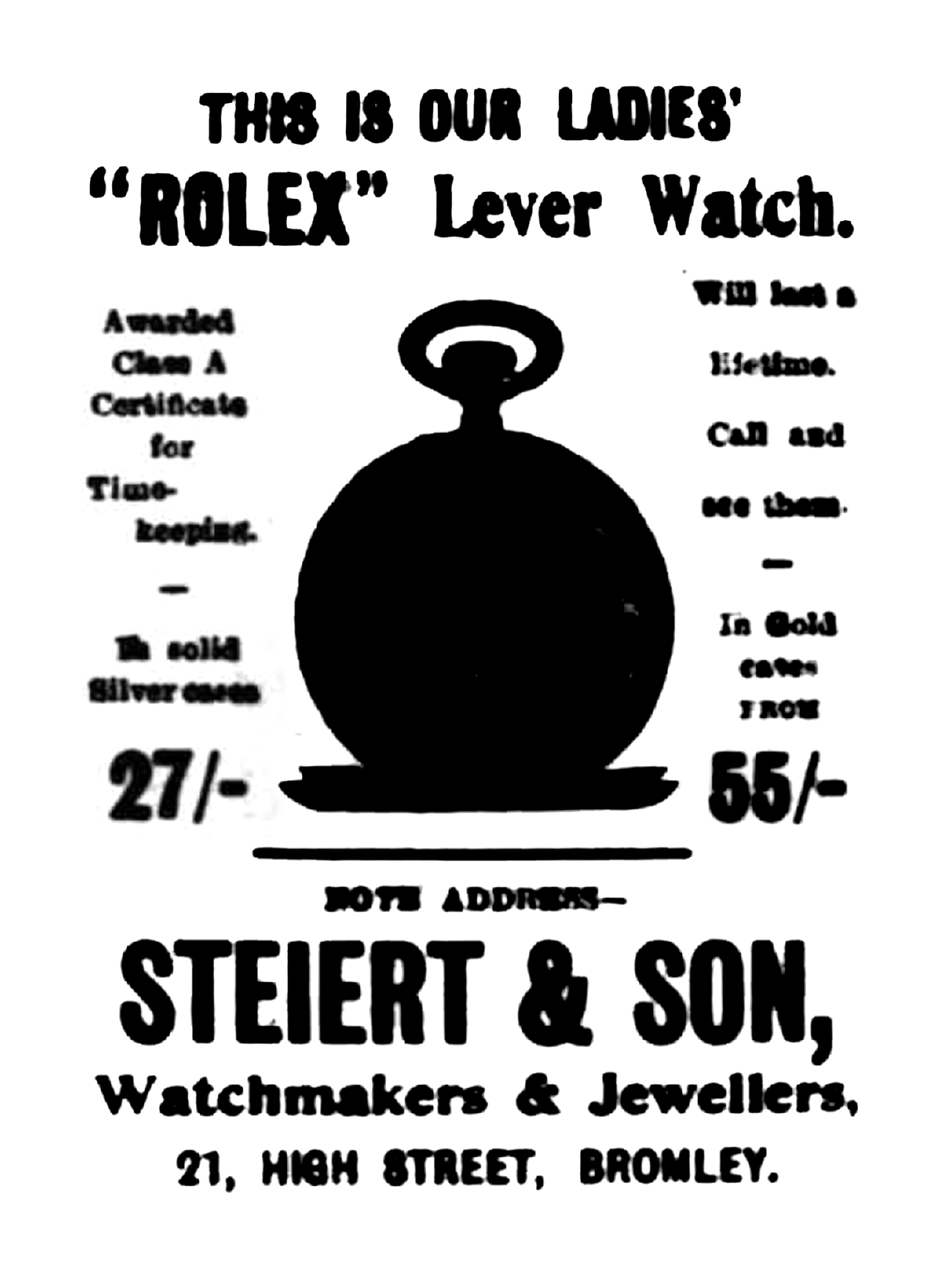
Steiert & Son advert 6 October 1911
Click image to enlarge
In the early twentieth century, British retailers usually refused to have a brand name on the watches they sold, and did not use brand names in advertisements. If any name appeared on a watch, it was that of the retailer. Their idea was that when one of their customers was asked about a watch they were wearing, instead of mentioning a brand name, the person would say the name of the shop where they had bought it. Someone wanting to buy a similar watch would have to go to that shop instead of finding a rival shop that stocked the same brand, possibly at a lower price. This attitude of British retailers is discussed at Names on Dials.
This means that advertisements before the mid-1920s with the brand name of a watch are rare. However, two early adverts with the Rolex name have been found.
Steiert & Son
The advertisement reproduced here from October 1911 by Steiert & Son, jewellers and watchmakers (watch retailers) in Bromley, a prosperous town on the south east side of Greater London, is the earliest I have found for Rolex watches - if you know of an earlier one, please let me know.
The advert is very unusual for 1911 in mentioning the Rolex brand. Perhaps the company was given the impression by Wilsdorf or his representative that the Rolex name was already well known and attractive to clients. It is notable that although Steiert & Son ran many adverts in local newspapers between the 1880s and 1918, this is the only one that has been found which mentions Rolex.
The watch is a ladies' fob watch rather than a wristwatch. Unfortunately, the quality of the scan of the newspaper is poor, and no further details of the watch can be seen.
The reference to a Class A certificate for timekeeping does not mean a Kew Class A certificate. An Aegler 11-ligne watch was awarded a First Class certificate by the Bienne watch rating office in 1910, which must be what this statement refers to, but the standard was lower than required for a Kew Class A certificate.
The prices are in British shillings. The solid silver case would be sterling silver, 92.5% pure. Twenty seven shillings is one pound and seven shillings, or one pound and 35 pence in decimal currency. In 1911, that would have represented about four days wages for a skilled tradesman. Prices for gold versions start at 55 shillings, two pounds and 15 shillings, which is just over twice the price of the silver version. The were probably gold plated, or possibly 9 carat gold.
E. Polland Ltd

E. Polland Ltd advert for Rolex watches, Belfast Evening Telegraph, 10 December1914
Click image to enlarge
After 1911, the next British advert found is from December 1914 by E. Polland Ltd of Belfast. Polland was one of the leading jewellers in Ireland, with a prominent shop in the centre of the shopping district of Belfast.
The watches in this advert were more expensive at £4 to £10 10s, which suggests that E. Polland was only offering them in gold cases. The expanding bangle referred to is almost certainly a Britannic bracelet made by the company Edwin Harrop.
The advert is in error in saying that Rolex watches obtained ‘first place’ at Kew Observatory during 1913 and 1914. Two Rolex watches were awarded Class B certificates in 1913, one of which was endorsed ‘especially good’, and a Rolex watch obtained a Class A certificate in the 1914 trials, but none of these can be described as first place.
The 1914 Kew trials began in April. A Rolex watch was awarded a Kew Class A certificate in July 1914, but it did not achieve the highest marks of all the watches entered for trial in 1914, so it was not ‘first’. It achieved a very creditable 77.3 marks out of 100, just short of the 80 marks required for an endorsement of ‘especially good’. The watch that scored the highest number of marks in the 1914 trial was entered by Paul Ditisheim and achieved 94.0 marks. The lowest scoring of the top 50 watches entered was by Vacheron & Constantin, scoring 85.7 marks. However, although it was not first, the award of a Class A certificate to such a small watch was a remarkable achievement.
E. C. Kemp & Co.
From February 1915, the jewellers E. C. Kemp & Co. of Gallowtree Gate, Leicester, ran a series of adverts in Leicester newspapers which continued throughout the First World War. These are the first British adverts for Rolex watches to have been run more than once.
The earliest advert found so far was published in The Leicester Mail on 24 February 1915. It stated that Kemp & Co. had been ‘appointed Sole Agents for Leicester and Leicestershire for the “ROLEX” Watch.’
The following styles of watches were listed in the advert by Kemp & Co.
| Gold Expanding Bracelet Watches from | £3 3 0 |
| Silver Strap Watches | £1 3 6 |
| Special Army Watches | £1 10 0 |
| (FITTED WITH RADIUM DIALS AND HANDS) | |
| EVERY WATCH FULLY GUARANTEED FIVE YEARS. |
The mention of ‘Special Army Watches’ with radium luminous dials and hands makes this the first known advert for Rolex men's watches.
First Australian and New Zealand Adverts
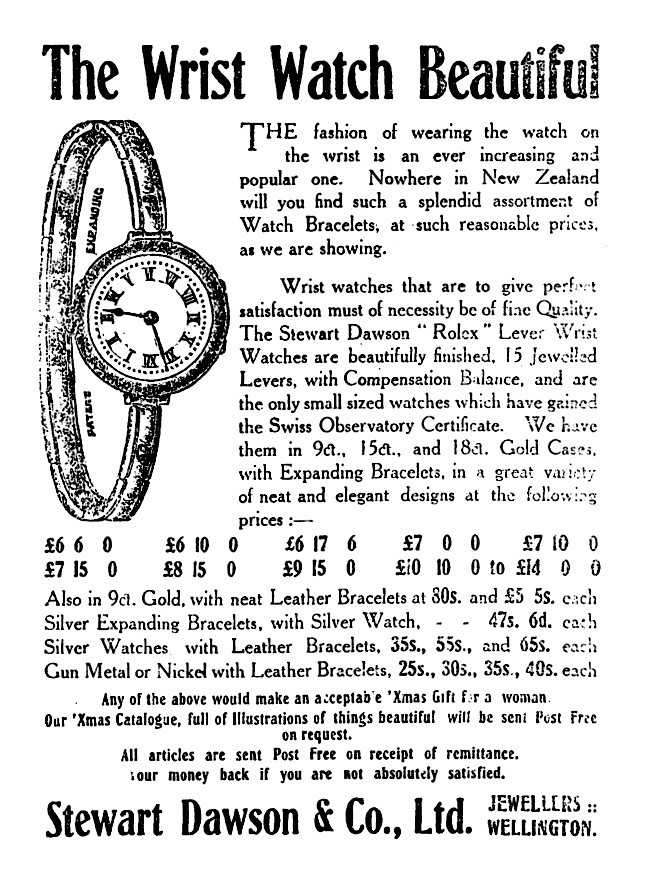
Stewart Dawson Wellington advert November 1912
Click image to enlarge
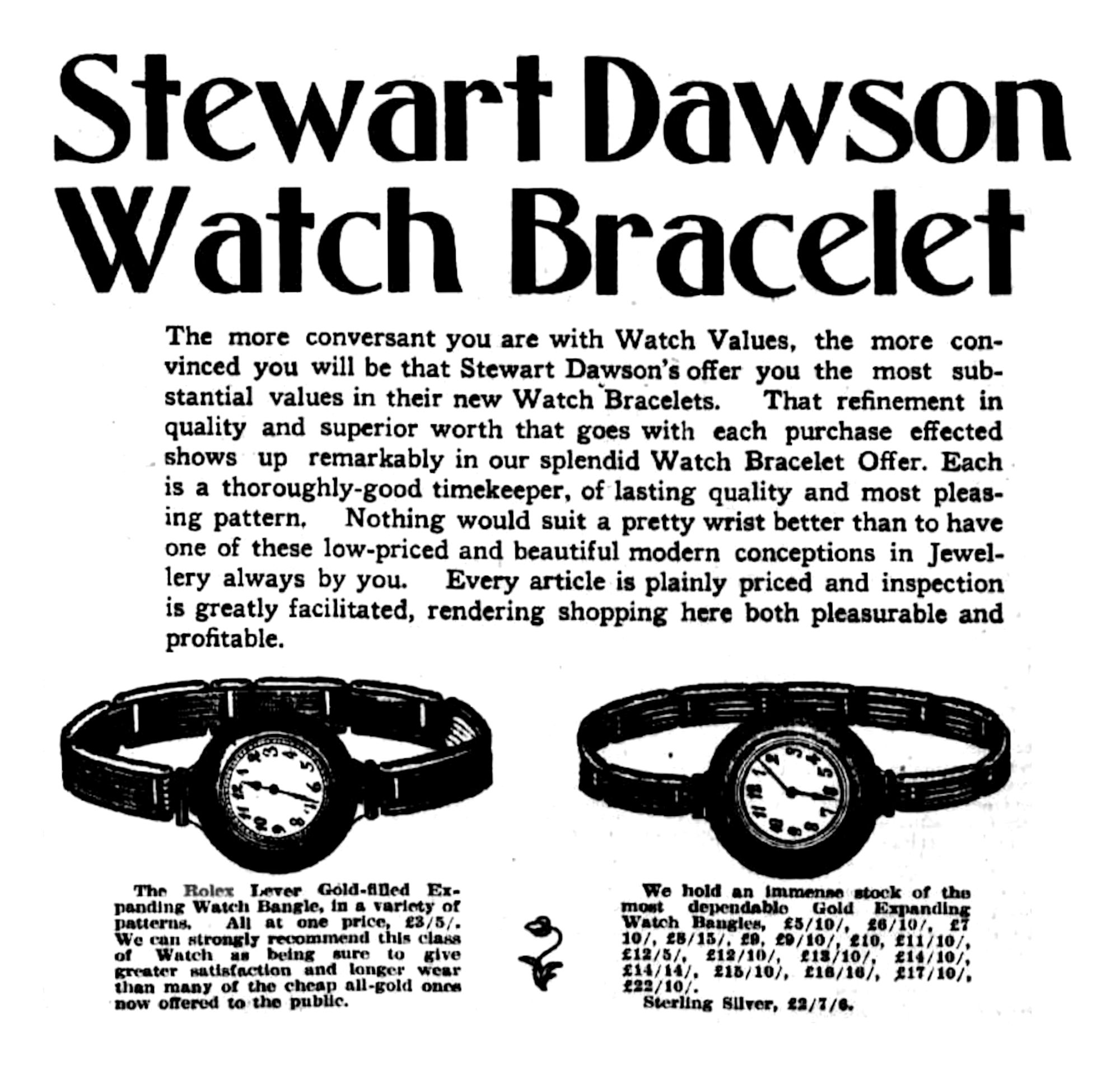
Stewart Dawson Melbourne advert January 1914
Click image to enlarge
In the Rolex Jubilee Vade Mecum, Wilsdorf writes,
The new fashion in [bracelet] watches became extremely popular, in Australia and New Zealand especially
The earliest advert for Rolex watches in Australia and New Zealand currently known was placed in the Wairarapa Daily Times in November 1912 by the retailers Stewart Dawson & Company in Wellington, New Zealand.
Stewart Dawson & Company was established in London as a jewellery wholesale and retail business in about 1869 by David Stewart Dawson, later opening branches in Australia and New Zealand. The business was incorporated in London as Stewart Dawson & Co. Ltd. in 1907.
The earliest advert for Rolex watches in Australia currently known was placed in Table Talk, published in Melbourne, Victoria, in November 1913 by Stewart Dawson & Company. The address is ‘On the corner of Swanston and Collins Streets, Melbourne’.
This advert simply states ‘The Celebrated ROLEX LEVER WATCH BRACELET, with expanding gold-filled Bracelet, £3 5/-’ (three pounds and five shillings).
A subsequent advert by Stewart Dawson & Company in January 1914, part of which is reproduced here, goes into more detail, saying, ‘The Rolex Lever Gold-filled Expanding Watch Bangle, in a variety of patterns. All at one price, £3/5/. We can strongly recommend this class of Watch as being sure to give greater satisfaction and longer wear than many of the cheap all-gold ones now offered to the public.’
To the right of the advert is a very similar watch, with the caption ‘We hold an immense stock of the most dependable Gold Expanding Watch Bangles’. The prices for these range from £5/10 (five pounds and ten shillings) to £22/10/ (twenty two pounds and ten shillings), with Sterling Silver at £2/7/6 (two pounds, seven shillings and sixpence). The gold-filled Rolex, at three pounds and five shillings, sits between sterling silver and the cheapest gold watch.
It is not clear whether the gold watch to the right of the Australian advert is also a Rolex, but the New Zealand advert lists a similar wide variety of styles and prices, and it is clear that these are Rolex wristwatches. The fact that the same company placed both adverts suggests that Stewart Dawson & Company were most likely selling Rolex watches in Australia as well as New Zealand in 1912, and possibly earlier, even if they weren't advertising them in newspapers.
Back to the top of the page.
Rolex Trench Watches

A ‘Proper Wristwatch’
British military officers began wearing wristwatches in the early 1880s, and subsequently a wristwatch was required as part of an officer's outfit. Ladies had soon taken up the idea and ladies wristwatches became fashionable and very popular by the end of the nineteenth century. However, civilian men did not wear wristwatches, preferring to carry a pocket watch.
Before the First World War, the British Army was a small, professional, force deployed around the Empire. When on leave, officers out of uniform followed the civilian male fashion of carrying a pocket watch. The sight of a British officer in uniform wearing a wristwatch was well-known to soldiers, but a rare sight for civilians.
During the First World War, many new officers were commissioned, and every one had to buy a wristwatch. Millions of men joined the army, and witnessed officers wearing and using wristwatches every day. The nickname of ‘a proper wristwatch’ was soon coined by these new soldiers to describe a smartly turned out officer.
Because many operation were carried out at night, it soon became obvious that a luminous wristwatch was a necessity. Watch dials and hands were made luminous with radium based radioluminescent paint, which glowed brightly all the time. A wristwatch with a luminous dial and unbreakable glass was an essential part of an officer's outfit and soon termed a ‘trench watch’. Many enlisted men, seeing an officer's wristwatch glowing eerily in the dark of the trenches, decided they would like to have such a wristwatch themselves.
Before the war, Rolex sold mainly ladies' bracelet watches, which meant it was not well placed to take advantage of a sudden huge increase in demand for men's wristwatches. The demand for trench watches from newly commissioned officers and enlisted men during the war was transformational for Wilsdorf and Rolex. Aegler already made 13-ligne lever escapement movements, the perfect size for men's wristwatches. Soon, Rolex was also selling significant numbers of men's wristwatches. However, from the nature and wide variety of cases of surviving Rolex trench watches, it is evident that Rolex struggled to find suitable men's-size wristwatch cases.
Soon after the First World War had begun, the whole Swiss watch industry turned to making trench watches, but was unable to ramp up production quickly enough to satisfy the sudden huge increase in demand. Watchmakers such as Longines, who already had an established business supplying wristwatches for military officers, were better placed, having existing case suppliers they could call upon, but Aegler and Rolex had not concentrated on this area before the war, so they had to almost start from scratch.
The best watch case for the conditions of the trenches was the Borgel screw case, but, like all Swiss manufacturers, Borgel could not increase production rapidly enough to satisfy demand, and existing customers were served first. Similarly, watch cases with screw backs, or even with double backs, which have an outer back and a second inner cuvette to give extra protection against dust and damp, were in high demand.
There are no known Rolex trench watches from the First World War with Borgel cases. Although some have better quality cases, such as hunter cases with screw backs, many Rolex trench watches have cases with only a single back. This is the most basic type of case, which gives the lowest level of protection against dust and damp. It is also the least expensive type of case, but it seems unlikely that Wilsdorf was being economical when there was such a huge demand for wristwatches. It therefore appears, from the evidence, that Rolex had difficulty in obtaining adequate supplies of higher-quality cases.
The difficulty Rolex had in obtaining supplies of cases for trench watches is evident in the cases of those that survive. From a sample, 57% have single backs, 36% have screw backs (all hunter cases), and 7% have snap backs.
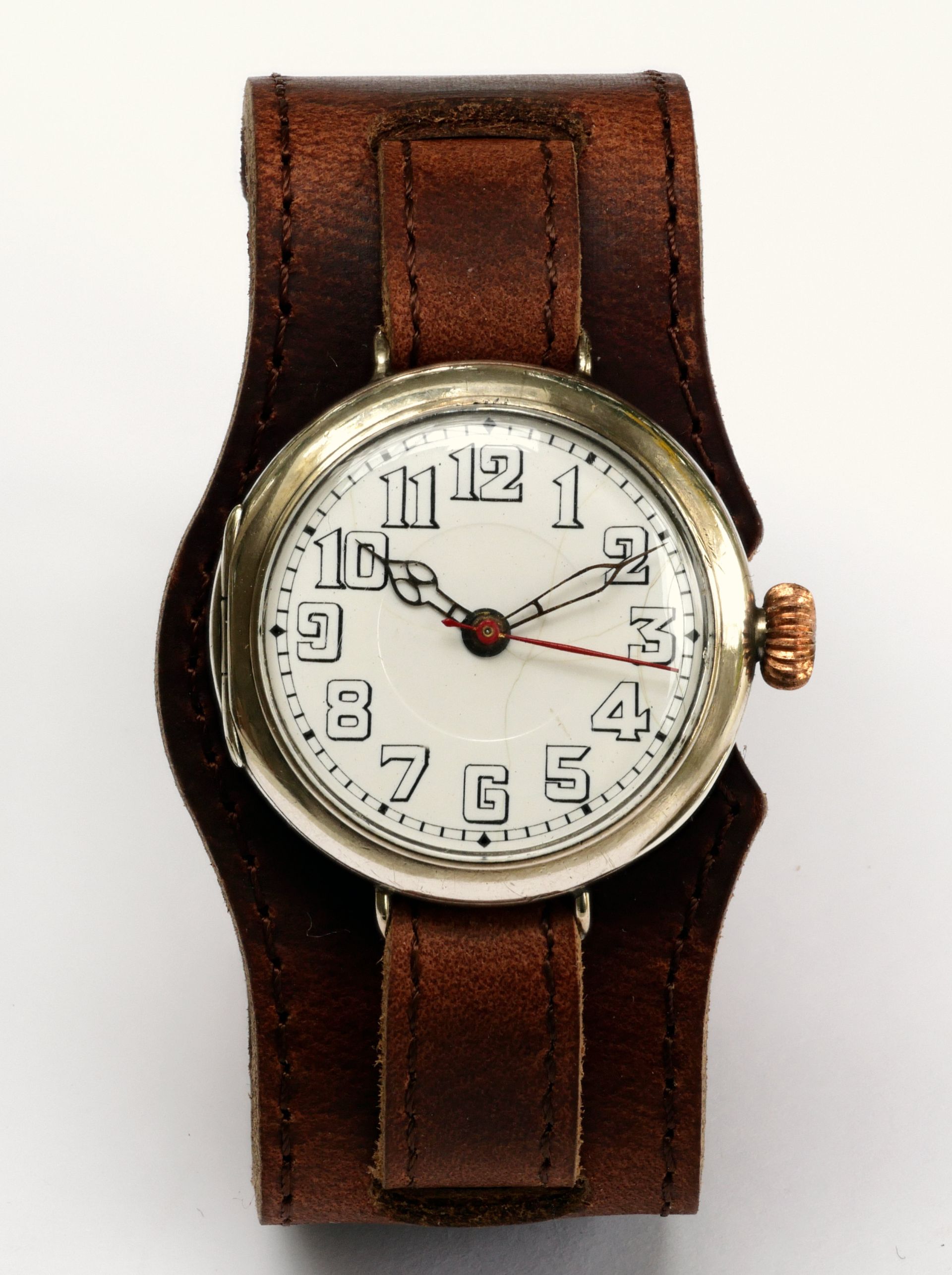
Rolex centre seconds trench watch
Click image to enlarge
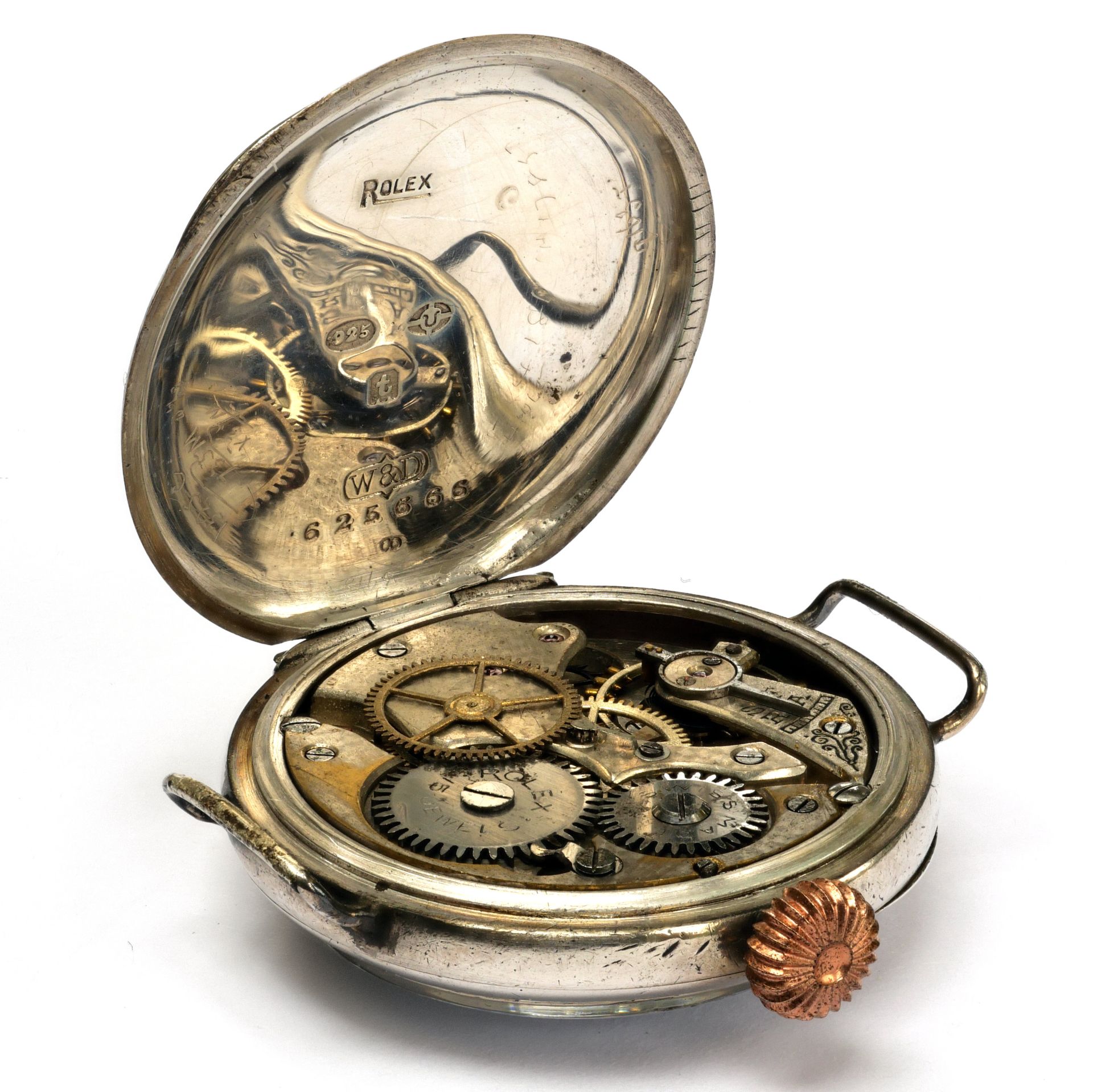
Rolex centre seconds trench watch, single jointed back
Click image to enlarge
The photos here show a Rolex centre seconds trench watch with a single jointed back case.
The case has London Assay Office import hallmarks for sterling silver with the date letter ‘t’ for the hallmarking year from May 1914 to May 1915. The sponsor's mark is the W&D mark entered by Wilsdorf and Davis at the London Assay Office. The case back is also stamped ‘Rolex’. The movement is a 13-ligne, 15 jewel, Aegler Rebberg with ‘Rolex - 15 Jewels’ engraved on the ratchet wheel.
The watch is mounted on an F-Type strap in brown oiled leather, which has the perfect aged look for an original trench watch.
Before the First World War, Wilsdorf and Rolex had concentrated on ladies' bracelet watches. This left them, at the start of the war, unprepared to supply large numbers of men's wristwatches. However, the First World War was the event that transformed men's wristwatches from something confined strictly to military officers in uniform into something that millions of civilian men were prepared to, indeed wanted to, wear. Wilsdorf quickly picked up on this trend, and men's wristwatches became not just a second line, but an increasingly important part of Rolex's range.
Hunter Cases
Some Wilsdorf and Davis trench watches have hunter cases, with a metal lid covering the dial that has to be opened to read the time. These usually carry the legend ‘Brevet  71363’. Brevet means patent in French and the Swiss federal cross shows that this refers to a Swiss patent granted to Charles Zurbrügg on 23 June 1915 for a ‘Boîte-savonnette pour montres-bracelet’, or hunter case for wristwatches.
Zurbrügg hunter cases have screw backs, which give good protection against dust and damp.
Reference to Zurbrügg's patent in hunter cased wristwatches with Wilsdorf and Davis' sponsor's mark and / or Rolex branding has led some people to claim that Hans Wilsdorf bought the rights to the patent. This would have been a bit pointless, because Rolex didn't make watch cases and therefore would have needed to find a watch case manufacturer to make them, something that Zurbrügg, a watch case manufacturer, was already doing. In fact, the story is much simpler; Rolex bought cases made by Zurbrügg's company.

Huguenin Frères Trademark
Huguenin Frères trademark, shown here, is sometimes seen in Rolex hunter wristwatches. The case is also usually stamped with “BREVET DEM”, the DEM indicating that a request for a patent (brevet) had been “demanded”, that is an application for a patent had been submitted but the patent had not been granted, so its eventual patent number was not known.
In September 1916, Huguenin Frères were granted Swiss patent number 72290 for a spring for a wristwatch hunter case, ‘Secret de boîte-savonnette de montre-bracelet’. The lid of a hunter case is normally held closed by a catch. When the catch is released, usually by pressing a button, a concealed spring causes the lid to open. Huguenin Frères invention was a small lever next to the crown, instead of a button, to release the catch. The application for the patent was registered on 20 August 1915.
Huguenin Frères' hunter cases have single jointed backs, which give poor protection against dust and damp.
The presence of Huguenin Frères trademark in the cases of Rolex hunter wristwatches sometimes leads people to assume that Wilsdorf acquired the rights to the patent from Huguenin Frères. However, the truth is simpler. Rolex bought cases from Huguenin Frères.
A Bad Idea
The hunter cased wristwatch was one of the worst ideas in watchmaking. Although it might appear at first sight that a hunter lid protecting a wristwatch's glass was a good idea, especially in combat situations, it was in practice of no real benefit and a downright nuisance.
The principal benefit of a wristwatch is to free the hands. A mounted officer can hold the reins of his horse in one hand, and his sword or revolver in the other, whilst simultaneously reading the time from his wristwatch. In a combat situation, this can be crucial, and a hunter lid defeats it. With a hunter watch, both hands have to be brought together to open the lid and see the time. This defeats the objective of wearing a wristwatch. A pocket watch is more accessible.
Although the dangers of breaking a watch glass were much smaller than the popular imagination conceived, in 1915, trench watches began to be fitted with unbreakable glass. The need for a hunter lid disappeared overnight. This meant that hunter wristwatch cases became easier to get hold of, which may be why so many Rolex trench watches have hunter cases.
Back to the top of the page.
Rolex Watch Company Limited
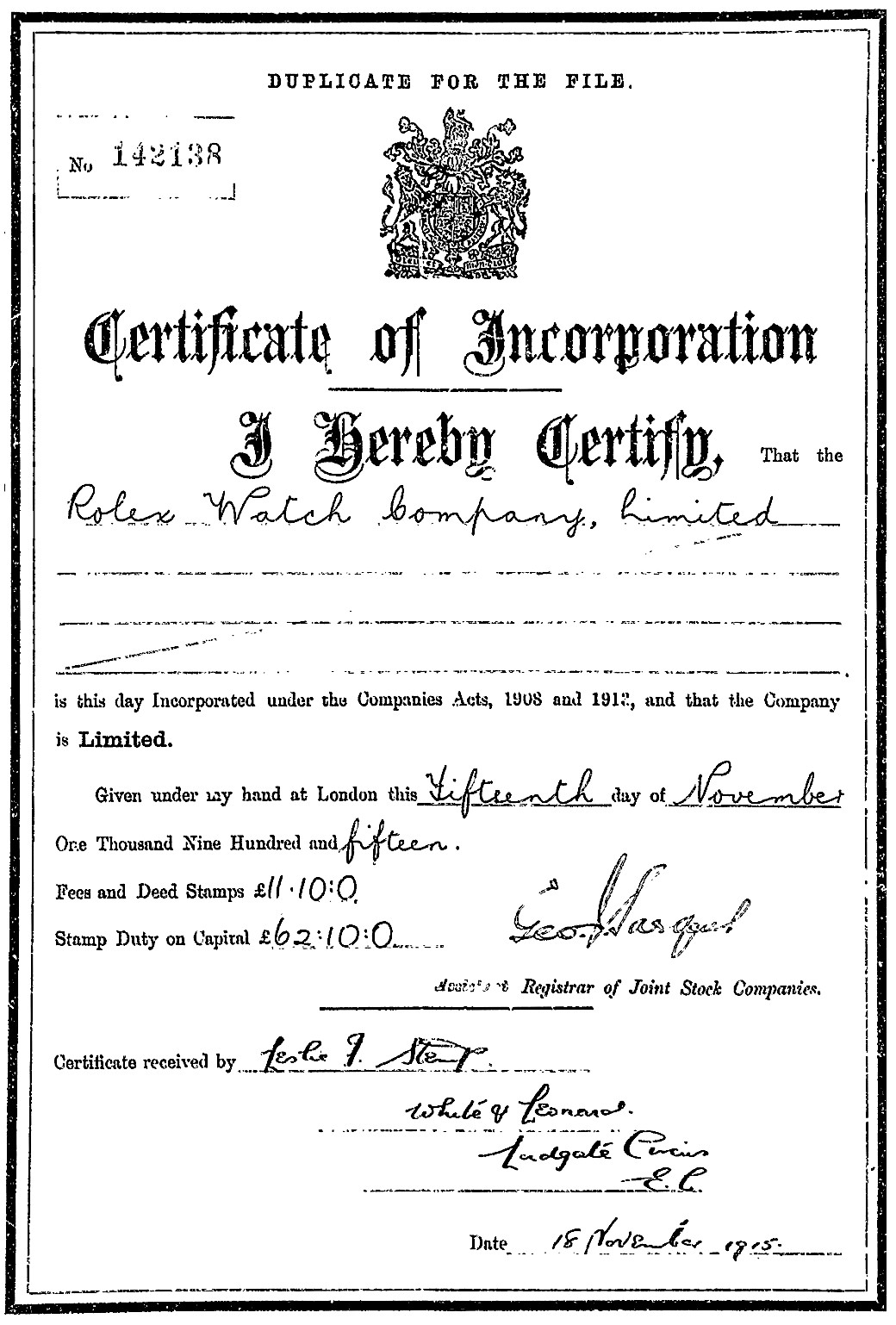
Rolex Watch Company Limited Incorporation: 18 November 1915: Click image to enlarge
London was the export centre for Wilsdorf & Davis watches for overseas markets as well as Britain. Every watch was examined in London before being sent to the retailers, whether British or abroad. By 1914 the London company had grown to such an extent that it was occupying a large suite of offices and had a payroll of more than 60 employees.
As shown by the certificate of incorporation reproduced here, the Rolex Watch Company Limited was incorporated as a limited company in London on 18 November 1915 under the Companies Acts, 1908 and 1913. The registration cost Wilsdorf £11 10s for the fees and stamp duty on the deed and £62 10s for the stamp duty on the registered capital, a total of £74. Not a bad investment as it turned out.
If nothing had subsequently happened to change things, there would have been no reason why Rolex should not have continued to be a British registered company with its headquarters in London.
In September 1915, as part of the war effort, the British Government, in the form of Reginald McKenna, Chancellor of the Exchequer, imposed an ad valorem duty of 33⅓% on imported luxuries, which included clocks and watches, to conserve foreign currency reserves. Rather interestingly, was initially intended to charge the duty on hats, but it proved too difficult to formulate a precise definition of a hat. If only it had been so difficult to define a watch! The duty meant that any watches imported into London, even if only for checking before subsequent export abroad, would be subject to this high rate of tax.
In December 1916 the restrictions on imports of precious metals were further extended. The import of all gold and silver items, including gold watches or watch cases but specifically excluding silver watches or watch cases, was prohibited. For the remainder of the war, no gold watches or gold watch cases were imported. For more details about this, see First World War and Gold Cases.
As a result of British import duties and the prohibition on importing gold watches and gold watch cases, the function of the Bienne office was expanded to include the checking of all the watches purchased from Aegler. Watches destined for countries other than Britain no longer needed to pass through London and could be dispatched from Bienne.
All gold and silver watch cases made for Rolex were stamped during manufacture with the W&D sponsor's mark, whether they were sent to London or to another country. This was easily done as the case was being made, and simplified inventory holdings since the destination of a case was not necessarily known when it was being made. However, only cases for watches that were specifically to be exported to Britain were sent to England to be hallmarked. From this time, watches with gold or silver cases that have the W&D sponsor's mark but without British hallmarks did not pass through Britain, but were sent direct from Switzerland to the destination country.
In 1919 Wilsdorf decided to relocate the headquarters of Rolex from London to Geneva. If the McKenna duties and import ban on gold watches had not been imposed during the war, Rolex might still be a British company!
Today, the British Rolex Watch Company Limited is a wholly-owned subsidiary of Rolex Holdings SA, a company incorporated in Switzerland, and operates as part of the group's distribution and watch servicing operations. The company's principal activity is the sale of Rolex products to the watch industry in the UK and Ireland.
Back to the top of the page.
End of Wilsdorf & Davis
In 1919, Hans Wilsdorf established a sole proprietorship in Bienne under his own name. In 1920, a number of trademarks that had been registered by Wilsdorf & Davis were transferred to Hans Wilsdorf, Commerce, in Bienne and renewed.
It was also in 1919 that Wilsdorf and Aegler agreed that Aegler would stop making watch cases and concentrate solely on making movements. Watch cases would be bought in by Rolex from third-party case makers and watches would be assembled in Geneva.
On 1 September 1919 it was announced that the Bienne branch of the general partnership Wilsdorf & Davis, based in London, had expired after liquidation of the company had been completed. It was also announced that the joint-stock company under the name Wilsdorf & Davis Export S.A., based in Bienne, had expired after the liquidation had been completed.
In the Vade Mecum, Wilsdorf says ‘It was in 1919 that I finally founded at Geneva, in the offices we still occupy to-day, our present company, the Rolex Watch Co. Ltd., of which I am sole proprietor.’ The address was No. 18, du passage du Terraillet, which is off Rue de Marché. The offices were on the third floor of the building, with a workshop on the fifth floor.
Beginning in 1928, trademarks registered by Wilsdorf & Davis began to be struck off the public register because they had not been renewed. The first of these was were numbers 22837 to 22839, Lusitania, Mauretania and ‘The Eastern Watch’, registered by Wilsdorf & Davis, La Chaux-de-Fonds, in November 1907 and struck off in May 1928.
Montres Rolex S. A.
On 16 January 1920, a public limited company was established in Switzerland under the name Montres Rolex S. A. (Rolex Uhren A G.) (Rolex Watch Co Ltd.) with its registered office in Geneva at 18 Rue du Marché.
The board of directors was composed of: Hans Wilsdorf, Hermann Aegler and Emile Béha.
On 6 December 1935, Hermann Aegler's position was altered from president to secretary and his powers to represent the company removed. Marguerite Gagnebin and Antoinette Gagnebin were authorised to represent the company.
At an extraordinary general meeting on 21 January 1938, Misses Marguerite Gagnebin and Antoinette Gagnebin, of Sonceboz (Bern), both residing in Geneva were appointed as new members of the board of directors, with joint signing authority.
On 7 February 1941, Director Hermann Aegler (previously listed as secretary) was appointed chairman of the board, replacing Hans Wilsdorf, who remained a director. Lucie Berger, authorized signatory, was appointed secretary of the board.
Back to the top of the page.
Death of Hans Wilsdorf
After his wife's death in 1944, he founded the Hans Wilsdorf Foundation, into which he invested all his Rolex shares and ensured that part of the proceeds went to charitable causes. The trust ensures the continuity of the Rolex Organisation and provides annual grants to charitable institutions.
Hans Wilsdorf died on 6 July 1960 at his home on the shore of Lake Geneva. He was 79.
In 1981, a street in Geneva was named Rue Hans Wilsdorf to commemorate the 100th anniversary of his birth. The naming ceremony was carried out by Claude Ketterer, Vice-president of the Administrative Council and later Mayor of the City of Geneva. Among those present were Mrs. Wilsdorf and Mr. Andre J. Heiniger, Managing Director and Chief Executive of Rolex. Heiniger joined Rolex in 1948 and became chief executive in 1962. He became the second chairman in the company's history and ran Rolex until his retirement in 1997.
Back to the top of the page.
Rolex and Aegler
Aegler is very important name in the history of Rolex. From the very start of Rolex, Aegler manufactured the watches that were sold as Rolex watches. Rolex didn't own the company or the factory, it was owned by the Aegler and Borer families. This situation continued until 2004 when Rolex bought the company.
On 1 January 1913, Wilsdorf & Davis established an office in Bienne at Fabrikgasse 3 b. The nature of the business was given as Horlogerie en gros or wholesale horology. There can be little doubt that the reason for establishing this office was to improve the efficiency of communications between the London headquarters of Wilsdorf & Davis and the Aegler factory.
There is a separate page devoted to the history of the Aegler company at Aegler.
Aegler Rebberg Movements

Aegler Rebberg Movement marked “Rolex 15 Jewels” on ratchet wheel: Click to enlarge.

Aegler Rebberg Movement Marked W&D: Click to enlarge.
Aegler manufactured movements in its ébauche factory in the Rebberg district of Bienne, and consequently Rebberg was a registered as a trade mark by Aegler. Early Aegler movements used in Rolex watches are often referred to as “Rebberg” movements because of this, even if they are not stamped with the Rebberg name. If they are stamped Rebberg, it is often on the bottom plate under the dial so not normally visible.
Aegler supplied Rebberg movements to Wilsdorf & Davis, and also to a lot of other companies. In fact it is most likely that Aegler supplied complete, cased, watches. Companies in London that Aegler supplied, such as the fledgling Wilsdorf & Davis, were simple importation business operations with an office in London but no factory capability, either in Switzerland or in England to put movements into cases and test the finished watches. All the silver cases that are seen with Rebberg movements, and gold cases until 1915, were made in Switzerland, so it is clear that the movements would have been cased and the finished watches tested at the Aegler factory. You can read about the other companies that Aegler supplied on my page about Aegler and see movements with their brand names at Rebberg Movements.
The two images here show savonnette versions of these Rebberg movements with their characteristic single central bridge holding the pivots of all the train wheels; centre, third, fourth and escape wheel. The movement with the perlage decoration to the plates is 13 ligne, the one with the plain plates is slightly smaller and shows a slight variation in the shape of the central bridge, but is still unmistakably an Aegler Rebberg. They are both stem wound and set lever escapement movements with 15 jewel bearings. Savonnette movements were used in savonnette (hunter) pocket watches, and in Lépine (open face) wristwatches because they have the fourth wheel at 90 degrees from the stem. This allows the crown to be at three o'clock and the small seconds indication at six o'clock on the dial.
Wilsdorf also imported Rolex watches with lower grade 7 jewel versions of the Rebberg movement. The 15 jewel versions were better finished and had “Rolex 15 Jewels” on the ratchet wheel, the 7 jewel versions just had the word Rolex and were less highly finished. There were also a small number of Prima grade movements with 18 jewels.
The smaller movement with the plain bridge is from a watch with a Borgel screw case with London Assay Office import hallmarks for sterling silver dated 1910 to 1911. Although it appears to have been made after Wilsdorf came up with the name Rolex, this watch doesn't carry the name Rolex. Both the case and the movement carry the W&D mark of Wilsdorf and Davis. On the case this is not unusual, a silver or gold case had to be punched with a sponsor's mark before it would be accepted for assay and hallmarking. But to find the same WD mark stamped on the movement is quite unusual.
The larger movement with the perlage decoration on the bridge dates from circa 1918 carries the single name “Rolex” so this is from a Rolex watch, not just a watch that was sold by the Rolex Watch Company. But notice that the Rolex brand name is engraved on the ratchet wheel. This is an easy component to change, just a single screw holds it in place. This was most likely an idea of Aegler's to reduce the amount of stock they needed to hold. They could hold ratchet wheels engraved with Rolex or any other name, and then when an order came in they could simply take unbranded movements and change the ratchet wheels to one with the name given on the order. This was a more cash efficient system than tying up lots of movements with names engraved on their bridges which then could only be sold to that customer.
Wilsdorf would have wanted the Rolex name engraved on the bridge of movement from the outset, but in the early days, before the 1920s, he was only one of many customers Aegler had and they could afford to refuse him. This is most likely the source of the story that Aegler at first refused to put the Rolex name onto their movements. They didn't want to engrave it onto the bridges because that stock could then only be sold to Rolex. But they put lots of different names on ratchet wheels, which could be easily exchanged, so it wasn't that they didn't want another company's name appearing on their movements at all, just not on the bridge where it was difficult to change or remove.
When Rolex became more important to Aegler as a customer they had to listen to him more seriously and the Rolex name got engraved on the bridge. The earliest watch that I have seen with Rolex engraved on the central bridge of the Aegler Rebberg movement had Glasgow Assay Office import hallmarks in the case back with the date letter "d" for the year 1926 to 1927.
Back to the top of the page.
Aegler Xi Trademark

Aegler S.A. Trademark Xi and Ξ October 1900

Aegler Trademark Xi Ξ 1913
The letters Xi within an oval, and separately what appears at first glance to be three lines within an oval, were registered as trademarks in October 1900 by the company Vve. Jean Aegler.
The mark that appears to be simply three horizontal lines is actually the Greek uppercase letter Ξ, which is the 14th letter of the Greek alphabet. This is written in Roman letters as “Xi”. It represents the /ks/ sound and is pronounced [ksi]. It is distinct from the Greek letter Χ (chi), which gave its form to the Latin letter X.
In the photograph of a trademark stamped in a case dated 1913, the mark is a combination of the two separate marks within an oval.
The registration details show that the marks Xi and Ξ trademarks could be used on “Montres, boîtes, mouvements et emballages de montres”, or watches, cases, movements and packaging of watches. In fact, the Xi and Ξ trademarks are most often seen today on watch cases, which strongly suggests that Aegler made cases as well as watch movements. Aegler were also granted a number of patents for designs of watch cases, which further reinforces the idea that they made cases.
If it hadn't been for the domination of Aegler by their principal customers Rolex and Gruen, latterly of course Rolex who acquired Aegler in 2004, perhaps the symbol Ξ would be as well known today as is the Ω of another, quite well known, Swiss watch manufacturer.
Back to the top of the page.
Rolex in North America
Wilsdorf & Davis and Rolex started off as an English company with its headquarters in London. As the business expanded Wilsdorf naturally started looking to export watches to other countries. Until the First World War all Rolex watches were first imported to Britain from Switzerland and inspected in London, a practice that had been started in the eighteenth century by London retailers such as J W Benson who wished to overcome customers resistance to paying a lot of money for a Swiss watch. During the War, high import duties forced Wilsdorf to set up a Swiss office to conduct the inspection and send watches to other countries without passing through England.
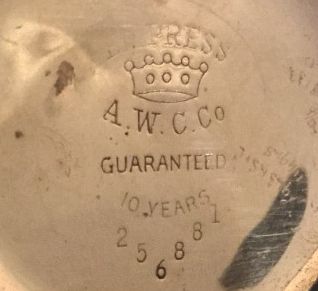
Canadian A. W. C. Co. "Empress" case
Image courtesy of and © John B., 2016.
Exports of Rolex watches to other countries were successful and Wilsdorf & Davis's overseas business thrived, apart from in the United States. Rolex Rebberg watch movements were supplied by Aegler, who also supplied the company of the brothers Frederick and George Gruen in the USA. Wilsdorf and the Gruen brothers were shareholders in Aegler and had seats on the board, which resulted in the agreement that Rolex watches with Aegler movements would be sold throughout Europe, Asia and the British Empire, which included Australia and Canada, whereas Gruen would sell watches with Aegler movements in the USA only.
The image here of the inside case back of a watch with a Rolex branded Aegler Rebberg movement shows trademarks of the American Watch Case Co. of Toronto, Canada. It's a gold filled ‘Empress’ grade case, the ‘10 years’ is how long the gold plate is guaranteed to last in normal use before it wears through. The Rebberg movement would have been shipped out to Canada as a bare movement and cased there. Gold filled cases are not hallmarked so unfortunately this case can't be dated from a hallmark, but the watch appears to be from around the time of the First World War. During the War Wilsdorf had gold cases made in England, see and my immediate thought is that this case was made in Canada for similar reasons, import duties during the First World War. It is currently in England, perhaps it was brought to Europe by a Canadian soldier during the First World War and sold, swapped or lost.
Wilsdorf made a couple of half-hearted attempts to enter the US market while the agreement with Gruen was in force by selling watches with non-Aegler movements. The first was a watch with a movement from the Fontainemelon factory that was sold through Abercrombie and Fitch, a high-end retailer of sportsman's equipment and clothing. This did not work out well, the watch was not heavily advertised and had a cheap, chrome plated base metal, version of the Oyster case. Wilsdorf would not allow the name Rolex to be used on watches that didn't have Aegler movements so it was branded "Abercrombie and Fitch Seafarer", not to be confused by a later watch with the same name made for Abercrombie and Fitch by Heuer. It appears that Wilsdorf's watch didn't appeal to Abercrombie and Fitch's wealthy customers and the venture flopped.
Some time later Wilsdorf was approached by Zell Brothers, jewellers headquartered in Seattle who had a chain of jewellery stores in the North West of the USA and Canada. Zell had been selling Rolex watches very well in Canada, particularly in Vancouver which is not far from Seattle just across the US/Canadian border. The Zell brothers asked to be the exclusive importer for Rolex in the North West of the USA and Wilsdorf agreed. Again, because of the agreement with Gruen, any watches that Zell sold in the USA could not have Aegler movements. Wilsdorf would not allow the name Rolex to be used on watches that didn't have Aegler movements so the watches sold by Zell in the USA were branded "Turtle Timer", not exactly an inspired choice. Although the watches were better made, with stainless steel cases, and Zell was more successful than the Abercrombie and Fitch venture, this was not a breakthrough into the US market for the Rolex brand.
In the 1930s Gruen stopped buying movements from Aegler and sold their shares in Aegler back to the family. Wilsdorf was finally free to introduce the name Rolex and watches with Aegler movements to the US market.
Back to the top of the page.
Prisoner of War Watches
Just before Christmas 1942, the Red Cross announced that the German High Command had agreed to let Rolex supply watches to British Prisoners of War held in German prison camps.
The prisoners had no means of paying for the watches, but Hans Wilsdorf stipulated that they did not need to pay at the time; all that was necessary was that they give their word as British Officers to pay when requested after the War. This act of trust was rewarded with hundreds of orders, which were duly delivered to prisoners in their prison camps by the Red Cross.
Only two per cent of the watches were not paid for, in many cases because the recipient died in captivity or before they received the bill.
Back to the top of the page.
Sponsor's Marks and Trademarks
Various marks appear on Rolex cases and movements. By tracking the evolution of these marks we can sometimes learn a bit more about the date of a watch. The earliest of these marks is the W&D mark in an oval surround with points top and bottom. This was first used as a sponsor's mark on gold and silver cases. From 1 June 1907 all gold and silver watch cases imported into Britain had to be assayed and hallmarked in a British assay office, and it was necessary for Wilsdorf and Davis to enter their details and a punch mark with the assay offices that they wished to use. This mark is also sometimes seen on watch movements. It seems likely that having created a unique mark for hallmarking purposes, Wilsdorf decided that it would also be used it to identify movements, strengthening the W&D brand identity.
The W&D sponsor's mark was superseded some time in the 1920s by "R.W.C.Ltd." The reason is not known, it perhaps indicates a more mature company stepping away from referencing the founder's names, and it also ties in with Wilsdorf's desire to promote the Rolex brand name. The R.W.C.Ltd. mark also seems to have been first used as a sponsor's mark for British hallmarking purposes, but then more widely used to promote brand identity.
Wilsdorf & Davis W&D Sponsor's Mark
W&D sponsor's mark
Until 1907 Wilsdorf & Davis imported gold and silver watches with Swiss hallmarks in their cases and under British law didn't require them to do any more. British law changed in 1907 and from 1 June 1907 all imported gold and silver watch cases were required to be assayed and hallmarked at a British assay office. Before items could be sent to an assay office for hallmarking it was necessary for a sponsor's mark to be registered. The sponsor is the person repsonsible for the item, who may not be its maker.
The sponsor's details to be registered with the assay office include a UK address and the sponsor's mark made by a punch used to identify each item that was sent in. This is the reason for the registration of the W&D sponsor's mark. The mark shown here with the initials W&D within a surround with round ends and points top and bottom was first registered at the London Assay Office on 25 June 1907. Wilsdorf and Davis were recorded in the register as importers of gold and silver wares. A second punch with the same mark was registered on 13 August 1907.

W&D on a Rebberg movement
Before watch cases could be sent to the assay office for hallmarking, the movements had to be removed and the empty cases stamped with the sponsor's mark by a registered punch. The registration of two punches on dates so close together indicates that the second punch was required to keep up with the volume of work rather than replacing a worn out punch, so Wilsdorf & Davis must have had at least two men working full time punching cases that were to be sent for hallmarking, and quite likely other workmen taking the movements out of the cases, and later putting them back into their cases after hallmarking.
The W&D mark was also entered at the Chester Assay Office on 6 April 1912. Two more punches with the same W&D mark were entered at the London Assay Office on 25 April 1915 and 25 August 1919. The same mark W&D mark was entered at the Glasgow Assay Office, but unfortunately the date is not found in the surviving records.
The following information is gleaned from Culme John Culme "The Directory of Gold and Silversmiths, Jewellers and Allied Traders, 1838-1914: From the London Assay Office Registers"
Publication Date: 15 Oct 1987 | ISBN-10: 0907462464 | ISBN-13: 978-0907462460
Two volumes; the first with 4,000 biographies, the second with photographs of 15,000 marks taken directly from the London Assay Office Registers at Goldsmiths' Hall.
. The partners in Wilsdorf & Davis were Hans Wilsdorf and Alfred James Davis. The address recorded at the registration of their punches was 83 Hatton Garden, later recorded on 1 November 1907 as moving to 85 Hatton Garden, EC1, then between 17 August 1912 and 25 August 1919 they are recorded at Stevenage House, 40-44 Holborn Viaduct, EC, where they are listed in 1913 as watch manufacturers and importers (TA: 'Wilsdorfs').
John Culme "The Directory of Gold and Silversmiths, Jewellers and Allied Traders, 1838-1914: From the London Assay Office Registers"
Publication Date: 15 Oct 1987 | ISBN-10: 0907462464 | ISBN-13: 978-0907462460
Two volumes; the first with 4,000 biographies, the second with photographs of 15,000 marks taken directly from the London Assay Office Registers at Goldsmiths' Hall.
. The partners in Wilsdorf & Davis were Hans Wilsdorf and Alfred James Davis. The address recorded at the registration of their punches was 83 Hatton Garden, later recorded on 1 November 1907 as moving to 85 Hatton Garden, EC1, then between 17 August 1912 and 25 August 1919 they are recorded at Stevenage House, 40-44 Holborn Viaduct, EC, where they are listed in 1913 as watch manufacturers and importers (TA: 'Wilsdorfs').
Wilsdorf & Davis are also recorded on 8 April 1915 at 15 Northampton Street, Birmingham, and also 3 Ruelle de la Fabrique, Bienne, Switzerland. They are recorded 25 August 1919 as having an office at 61 Rue Elfenau Gare, Bienne, Switzerland, in addition to their London office, and also as representatives of the Rolex Watch Co. Ltd. whose chairman was Hermann Aegler with Hans Wilsdorf and Alfred James Davis as directors and Harry Sedgley as secretary.
R.W.C.Ltd: Rolex Watch Company Limited

At some time the W&D sponsor's mark was superseded by the sponsor's mark “R.W.C.Ltd” incuse within an incuse oval surround. The dates at which sponsor's marks such as the W&D mark ceased to be used was decided by the company, is not recorded by the assay offices.
The first entry of this mark appears to be four punches with the sponsor's mark R.W.C.Ltd that were registered at the London Assay Office at Goldsmiths' Hall on 11 September 1923 by Hans Wilsdorf for the Rolex Watch Company Limited, 40/44 Holborn Viaduct, London EC.
The same R.W.C.Ltd mark was also entered at the Glasgow Assay Office, although the date of its entry at Glasgow is not recorded. The earliest Glasgow hallmark that I have seen in conjunction with the R.W.C.Ltd. mark has the date letter “a” for July 1923 to June 1924, so the Glasgow registration was most likely also entered in 1923, probably at around the same September date as the punches registered at the London Assay Office.
The instance of this sponsor's mark shown in the image here is in the case back of an early Rolex Oyster. The hallmarks below the sponsor's mark are Glasgow Assay Office import hallmarks for nine carat (·375) gold for the years 1927 to 1928 - Glasgow date letter punches were changed on 1 July each year after the election of new wardens at the end of June. Note that the RWC mark is the registered sponsor's mark, without which an item could not be hallmarked. The Rolex name beneath the hallmarks is a trademark, which is not required for hallmarking.
It seems likely that Wilsdorf registered the R.W.C.Ltd sponsor's mark in 1923 as part of his push to get the Rolex name and Rolex Watch Company more widely recognised instead of Wilsdorf and Davis. There would have been some marketing and brand recognition reason behind it, as Wilsdorf discusses in the Rolex Jubilee Vade Mecum, when he was also trying to get British retailers to accept the name Rolex on the dial, alongside or instead of their own.
Caution is needed with the initials RWC because the Replica Watch Case Company, the Roy Watch Case Company and the Rone Watch Company all entered marks with the same RWC letters. The precise form, shape and lettering of the mark are important to distinguish between these marks.
British and Irish Hallmarks
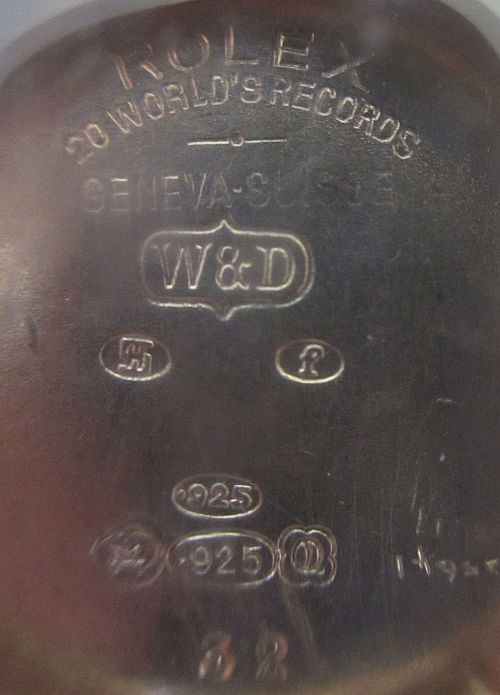
Both Glasgow and Dublin hallmarks: Click image to enlarge
Sometimes watch cases are seen with hallmarks from a British mainland assay office, and a second set of hallmarks from the Dublin Assay Office. The British hallmarks were struck first, the Dublin marks were struck later when the watch was imported into Ireland.
Before 1922 all of Ireland was part of the United Kingdom, and hallmarks struck in any UK assay office were valid throughout the realm. In 1922 the Irish Free State separated from the United Kingdom and formed the republic of Ireland. As a result of this separation, Irish hallmarks were not accepted in the UK after 1923, and UK hallmarks were not accepted in Ireland after 1927. Because of this, watches imported into Britain and hallmarked in Britain, if sent to Ireland, were then also assayed and hallmarked in Dublin. This could of course happen with any British assay office mark, but Glasgow Assay Office hallmarks are the ones most commonly seen alongside Dublin hallmarks.
This was confirmed to me in 2013 by Mr Le Bas, at the time Assay Master at the Dublin Assay Office.
This happened more than you might think at first sight, because many Swiss manufacturers and watch importers had offices in London, and held stocks of hallmarked watches in England. If a retailer in Ireland ordered a watch, it was sent from England and assayed and assayed and hallmarked again in Dublin before sale, so one watches with both British and Irish hallmarks are not too unusual.
This seems to have happened more with Rolex watches than any other brand. The picture here shows a Rolex case with Glasgow and Dublin hallmarks. The Glasgow marks are three below the W&D sponsor's mark; the Glasgow Assay Office import mark of two horizontal capital letters "F" facing each other, the date letter “f” for 1928/29, and the imported sterling silver standard mark of ·925 in an oval. Below these Glasgow marks the Dublin import hallmarks have been squeezed in straight line; the Dublin Assay Office import mark of a boujet or water bucket, the ·925 standard mark and the date letter “Q” for 1932/33.
Back to the top of the page.
Crown or Coronet

Rolex SAR

Rolex Coronet
Kathleen Pritchard says that the Rolex crown or coronet symbol with its five spikes tipped with balls or spheres was first used in an advertising campaign in 1925 and was registered later that year.
Rolex SAR
The mark shown here of the letters ‘SAR’ under a crown or coronet with seven points (rather than the five points of the Rolex trademark) is sometimes seen in the case backs of Rolex watches. This mark doesn't seem to be recorded anywhere. SAR might stand for "Société Anonyme Rolex".
The mark often appears along with the parachute trademark of Robert Meylan.
The legend ‘25 World's Records’ seen in the case back here was first used in 1928 (see below for more World's Records dates).
The crown or coronet symbol above the SAR has seven spikes tipped with balls or spheres, which is two more than the Rolex crown trademark.
Back to the top of the page.
Observatory Trials
Wilsdorf was a perfectionist and never ceased pressing Aegler to improve the timekeeping of watches they made for him. One of the areas of watch performance that Wilsdorf was very insistent on was gaining certificates of performance from independent testing establishments, usually astronomical observatories that, in the days before atomic time, were the sources of national time references.
Observatory trials were established in the nineteenth century to test and certify the performance of box chronometers used for ship's navigation and surveying, and were later expanded to test the performance of watches.
In England, box chronometers were tested at the Royal Observatory at Greenwich and the best performing were purchased by the Royal Navy. From 1884, separate trials of watches were carried out at Kew Observatory, moving to the National Physical Laboratory at Teddington, England, in 1913.
In 1910 Aegler submitted as its manufacture a Rolex wristwatch to the Bienne testing station at the School of Horology. On March 22nd 1910 this watch received a First Class certificate and thus became the first wristwatch to be officially certified in Switzerland.
Kew Class A Certificate
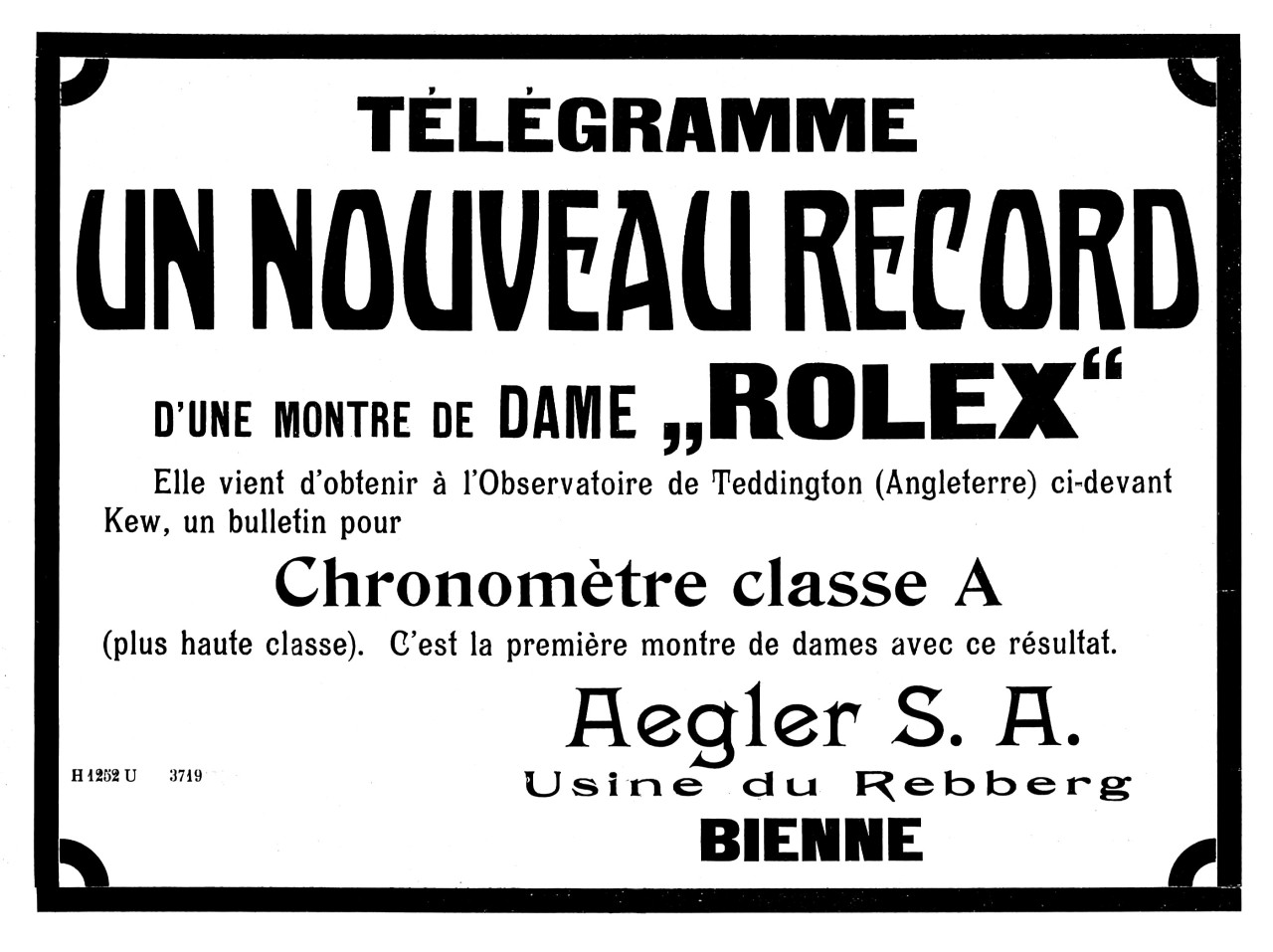
Aegler advert in 1914 announcing Kew A certificate: Click image to enlarge
On July 15th 1914, an 11 ligne (movement 25 mm diameter) Rolex wristwatch achieved 77.3 marks in the Kew trials and was awarded a Kew Class A certificate by the National Physical Laboratory. This was the first time that a Kew A certificate had been awarded to a wristlet watch and was a remarkable performance for such a small watch.
The watch was tested over 45 days from 1 June to 15 July in five different positions and three different temperatures. There are more details about the tests and results on the page about the Kew Watch Trials.
The result was triumphantly announced in the Swiss trade press by Aegler. The advert here was published on 18 July, only a few days after the Class A certificate was awarded. It is headed "Telegram", showing how the news was quickly communicated to Switzerland.
The full text reads;
A NEW RECORD FOR A ROLEX LADY'S WATCH
It has just been awarded a certificate for Class A Chronometer (highest class) at the Teddington Observatory (England), formerly Kew. It is the first ladies' watch to achieve this standard.
Aegler S.A. Rebberg Factory BIENNE
Wilsdorf said that this was a red letter day in the development of the firm, a day that he would never forget. The ability of a wristwatch to maintain accurate time keeping could no longer be doubted.
Wilsdorf made chronometer-level performance central to Rolex’s strategy, and asked Aegler to adjust all Rolex watches as if they were candidates for observatory testing. Aegler subsequently submitted Rolex movements for observatory trials in large numbers. Although only a small proportion of the total production of Rolex watches were actually tested, these served to demonstrate that the standard was being achieved and maintained.
The Rolex Vade Mecum erroneously states that the watch had undergone the same trials as ‘any large marine chronometer.’ Marine (box) chronometers were tested at Greenwich for the purposes of selection by the Navy, whereas watches were tested at Kew, and later Teddington.
One of the differences between the Kew and Greenwich tests was that box chronometers were not tested in different positions, because they were suspended in gimbals which kept them dial up at all times except when they were being wound. The Kew watch trials tested the performance of watches in different positions; dial up and down, pendant up, left and right, and at different temperatures.
During 1927 the Rolex Company obtained 288 Class ‘A’ Swiss observatory certificates for 10½ ligne watches and 135 for 8¾ ligne.
After this, in Britain at least, Rolex wristwatches from 5½ ligne to 10½ ligne could be ordered with Swiss observatory certificates at an extra cost of £3 3s. in addition to the usual retail price. This was a lot of extra money to pay for a piece of paper that didn't actually add much, because all Rolex watches were promoted as being of the same quality. It seems unlikely that many people bought a watch with a certificate, which explains why original certificates from this time are rare. Of course, at some time Rolex started to include certificates of performance with every watch sold.
In 1941 the Rolex Watch Company in Bienne received a letter dated 3 October from the Swiss Bureau Officiel de Contrôle de la Marche des Montres confirming a 9¾‴ chronomètre-bracelet No. 96717 had that day passed the test and become the 20,000th such Rolex watch to achieve this since June 1927.
Back to the top of the page.
Rolex World's Records
Rolex watch case backs sometimes have inside a reference to a certain number of ‘World's Records’. It is not known exactly what records these claims refer to, but advertisements generally imply that they were records for accuracy of timekeeping.
Observatories and other establishments carried out tests on the accuracy of timekeeping of watches over a number days in different positions and at different temperatures, and issued results as a number of marks; the higher the number of marks, the better the performance. If a watch passed a certain threshold number of marks, it would qualify to be awarded a performance certificate.
In Switzerland, chronometer trials were conducted at the astronomical observatories of Neuchâtel and, to a lesser extent, Geneva. In England, watches were tried at Kew Observatory until 1912, when the trials moved to the National Physical Laboratory at Teddington, although they were still usually referred to as Kew trials. Watches that performed to certain standards at one of these observatories were awarded ‘observatory certificates’.
The towns of La Chaux-de-Fonds, Bienne, Le Locle and St-Imier each had a bureau d’observation des montres (watch rating office), usually attached to the town’s school of horology. These provided local watchmakers with an accessible means of having the timekeeping of their watches evaluated. These offices issued ‘bulletins de marche’ (performance certificates) after tests that were shorter and less demanding than observatory trials.
Initially, these watch rating offices were called ‘bureaux d’observation des montres’. In 1912, they were officially renamed ‘bureaux officiels de contrôle de la marche des montres’, removing the word ‘observation’ so that their performance certificates could not be called observatory certificates.
Seven World's Records
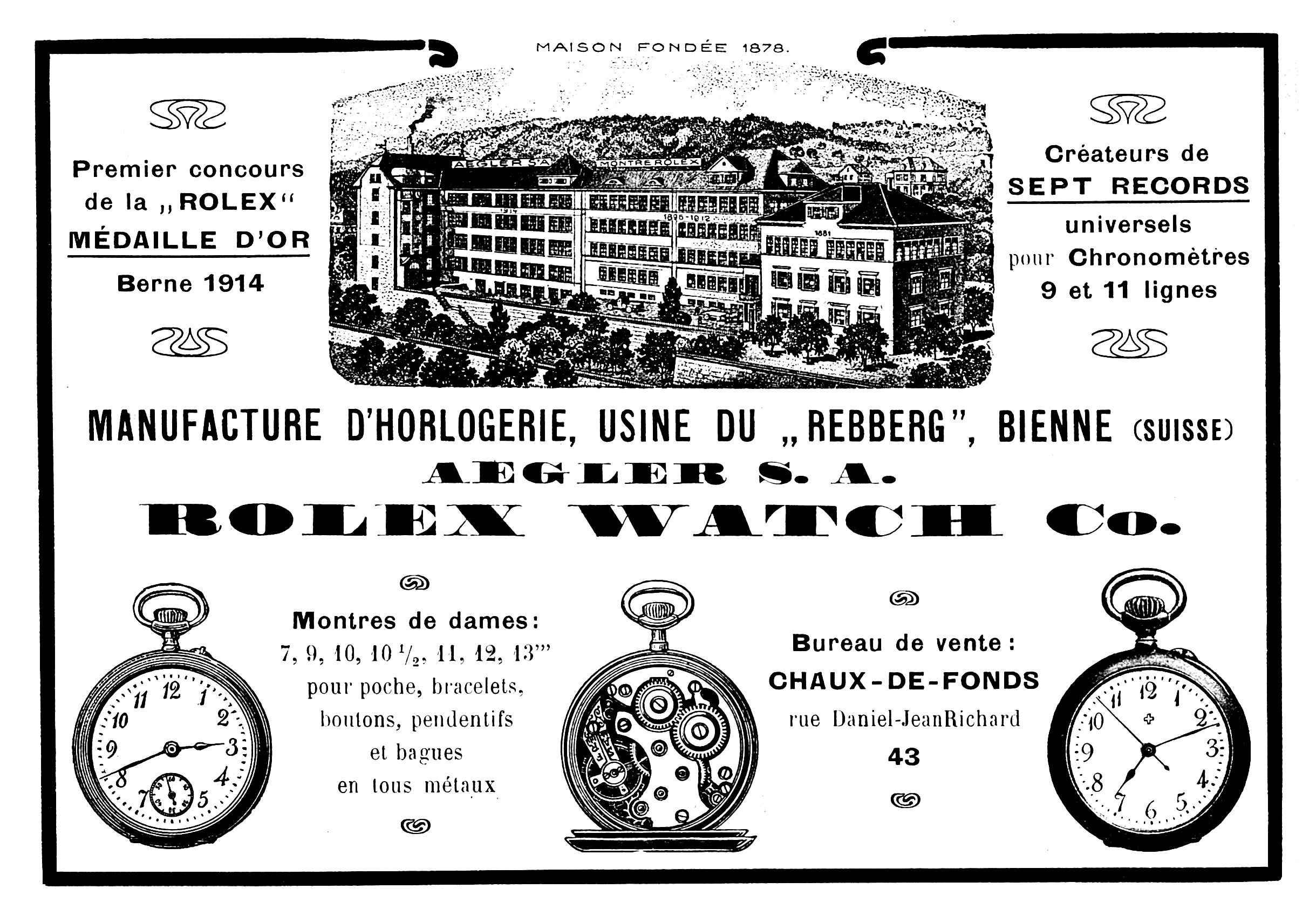
Aegler Advert from January 1915
Click image to enlarge
The first claim by Aegler and Rolex to a number of World's Records appeared in adverts in 1915. The first six of these can be identified from previous adverts as:
- March 1910. A performance certificate awarded to an 11-ligne watch by the Bienne bureau d’observation. This was not the first 11-ligne watch to be awarded a performance certificate, but may have been the first at the Bienne office.
- January 1913. A performance certificate awarded to a 9-ligne watch by the Bienne bureau d’observation. This was the first 9-ligne watch to be awarded a performance certificate.
- February 1913. A Kew Class B certificate awarded to a 9-ligne watch. This was the first 9-ligne watch to be awarded a Kew certificate of any class.
- March 1913. A Kew Class B certificate endorsed ‘Especially good’ awarded to a 11-ligne watch.
- December 1913. An bulletin de réglage chronométrique awarded by the Neuchâtel Observatory to an 11-ligne watch. This watch had passed the more stringent observatory trial and could be described, in Swiss terms, as a chronometer.
- July 1914. A Kew Class A certificate awarded to an 11-ligne watch.
It should be noted that not all Rolex watches entered at Kew passed the trial. On 3 January 1913, three 11-ligne bracelet watches were submitted for trial by Wilsdorf & Davis for the Rolex Watch Co. The first of these was entered for the Class A trial but did not pass. The second and third were entered for the Class B trial. The mainspring of one failed on 4 January, the second day of the trial. The other completed the trial but did not pass. The 11-ligne watch that was awarded a Class A certificate in July 1914 had been entered along with another in early 1914, when neither passed.
It is known that some of the watches entered for trials were regulated by Edouard Lüthi-Hirt, a professional ‘regleur’ (watch adjuster) working in Bienne, whose company also made tools for watch regulators. This use of an independent watch adjuster when high marks in trials were wanted was common practice amongst watch manufacturers, English as well as Swiss. Ordinary Aegler production watches were not adjusted to such a high degree at the time.
The nature of the seventh record is more difficult to pin down. The first advert claiming ‘Sept Records Universels’, which became Seven World's Records in English, was published by Aegler in January 1915. This advert contains the statement ‘Premier Concours de la Rolex Médaille d'Or, Berne 1914’ (First Rolex competition gold medal, Bern 1914). Since this was a ‘first’, it is plausible that this was the seventh record claimed.
Twenty World's Records
The published results of the Kew watch trials don't record any absolute records being set by Rolex watches, but the report in 1928 of the 1927 trials says
Another noteworthy result this year has been the award of a ‘Class A, especially good’ certificate for the 10¾ × 6¾ lignes (24 X 15mms.) rectangular bracelet watch sent by Messrs. The Rolex Watch Co., Bienne, which gained a total of 86.5 marks.
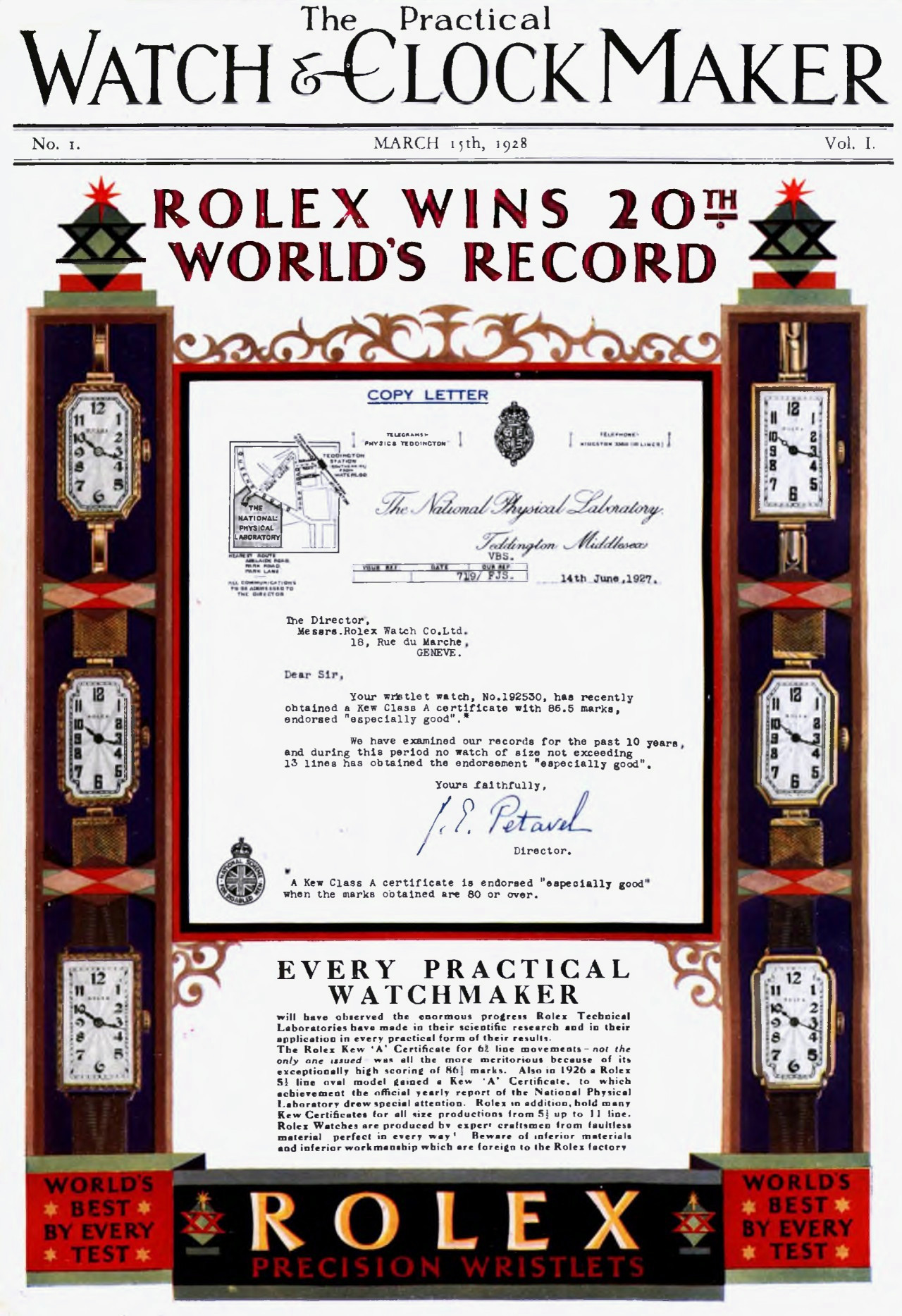
Rolex 20 World's Records: Click image to enlarge
This is the event that Rolex advertised in 1928 as their 20th World Record. The watch had a 6¾ lignes movement measuring 15 by 24 millimetres and it was remarked in the letter communicating the results to Rolex that over the preceding 10 years no other watch of 13 lignes or smaller that had received a Kew Class A Certificate had been endorsed as ‘especially good’.
It appears that the World's Records claimed are not absolute records - the two Rolex watches entered by Aegler in the 1927 trials were placed in 31st and 39th positions - but rather records of accuracy for watches of their particularly small sizes. The achievement of a Kew Class A certificate endorsed especially good by a movement measuring only 15 × 24 millimetres was certainly a remarkable achievement. A later Rolex advertisement says that ‘No Wristwatch from 11-line down to 5½-line has at any time obtained a Kew Class A Certificate excepting the Rolex.’
An advert by Rolex in 1928 said ‘The Rolex factories have specialized in the production of small-sized movements since 1878, and the Twenty World’s Records which their movements have gained prove that they have attained to a position of pre-eminence, and constant research and experiments in the laboratories ensure that they will retain that supremacy. ‘The World’s Best by Every Test’ is no mere advertising slogan, but the essence of accomplished fact. Many hundreds of Observatory Quality 10½ and 8¾ line movements have been produced during the last few months. Each and every one of them obtained an individual Swiss Official Class ‘A’ Rating Certificate, proving that Rolex claims to unusual precision are founded as much on a generally superior method of production as on their World’s Records.’
Dating World's Records
The number of world's records claimed increases in steps from seven to thirty one. Knowing when the increment occurred can help to identify approximately when an otherwise undated watch was made.
World's Record stamps can be used to establish approximately the earliest possible date for a case, but not the last. Old punches could continue to be used, or cases not be used until some time after they were made.
By studying dozens of case backs with British hallmarks, the approximate dates when the increments of World's Records occurred. Until 1975, the date letters of hallmarks cover a two year period, British assay offices changed their date letter punches when new wardens were elected, part way through the calendar year. At the London Assay Office this was at the end of May, for most other offices it was the beginning of July.
- No claims to World's Records have been seen in Rolex watch case backs hallmarked before the 1923/24 hallmarking year.
- 7 World's Records: The earliest evidence seen for this claim is an advert from Janusry 1915. However, as noted above, it does not appear to have been stamped into Rolex case backs until 1923 or 1924.
- 16 World's Records: Earliest evidence seen is an advert dated 14 July 1926. There is some overlap between the hallmark dates of cases marked 7 and 16 World's Records, an 18 carat gold case has been seen with 7 World's Records and Dublin Assay Office hallmarks for 1928 to 1929.
- 20 World's Records: This refers to an Aegler Rolex wristwatch with a 6¾ ligne movement that in June 1927 was awarded a Kew Class A certificate endorsed ‘especially good’ for achieving 86.5 marks in the trials. There is some overlap between the hallmark dates of cases marked 16 and 20 World's Records. Cases stamped 20 World's Records have been seen with Glasgow Assay Office hallmarks for 1932 to 1933.
- 22, 23 and 24 World's Records:An advertisement dated September 1928 says ‘The Rolex Watch Co., Ltd. beg to announce their World's Records Numbers 22, 23 and 24 obtained in quick succession ...’
- 25 World's Records: Earliest evidence seen is an advert dated 1 December 1928.
- 27 World's Records: Earliest evidence seen is an advert dated 10 December 1931.
- 31 World's Records: Earliest evidence seen is an advert dated 22 October 1937.
- 34 World's Records: A single instance of a case stamped 34 World's Records has been seen, dated to around 1941, although the first use was most likely earlier than this date. No advertisements have been found with this claim. Further evidence is sought.
Back to the top of the page.
Patents
The Rolex Watch Company and its suppliers have taken out many patents over the years. There are far too many to list here, so this section discusses aspects of some of the more obscure but still interesting ones.
CH 97101: Mécanisme de Remontoir et de Mise à l'Heure
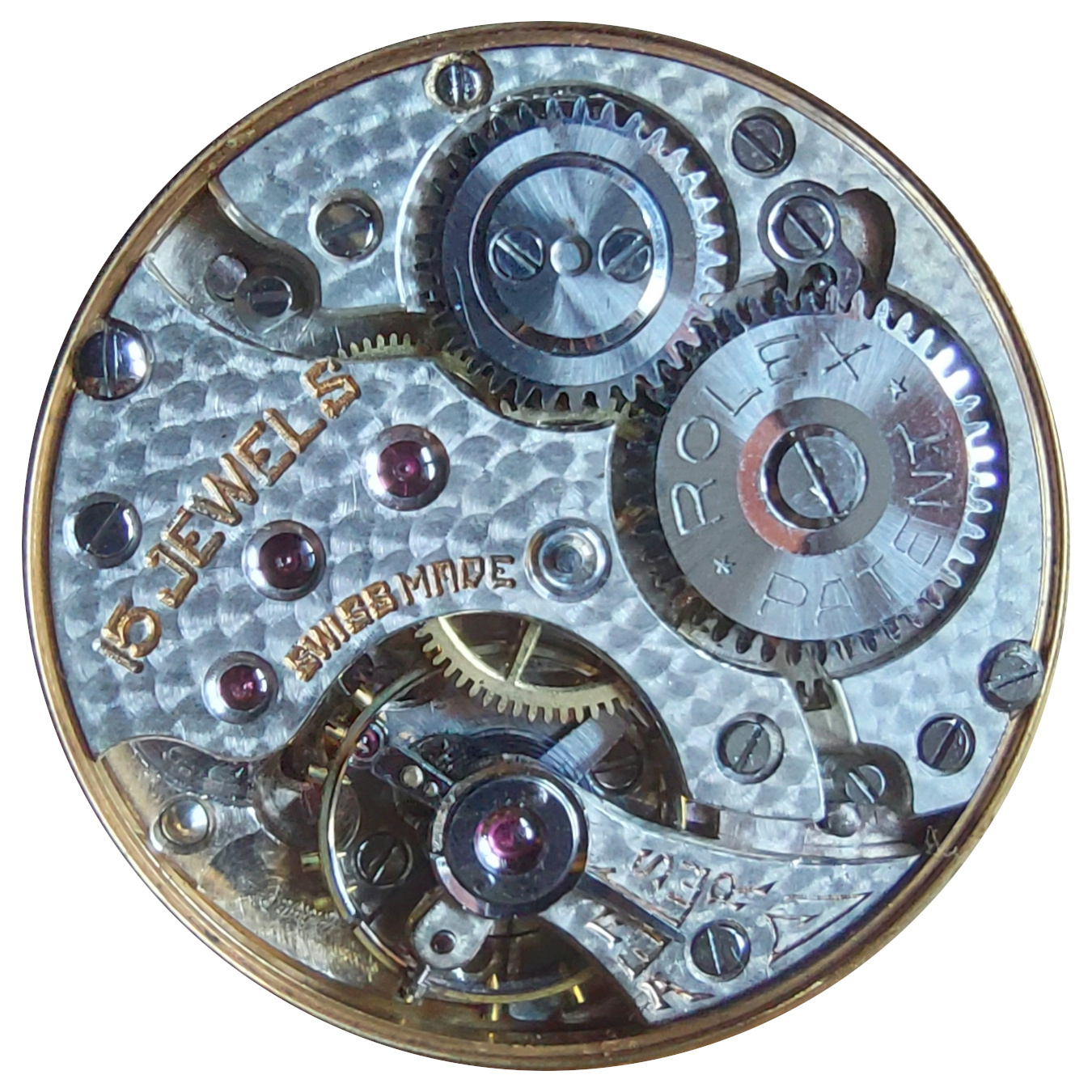
Aegler Movement with Patent CH 97101 Crown Wheel: Click image to enlarge
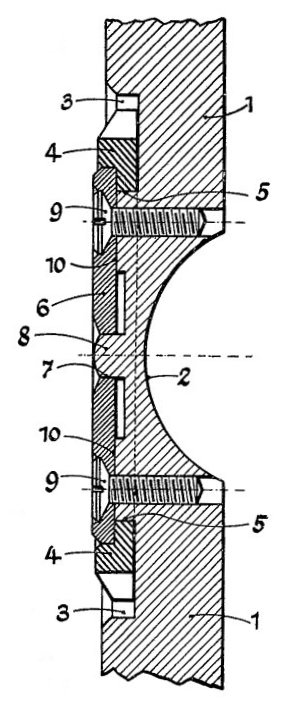
Detail from Aegler Patent CH 97101: Click image to enlarge
Some Aegler movements used in Rolex watches carry the number 97101. This refers to Swiss patent N° 97101, Mécanisme de Remontoir et de Mise à l'Heure, application date 2 August 1921 granted 1 December 1922.
The patent was applied for by, and granted to, Aegler S.A. Rolex Watch Co., Bienne (Suisse). This shows that the patent was actually granted to Aegler, not to Rolex.
The subject of the patent was an improvement to the way that the crown wheel of the keyless work is attached to the barrel bridge.
Referring to the photo here of an Aegler movement, the crown wheel is the smaller of the two winding wheels at the top of the photo. This is the wheel that is turned by the winding pinion on the stem during winding, and it turns the larger ratchet wheel, which is attached to the barrel arbor.
The crown wheel is usually attached to the barrel bridge by a single central screw, which often has a left-hand thread so that it does not unscrew during winding if the crown wheel binds to it. Sometimes the crown wheel turns directly about this screw, sometimes there is a steel core that remains stationary during winding.
The patent points out that the part of the barrel bridge on which the crown wheel is mounted is thin, because of the recess cut in the underside of the bridge for the winding pinion. This recess is labelled 2 in the figure from the patent reproduced here. In the usual arrangement, a threaded hole for the central screw is made at the location labelled 8.
In the patented design the crown wheel is held onto the bridge of the movement by means of a fixed central core, but this is not an original invention; crown wheels with fixed central cores like this were made in the nineteenth century, so on its own this would not justify a patent being granted.
The novel idea of this invention is that the crown wheel core is attached to the bridge by two screws labelled 9. These are offset from the centre of the crown wheel, so that the threaded holes for these screws are made in parts of the bridge that are much thicker than the central location.
The photograph here shows an Aegler Rebberg movement with this patented crown wheel at the top with two screws. The ratchet wheel carries the legend ‘Rolex Patent’, although the patent was actually granted to Aegler.
On 21 April 1923, Aegler licensed this patent to Frey & Co. S.A., Montres Freco, and Gruen Watch Mfg. Co. S.A.
Superbalance
Some Aegler movements used in Rolex watches have the words "Patented Superbalance" on the ratchet wheel. This refers to the type of balance shown in the image here, reproduced from Swiss patent CH196706. The patent was granted to Manufacture des Montres Rolex, Aegler Société Anonyme, Bienne (Suisse). This shows that the patent was actually granted to Aegler SA, not to Rolex.

CH196706 Patent Superbalance
The application for the patent was submitted in August 1936, but the words "Patented Superbalance" would only be used after the patent was actually granted, which was in March 1938.
The subject of the patent was a balance with the screws recessed into its rim as shown in the figure from the patent reproduced here.
It is sometimes said that the purpose of recessing the screws into the rim was to make the balance more streamlined, thus reducing air resistance. This was not in fact the principal objective of the design, although one of the six claims does say that the walls of the recesses are convex in order that their shape is advantageous from an aéro-dynamique point of view. Having worked in a fluid flow laboratory I can say that the effect of this would be, at best, negligible, and that the turbulence-inducing recesses might actually increase air resistance. It's a moot point. However, the main text makes it clear that aerodynamics were not the main purpose of the design.
The principal objective of the Superbalance was to make maximum use of the space available for the balance, especially within a small calibre wristwatch movement. By recessing the screws into the rim of the balance, or in effect growing the rim of the balance outwards so that it extended past the base of the screws, the radius of gyration of the balance could be made greater than that of a balance with a plain rim and screws sticking out.
Inertia is the resistance of a body to any change in its speed or direction of motion. The moment of inertia, also called the rotational inertia or angular mass, determines the torque needed for angular acceleration about a rotational axis. In a watch oscillator comprised of a balance and spring, the moment of inertia plays an important role in determining the period or frequency of oscillation. The period \(T\) of oscillation of a sprung balance is given by the equation:
\[ T=2\pi\sqrt{\frac{I}{S}} \]where \(I\) is the ‘moment of inertia’ of the balance, and \(S\) the turning force produced by the balance spring.
The moment of inertia is determined by the product of the effective rotating mass of the balance ‘m’, which as an approximation can be thought of as the mass of the rim, and the square of its radius of gyration ‘k’, which is the radial location of the effective mass and is approximately the radius of the rim as shown in red on the figure. The moment of inertia is given by:
\[ I = mk^2 \]The Superbalance, with a radius of gyration greater than that of a plain balance which occupied the same space, could be made to have either a higher moment of inertia than a plain balance of the same mass, which would require a stronger balance spring, or a lower mass whilst maintaining the same moment of inertia. Reducing the mass of a balance whilst maintaining the same moment of inertia is beneficial because it keeps its natural frequency the same whilst reducing the loads on the balance staff pivots, which reduces friction.
Back to the top of the page.
Rolex Watch Cases
Rolex watch manufacturers used cases from a variety of case makers. The most famous of these was C. R. Spillmann SA who made the cases for the early Rolex Oysters as well as other Rolex watches, and was eventually taken over by Rolex. Another was the Dennison Watch Case Company of Birmingham, England, who made gold cases for Rolex watches sold in Britain to avoid high import taxes.
This section documents some lesser known aspects of Rolex watch cases.
English Made Gold Cases

English B&S gold watch case for Rolex: Click image to enlarge.
Image courtesy of and © John B, August 2016.
In addition to Dennison, Wilsdorf also used other English case makers to make gold cases for watches sold in Britain.
The image here shows a gold case made by B H Britton & Sons; Charles Henry Britton, Walter Britton and Herbert Britton, of 35 Hockley Hill, Birmingham, England.
The sponsor's mark B & S was first entered at the Chester Assay Office in 1912. The registered sponsor's mark shown here, an incuse B & S with a double circle surround, was first registered at the Chester Assay Office in May 1931.
The hallmarks in this case are Chester Assay Office marks for a nine carat gold item made in Britain. Imported items were given different import hallmarks. The date letter "J" is for 1959 to 1960, showing that the trend for having gold cases made in England that started in 1915 continued long after the First World War, and after the Second World War.
Dennison Cases
During the First World War, the British Government introduced various taxes and restrictions on imported items. Initially, in September 1915, a tax of 33⅓% was imposed on imported luxuries, including clocks and watches. In November 1916, the importation of jewellery and all manufactures of gold and silver other than watches and watch cases was prohibited. This was extended in December 1916 to prohibit the importation of gold watches and gold watch cases for the remaining duration of the war.
The import tax on watches in silver cases was uncomfortable but bearable, particularly as there was a huge demand for wristwatches from newly commissioned officers, so increasing prices was not much of a problem. But the outright ban on gold watches could not be got around. As a result, Rolex looked for a British case maker to make gold cases and found the Dennison Watch Case Company of Birmingham. This started a practice of having gold cases for Rolex watches manufactured in England by Dennison. Swiss watch movements were imported bare and cased in England.
Back to the top of the page.
Robert Meylan
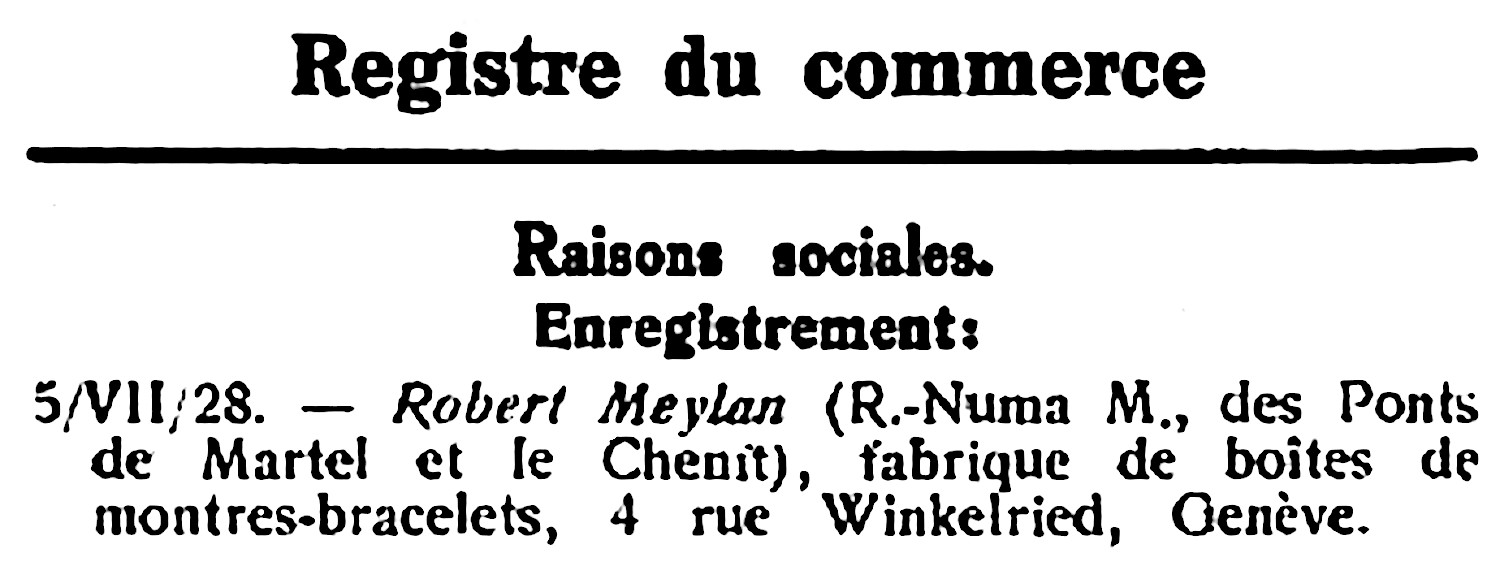
Robert Meylan registration 1928
Click image to enlarge
The company Robert Meylan, a Geneva based watch case manufacturer, was first registered on 5 July 1928.
The registration details say that Robert Meylan specifically manufactured wristwatch cases – boîtes de montres-bracelets. The address of the company is 4 rue Winkelried, Geneva.
The registration also gives R.-Numa M, des Ponts-de-Martel and le Chenit in brackets. This means that the company Robert Meylan was legally domiciled in Geneva, but carried out case manufacture through workshops or subcontracting in La Chaux-de-Fonds (Rue Numa-Maire), Les Ponts-de-Martel, and Le Chenit.
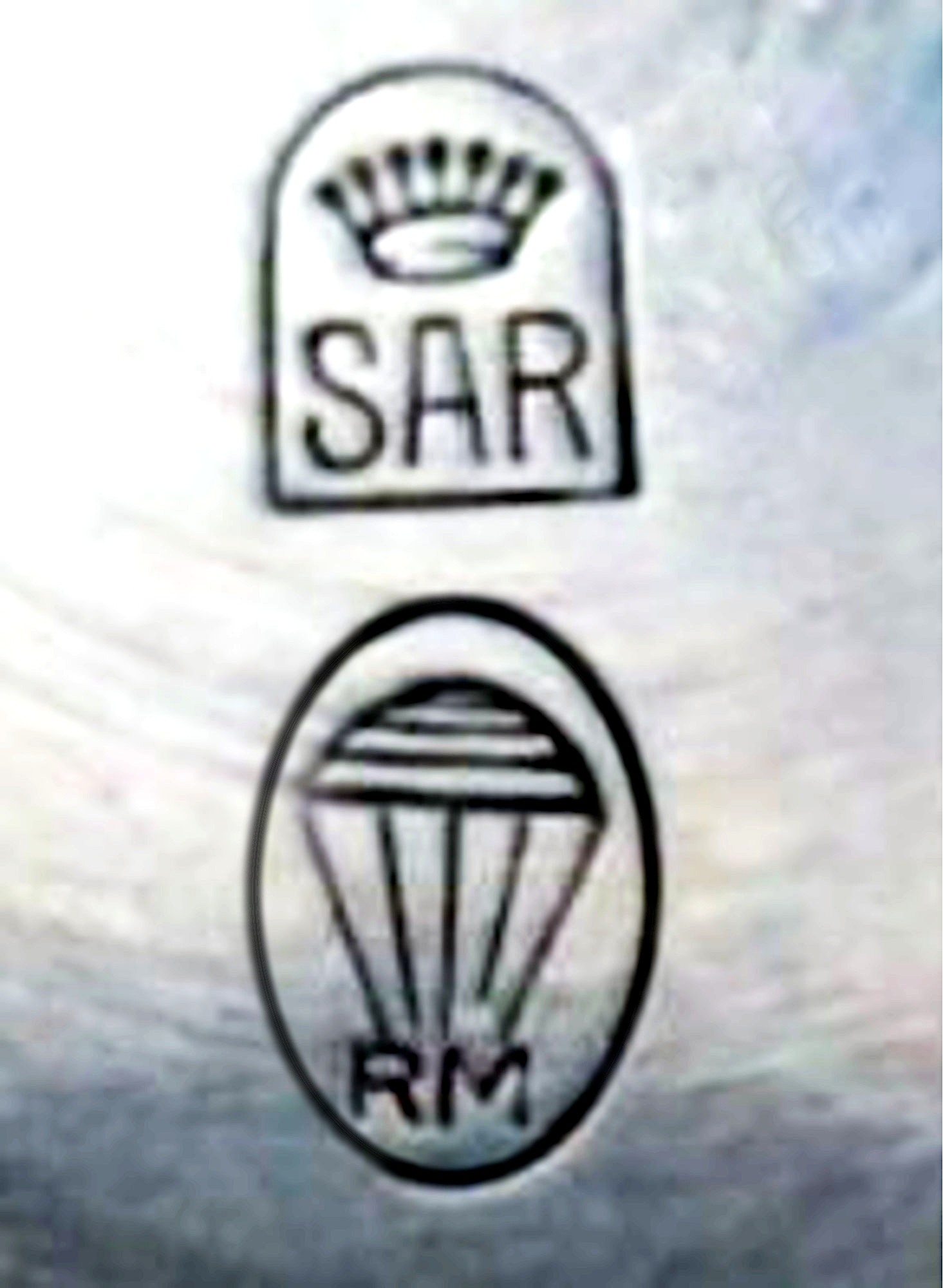
SAR with Robert Meylan parachute trademark
Click image to enlarge
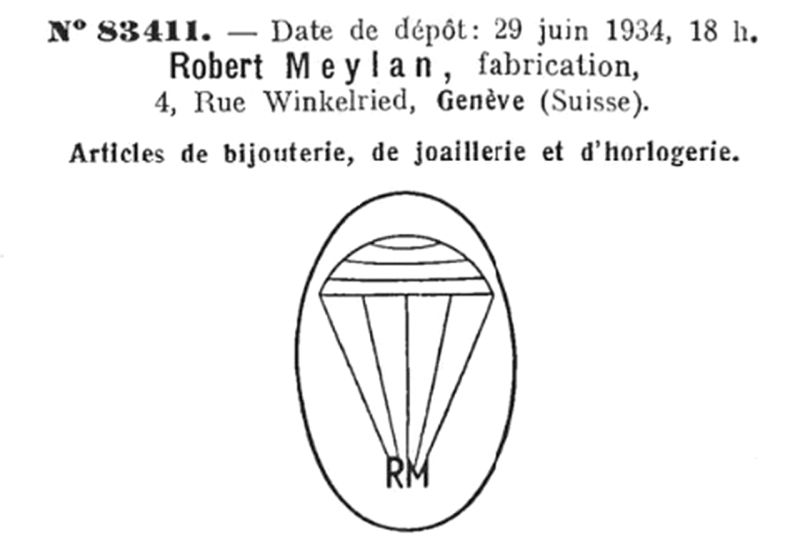
Robert Meylan parachute trademark
Click image to enlarge
Robert Meylan trademarks
Robert Meylan registered the trademark of a parachute carrying the initial ‘RM’ on 29 June 1934.
The registration includes articles of joaillerie and bijouterie, which both translate to ‘jewellery’ in English. In French, joaillerie refers to jewellery featuring precious metals and gemstones, while bijouterie covers less expensive jewellery made from materials including base metals, plastic and glass, which is called ‘costume jewellery’ in English.
Meylan specialised in gold watch cases, but the trademark is frequently seen in stainless steel watch cases. These required specialised techniques to produce, involving a lot of capital expenditure on powerful machinery. Not many companies made both gold and stainless steel cases because the cost of the raw materials and the manufacturing techniques were so different.
The parachute trademark is also frequently seen accompanied by the trademark of the letters ‘SAR’ beneath a crown with seven points. This mark looks somewhat like the crown trademark of Rolex, but that has five points and there is no record of Rolex registering or using the crown with seven points.
The association of the crown with seven points and the letters SAR suggests that this trademark might have been registered by Robert Meylan, but no record of such a registration has been found.
Robert Meylan's Poinçon de Maître
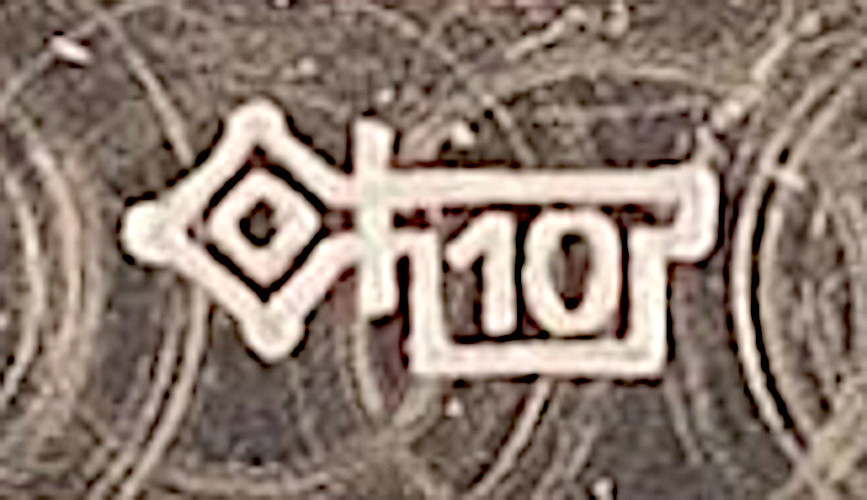
Robert Meylan's Poinçon de Maître PdM 5/10
Click image to enlarge
Robert Meylan's company was entered onto the central database of Poinçons de Maître of Swiss watch case makers on 8 September 1934 with registration number 10 in the list PdM5, the Key of Geneva, the symbol for gold, platinum and palladium watch cases of thickness 0.3mm or greater made in Geneva. Note that this was the date that the registration was entered onto the central database; it is almost certain that Meylan was registered before the centralisation took place, most likely from the founding of the company in 1928.
Although the PdM 5 Key of Geneva mark was defined as being for gold, platinum and palladium watch cases, Meylan's mark PdM 5 /10, that is the Key of Geneva with the number 10 on the lever, is seen stamped on stainless steel and Rolesium cases. This was not supposed to happen, but Meylan was evidently not someone who respected rules and regulations.
Thanks to John Goldberger, I have seen a Rolex case made by Robert Meylan in sterling 0·925 silver. This case doesn't carry a Poinçon de Maître. Although the system of Poinçons de Maître included provision for marking silver cases, very few have such marks. It was evidently only gold and platinum cases that the authorities were particularly keen to see marked.
Robert Meylan Patents
Robert Meylan was granted three Swiss patents for watch cases in 1932/33 :
- CH 153544 : Boîte de montre. Priority date 21 February 1931, Published 31 March 1932. A water resistant watch case with screw back and bezel that screwed onto a threaded carrier ring, clamping the outer part of the case between them. Very similar to the original Oyster case, which itself was very similar to a 1903 Borgel screw case.
- CH 161355 : Boîte de montre étanche. Priority date 28 April 1932, Published 30 April 1933. A water resistant watch case with the bezel and middle part made in one piece, the movement held in place by a spring under a screw back, very similar to the Taubert Decagonal Case patented in 1931.
- CH 163946 : Boîte de montre hermétique. Priority date 16 November 1932, Published 15 September 1933. A water resistant watch case with the bezel extended through the middle part of the case and a screw back, clamping the middle part of the case between the extended bezel and back.
None of these patents were particularly original and shouldn't have passed the ‘prior art’ test as new inventions.
The first Oyster cases were made by C. R. Spillmann & Co, before the company Robert Meylan was founded. However, many Oyster cases from the 1930s were made by Robert Meylan.
Burglary at Rolex
On the night of 25 July 1938, two men broke into the workshop of Rolex in Geneva on the fifth floor of No. 18, du passage du Terraillet, a passage between Rue de la Rôtisserie and Rue de Marché, and stole 100,000 Swiss francs worth of gold and platinum watch cases.
Rolex had offices on the third floor and a large workshop on the fifth floor. The burglars attempted to break into the third-floor offices, where many finished watches were stored in safes, but the locks held. They then went to the fifth floor and easily broke into an architect's office. From there, they broke through a sliding partition separating the architects' offices from the Rolex workshop. They ransacked the workshop, discarding all the plated watch cases and selecting only those of solid gold or platinum.
In February 1939, Robert Meylan was arrested in connection with this burglary, which he confessed he had carried out with Yves Le Gallou, a notorious French criminal wanted in France for fraud amounting to 500,000 francs carried out in Tahiti, identity theft, and draft evasion.
Meylan admitted to having melted down, in his own factory, the greater part of the watch cases stolen from the Rolex Watch Co, which was his main client. It was revealed that an ingot mould had been brought into the workshop so that the watch cases, which would easily be recognised, could be turned into anonymous ingots and thereby sold.
Robert Meylan was held at Saint-Antoine prison. A few days after his arrest, he informed Mr. Foex, the investigating judge, that the remaining stolen jewellery that had escaped being melted down had been buried near the Chalet de la Dôle by Yves Le Gallou, with the intention of retrieving it later. A first expedition was organized on 24 February, but heavy snowfall frustrated it. A second, better equipped, expedition managed to reach the site despite the heavy snow.
Police officers, equipped with shovels, cleared the snow and then, with pickaxes, excavated the ground. After an hour and a half of effort, they found some gold watch cases buried nearly a metre deep. They eventually retrieved about fifteen kilos of gold and platinum, representing thousands of watch cases, some with their movements still intact, and numerous platinum pieces set with diamonds.
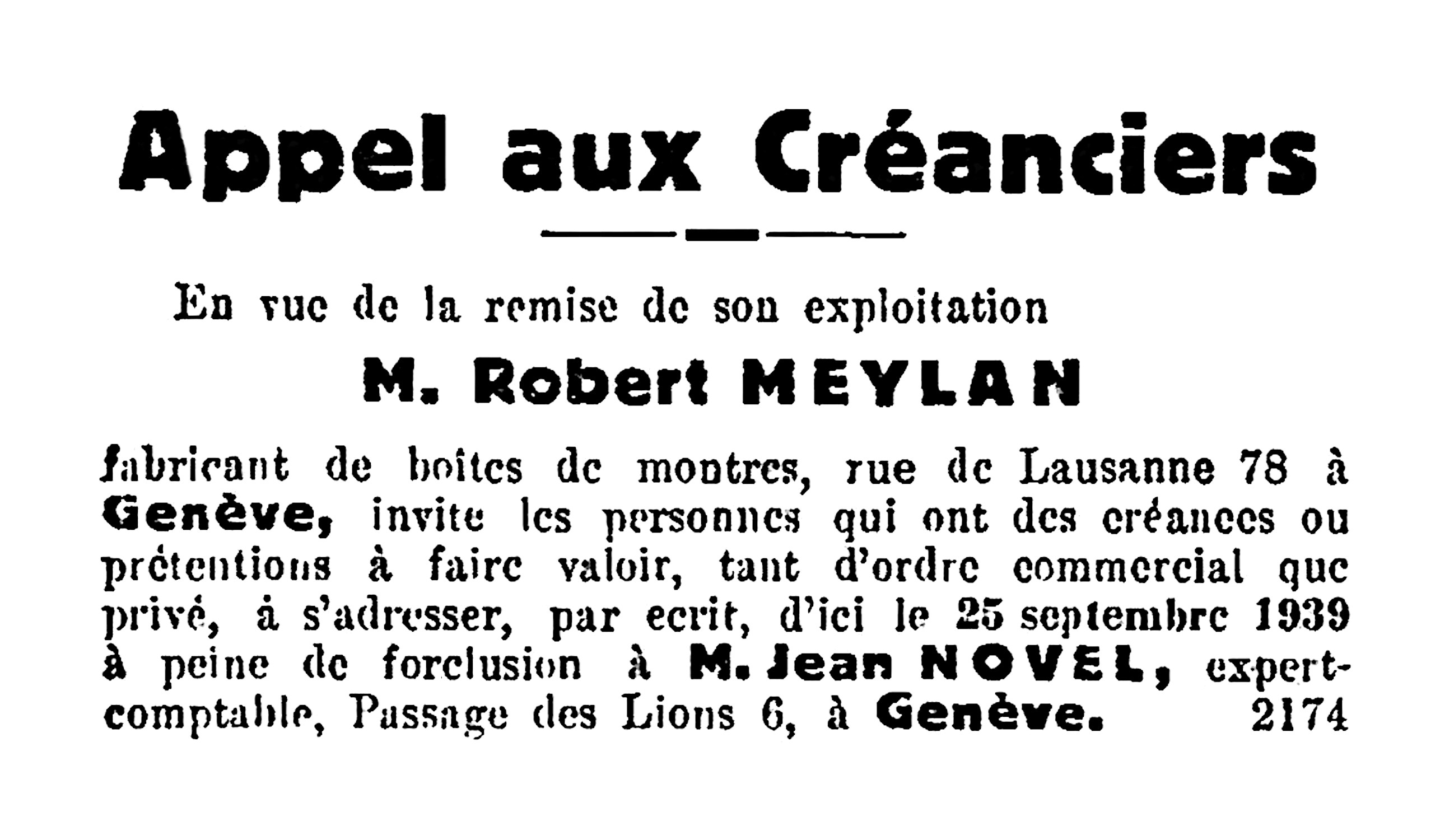
Robert Meylan Notice to Creditors
Click image to enlarge
At a subsequent appearance before the investigating judge, Robert Meylan learned, to his considerable astonishment, that a safe deposit box he owned at a financial institution in Lausanne had been opened and that 25,000 francs in gold coins and platinum plates worth 23,000 francs had been found inside. ‘That's my savings,’ he coldly declared, adding that he certainly hadn't declared this ‘nest egg’ to the tax authorities!
During one of the hearings, Hans Wilsdorf was praised for keeping the Meylan factory working and maintaining the jobs of the employees.
The company Robert Meylan, then at 78 Rue de Lausanne, Geneva, closed down operations and called in creditors in September 1939. The notice reproduced here is a call to all creditors to submit claims, ‘In view of the transfer of his business’.
Genex S.A.
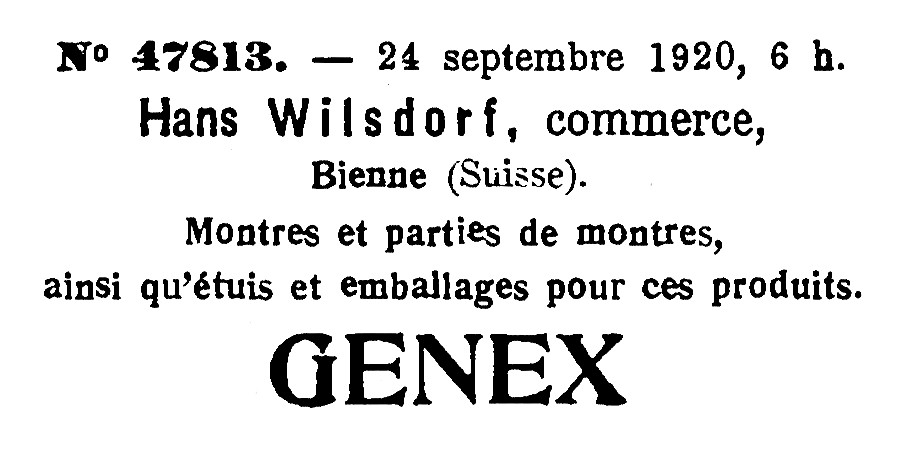
Registration of Genex, September 1920
Click image to enlarge
In February 1940, a new company, Genex S.A., was registered with the purpose of manufacturing watch cases of all kinds, jewellery items and all related business. Hans Wilsdorf had registered the name Genex in September 1920 for watches and watch parts, as well as cases and packaging for them.
Genex S.A. was formed with the explicit purpose of taking over the operation of Robert Meylan's workshop, located at 78 Rue de Lausanne, Geneva, and the assets specified in an inventory dated 30 September 1939.
The first board of directors of Genex consisted of the brothers Jean and Noël Gay, and Hans Wilsdorf. Jean Gay was appointed president and managing director, Hans Wilsdorf, secretary, and Noël Gay, director. The Company address was 18, Rue du Marché (office of M. Fernand Lilla, lawyer), the registered address of Montres Rolex S.A.
On 28 February 1940 the Meylan patent No. 161355 ‘Boîte de montre étanche’ was sold to Montres Rolex S.A., the transfer of title was registered on 9 April 1940.
On 12 January 1943, the registered office of Genex S.A. was transferred to 12, Rue des Glacis de Rive, the address of Gay Frères, the chain and watch bracelet maker.
Although the formation of Genex has been seen as a move towards vertical integration by Rolex, taking case making in-house, Hans Wilsdorf resigned from the board of directors of Genex on 30 October 1945. Werner Ryser was appointed member and secretary of the board of directors. In December 1945, Charles Gygax was given joint power of attorney. In January 1952, Charles Gygax was appointed sole director of Genex.
Robert Meylan's company registration was struck off the list of Poinçons de Maître on 29 June 1940 following the dissolution of the company. The registration number 10 for PdM5, the key of Geneva, (PdM 5/12 ) was reassigned to the Union Suisse pour l’Habillage de la Montre (USH), the name shown in the current list. On the same date, Genex S.A. was assigned the PdM5 registration number 12 (PdM 5/12).
The company of Robert Meylan was struck off the official list of Swiss registered companies on 11 April 1940.
Many Genex branded watches, particularly from the 1950s-60s, are fitted with movements from A. Schild (AS). It is widely believed that Rolex sold the Genex brand to A. Schild in 1933. However, the Genex trademark was renewed by Montres Rolex S.A. in 1940 and 1960, so that is not the complete story.
Back to the top of the page.
G. Pf. & Cie

Case marked G. Pf. & Cie: Click image to enlarge
The case back in the photograph here was advertised as part of an incomplete lady's Rolex wristwatch. Thanks to Gerhard for bringing it to my attention and for identifying G. Pfund & Cie as the case maker.
The watch movement is a 15 jewel Aegler Rebberg, with Rolex on the ratchet wheel with a single star, which is usually found only on 7 jewel movements; 15 jewel movements usually have 15 Jewels alongside Rolex on the ratchet wheel.
The case has fixed wire lugs. The watch probably dates to between about 1910 and 1920.
The case back is marked for 0.800 fineness silver and has the Swiss capercaillie hallmark for this standard.
The incuse mark G. Pf. & Cie within a rectangular surround was registered by G. Pfund & Cie, a watch case maker in Madretsch, which in 1920 became part of Biel/Bienne.
There is also an incuse capital letter A within a circle. This is usually recognised as a trademark of Alpina. It began as the mark of Alliance Horlogere, which was first registered in 1910 for small watches and cases. So it appears that G. Pfund & Cie. was a member of the Alliance Horlogere when the watch case was made.
It is unusual for a Swiss watch case maker to be identified in this way, by a trademark in the case back.
G. Pfund & Cie were one of the first watch case manufacturers to advertise chromium plated watch cases in 1928.
Snowite Cases

Oyster Watch Co. Case Back: Click to enlarge.

Snowite 20 years
Image courtesy of and © Heritage Auctions
Some Rolex Watch Co. watch cases, most them not branded as Rolex watches but with other brands such as Unicorn and Wintex, are stamped in the case back "Snowite". Some are stamped "Snowite Guaranteed to Stay Blue White". The name Snowite was registered by Hans Wilsdorf in Switzerland in February 1927.
Snowite was chrome plate over a base metal. Some people think the base metal was nickel but James Dowling told me that it was a zinc compound like Zamak or Mazak. These alloys can be formed into shapes by high pressure die casting, where the molten metal is injected into a steel mould and allowed to solidify under pressure before it is ejected. This allows a lot of identical shaped components to be produced very quickly and cheaply. The zinc alloys have a dull grey appearance and are not corrosion resistant so they are usually plated, most often with chromium.
The first commercial process for chromium plating was developed in 1924 in America and the 1927 registration of Snowite means that Rolex were one of the first companies to use it on watch cases. The 1920s economic depression that resulted in the Wall Street crash of 1929 meant that manufacturers were looking for cheaper but still eye catching alternatives to gold and silver. Stainless steel was introduced in the 1930s for the same reason
The case back in the picture here says "Snowite: Guaranteed to stay pure white for 20 years". This refers to the thickness of the plating, it won't wear through and show the base metal for at least twenty years in "normal use".
The second image shows the case back of an ‘Oyster Watch Co.’ watch made from the injection moulding zinc alloy. This is a very poor quality material and, although it is chrome plated, the back very heavily pitted on the outside. I don't have the other parts of the case so I don't know how well they survived, the case back was against the wrist and some people's perspiration can cause corrosion damage, even on some grades of stainless steel. This case is particularly bad.
Later watches with Snowite front parts to their cases have stainless steel backs to avoid this. However, even the front parts of Snowite cases can suffer from heavy corrosion. It is not a good material.
Rolesium or Rolésium

Rolesium Registration 21 May 1932: Click image to enlarge

Rolesium Description from advert dated 1933: Click image to enlarge

Extract from Rolex Price List dated 1934: Click image to enlarge
Rolesium or Rolésium is a term that Rolex have used for the material of cases and bracelets a number of times over the years, beginning in 1932. The registration was struck off in December 1952 because it had not been renewed.
Rolésium appears to have been first used as ‘Rolésium inaltérable’, which was claimed to have the appearance of platinum. However, Rolesium is certainly not platinum. Rolex themselves said only that Rolesium metal had only "the appearance of platinum", see for example the extract from a Rolex advert dated 1933 which says the ... métal Rolésium inaltérable (ayant l'appearance du platine), which means ‘having the appearance of platinum’.
It is not known what Rolésium is composed of, but on cases made from it there are no hallmarks so it is evidently not platinum. Swiss watch cases made of platinum were required to be hallmarked from 1914 with the symbol of the head of a goat. Like other materials used by Rolex at the time, Rolésium was evidently a base metal alloy that was intended to look like platinum but had no precious metal content so could not be hallmarked.
Platinum is hard and white, somewhat like stainless steel, although ordinary stainless steel is quite grey. Rolésium was probably a type of stainless steel with additional alloying elements to make it whiter.
Rolex watches with Rolesium cases were much cheaper than those with even 9 carat gold cases, see the extract from a Rolex price list from 1934. An R. 44 model watch with an 18 carat gold case was 2½ times more expensive than one with a Rolesium case!
It is notable that the model R.44 with a Rolesium Metal case at eleven pounds and 11 shillings is exactly the same price as the model R.45 with a stainless steel case, supporting the view that Rolesium is a type of stainless steel.
Platinette
Alfred Marcet advert 1923: Click image to enlarge
Rolex pocket watches are seen with cases marked Platinette.
The name Platinette does not appear to have been registered. It is not known what Platinette is composed of, but on cases made from it there are no hallmarks so it is evidently not platinum. It is most likely a base metal alloy with a colour similar to platinum
An Ingersoll watch has been seen with the case marked ‘Platinette - Pure White Throughout’, which makes it clear that it is a white metal that is not plated. From its appearance, it looks like a nickel-silver alloy.
Alfred Marcet of Geneva advertised Platinette watch cases in 1923. The advertisement reproduced here headlines fantasy case for bracelet watches, that is ladies' wristwatches, but also says that cases are made in all shapes and sizes.
The list of metals that can be chosen from, ‘or, argent, plaqué, or platinette’, is difficult to fathom. The literal translation of the French word platinette is turntable, so this implies gold turntables, which doesn't make any sense.
Marcet is the only manufacturer of Platinette cases so far found, so possibly was the only case maker using this material. The Marcet advertisements for Platinette watch cases only appeared between January and December 1923.
Back to the top of the page.
Rolex on the Dial

My grandfather's 1918 silver Rolex wristwatch. No Rolex name on the dial, and there never has been. Click image to enlarge.
Early Rolex watches, by which I mean before about 1926, are often clearly marked Rolex inside the case back and on the movement ratchet wheel, as well as carrying the W&D sponsor's mark if they are in gold or silver cases with British hallmarks. These watches usually do not have the Rolex name on the dial. This is because British retailers at that time did not allow the names of foreign watch manufacturers to appear on the faces of the watches they sold. If there was a name, it was the name of the British retailer. This was usually added in enamel paint, which is not as durable as the vitreous enamel of the dial and has often partially or fully worn off.
Occasionally one finds an early Rolex watch, or even a watch that is not a Rolex, with the name Rolex on the dial, and the question is asked; is this original? Not on Rolex watches sold in Britain, for the reason explained above, and especially not on non-Rolex watches, for obvious reasons. If a pre-1926 watch with British hallmarks showing that it was retailed in Britain has Rolex on the dial, then it was applied after it left the factory - and probably quite recently. Why is this? Basically the name has been added to increase the value of the watch. The full story is, of course, more complicated than this, so read on . . .
Wilsdorf began his business in London in 1905 as an importer, ordering watches and other items from Swiss manufacturers and wholesaling these to British retailers. Until 1 June 1907 watches would have carried no signs that Wilsdorf had ever had anything to do with them. Gold and silver watches would have Swiss hallmarks inside the case back and "Swiss made" on the movement and dial.
From 1 June 1907 imported gold and silver watches were required to be assayed and hallmarked in a British assay office, so Wilsdorf had to enter his details and a sponsor's mark, the well known W&D in a surround with points top and bottom, at the London Assay Office at Goldsmiths' Hall. Imported gold and silver watch cases were stamped with this sponsor's mark before being sent for hallmarking. It could well have been this development that eventually gave Wilsdorf the idea that he could put his own brand onto watches that he ordered from manufacturers in Switzerland, causing him to create the name and brand Rolex.
This gives rise to another question that comes up quite often, is a watch that carries the W&D mark but no other marks actually an early Rolex? No, it is not. Wilsdorf was very proud of the brand name Rolex and he reserved it for the best watches. Watches sometimes turn up with the W&D mark that are not of the top grade, with cylinder escapements for instance. In the early days when Wilsdorf was getting the business off the ground he would import anything that he thought he could make a margin on, but he didn't give these the Rolex name.
Wilsdorf also created a lot of other brand names such as Unicorn, Marconi, RolCo and Tudor for lower price points, always keeping the name Rolex for the premium, top line, products. To begin with there was no secret that these were products of the Rolex Watch Company and were often marked as such, but Wilsdorf did not intend to call them "Rolex watches". It seems that initially Wilsdorf was happy if people got the impression that they were getting a Rolex watch at a lower price. But over time it was realised that this was not a good idea as it took sales away from the premium Rolex brand, and as people became more brand conscious it diluted the effects of expensive marketing that was aimed at building up the cachet of owning a Rolex, so gradually the Rolex name was disassociated from the other brands. But once an idea is planted it is very difficult to stamp it out, and today people often describe a watch with one of these other brands as a "Rolex watch". For more about these other brands see Wilsdorf's Other Brands.
Unless a watch carries factory applied Rolex branding, then Wilsdorf wouldn't have regarded it as a Rolex, and neither should we. By factory applied Rolex branding I mean specifically the single word Rolex (Not "Rolex Watch Co.", "RWC" or any other variant) either stamped into the case back, engraved onto the ratchet wheel, or fired into the enamel of the dial.
Of course any of these can be faked, it is easy for someone to mark Rolex and W&D in a case back, engrave Rolex onto a ratchet wheel or take one from a scrap movement, and could paint the name Rolex onto the dial. I have seen many watches like this. I have even seen a Marvin watch that had been laser engraved with "Rolex" in the case back and on the movement, and had "Rolex" added to the dial with enamel paint. Needless to say, these watches have nothing to do with Rolex or the Rolex Watch Company.
Putting the name Rolex onto an enamel dial is the easiest of these to do, but it is also the easiest to detect. Because enamel paint foes not adhere well to an enamel dial, it is often flaking off, and with a touch of solvent the paint will dissolve. The same happens to retailers names painted on to enamel dials. When Rolex branding was applied to watch dials, it was fired into the enamel and impossible to remove.
British Rolex Branding
So when did Wilsdorf start applying factory Rolex branding to watch dials? In the beginning, in common with almost all other watches sold in Britain at the time, the Rolex name was stamped or engraved on the case and movement only; the dial was left free for the retailer to apply their name. To start with Rolex was a new and unknown name whilst most of the stores they supplied had been in business for a long time. Naturally people would have more faith in a watch with the name of "Asprey" or "Harrods" on the dial, rather than the unknown Rolex. This might not have been the case for markets outside Britain, of which more below
Wilsdorf had great difficulty in getting British retailers to accept the name Rolex on the dial as he explains in the Vade Mecum Despite the qualities of [the Rolex] name, it took twenty years of hard work to make the idea acceptable in England. At first, I ventured to inscribe it on one watch in every six; then it appeared on two, and later three, in every six. This half victory was still unsatisfactory and we knew that it would take many more years to obtain the desired result. Tired of waiting, in 1925, I decided to launch the "Rolex" trade mark by means of an intensive advertising campaign. The policy entailed annual expenditure of more than £12,000 - not for one year alone, but for several in succession. One of the results thus obtained was that dealers agreed first that four, and later five, out of every six watches should bear the name of "Rolex". At last, in 1927, the waterproof "Rolex-Oyster" was launched and we were then in a position to announce definitely that in future not one of our watches would ever again leave our works without our name on the dial, inside the case and on the movement.
Note that Wilsdorf says that one of the reasons he liked the name Rolex was that it was not cumbersome on the dial (thus leaving room enough for the inscription of the English trader's name) (emphasis added) and that it took twenty years of hard work to make the idea acceptable in England (emphasis added). His initial idea was clearly that the name Rolex would be placed on the dial whilst still leaving room for the English retailers name, but the retailers were not amenable. Britain and the empire was an important market for Wilsdorf and Rolex, which may be why he concentrates on this point. But is is clear that had the English retailers not prevented him from putting Rolex on the dial he would have been at it like a shot.
Wilsdorf is rather vague about what date he means when he says At first, I ventured to inscribe it on one watch in every six; He says the struggle took twenty years, and that At last, in 1927, the waterproof "Rolex-Oyster" was launched and we were then in a position to announce definitely that in future not one of our watches would ever again leave our works without our name on the dial ... Twenty years before 1927 would be 1907, when Wilsdorf had only just thought of the name Rolex. The implication of this is that right from the start one in every six British imports, which can generally be distinguished because cases at the time were usually gold or silver and carry British import hallmarks, would have had the Rolex name fired into the enamel at the factory. But I suspect that Wilsdorf is stretching the facts and that it was not actually until the 1920s that he really started on this campaign. After all, if he was so impatient and really had started in 1907 with one in six, why would he have waited until 1925 to get the proportion up to four in six? That doesn't ring true to me.
For markets other than Britain I am sure that Wilsdorf would have insisted on having Rolex on the dial from an earlier date, as did other manufacturers such as Longines and IWC, so there will Rolexes from earlier than the 1920s with the name Rolex fired into the enamel of the dial, but these would not have been officially imported into Britain and so would not carry British import hallmarks. Personal imports where someone buys a watch abroad and then returns to Britain are not required to be hallmarked. If you have a Rolex with the name fired into the enamel on the dial and a British hallmark earlier than 1925 I would be very interested to see it.
Painted Names

Dial cross section
Today one sees watches carrying pre-1920 British hallmarks and with the name "Rolex" on the dial. Sometimes these are not even Rolex branded watches; Marconi and Unicorn watches end up with Rolex on the dial. Why is this done? Today people are so conditioned to seeing brand names on everything that they like to see the name on the dial. Sometimes novice collectors even think that a watch without a name on the dial is not genuine. However, adding a name to a dial is easy to do, and is no surety against forgery.
In fact, most if not all early Rolex watches with British hallmarks, and names like Marconi, Unicorn etc. on the movement but with Rolex on the dial have had the name added by the simple expedient of painting it on with enamel paint. Dealers know that this makes the watch easier to sell and gets a better price, even though they know it is not original.
Original names on enamel dials were applied while the dial was being made, fired into the enamel along with the minute tracks and hour numerals. This was easy to do while the dial was being made and the most durable. The cross section through a dial here shows how enamel dials were made. A sheet of copper cut to the correct size and shape and with holes for the hands and dial feet attached, was coated with vitreous enamel, essentially crushed glass. This was then heated in a furnace until the enamel melted, bonding to the copper and forming a smooth surface. The numerals and minute and seconds tracks were then painted on, also in vitreous enamel, and the dial fired again. This melted the enamel of the numbers and other details and bonded them to the base layer of enamel. In the cross section I have shown a white enamel dial with a red 12. When the enamel of the numbers and other details melted and bonded with the underlying enamel it became virtually flat with the dial surface as the cross section shows.
If the name to be applied was not known at the time the dial was made - such as the name of the eventual retailer, then the name was painted on later with enamel paint. The importer might have offered this as part of his service to the retailer, or the retailer may have arranged himself for his name to be painted onto the dial. Enamel paint is a totally different material from vitreous enamel, it is called enamel because it forms a harder, glossier, surface than other paints such as oil paint. However, unlike vitreous enamel, enamel paint can be dissolved by a solvent such as acetone or isopropyl alcohol.
Often a retailer's name painted on to an enamel dial has partly or almost completely worn away over the years, whereas the rest of dial markings are still crisp and sharp. This is an easy indication that the name was painted on after the watch was made. However, a name painted on recently using enamel paint can be difficult to identify, it looks crisp and sharp and glossy, just like the rest of the dial. However, there are two ways in which such an addition can be identified.
- Look carefully across the dial at an oblique angle with a lens in good light. As the cross section shows, enamel paint stands up proud of the surface unlike the fired enamel numbers which are virtually flat. If you can see the name standing up like this it has definitely been added, but a very skilful painter will make the letters very flat so some painted names can be difficult to detect by this method.
- Wipe the suspect lettering with a solvent that dissolves paint such as acetone. Names fired into the enamel will not be affected by the solvent whereas names painted on later will dissolve and wash off, leaving the original enamel details of the dial intact.
If you have a pre-1925 Rolex with an enamel dial that has the Rolex name in fired vitreous enamel, not just painted on in enamel paint which can look very similar, and the case has pre-1925 British import hallmarks, then do let me know. Of course just one example is not be proof, the dial could have been exchanged, we really need a few hundred examples . . .
Back to the top of the page.
Unmarked or Unsigned Rolex?
Fairly often, correspondents contact me wondering if they have a Rolex watch because It looks very much like images I’ve found of a Rolex watch from this time or it looks a bit like the pictures of a Rolex found on the Titanic, or there is no name on the dial and they have read that they [Rolex] didn't put their name on them till after 1926, or because the dial has a red 12, or any one of numerous other reasons, such as their brother or a man in the pub said so. Invariably, the watch is not a Rolex watch or a Rolex Watch Company product.
Just because a watch looks like a Rolex watch doesn't mean that it is a Rolex watch. All watches look somewhat alike and if you search long enough you can probably find a Rolex watch that does look like your mystery watch, but that doesn't mean that your watch is a Rolex watch.
A red or blue 12 certainly does not identify a Rolex watch, or a military watch. Wristwatches with red and blue 12s were made before the company of Wilsdorf and Davis or Rolex even existed and were used on many watches.
Rolex didn't make parts of watches, they bought them from manufacturers such as Aegler, Fontainemelon, the General Watch Company and Beguelin. Those manufacturers also supplied other companies, so the only thing that distinguishes a Rolex Watch Company product are markings such as the W&D sponsors mark, or the name Rolex or Rolex Watch Co., or the name of one of Wilsdorf's “other brands”. However, not all of these products of the Rolex Watch Company are Rolex watches. Wilsdorf didn't intend e.g. a Unicorn or RolCo watch to be sold and known as a Rolex watch. Rolex watches were the premier line, with the other brands being sold at lower prices.
Rolex didn't put Rolex on the dials of watches sold in Britain until after 1926 because British retailers didn't allow it. The concept of a “brand”, which would conflict with the retailer's identity and reputation, was fiercely resisted by British retailers. If there was to be any name on the dial, British retailers wanted it to be their own name. It was not until the late 1920s that British retailers began to accept Swiss manufacturer's names on the dials of the watches they sold. For more details about this, see Names on Dials.
The only thing that makes a watch into a genuine Rolex watch is that it originally had certain Rolex markings applied to it at the factory. My grandfather's and grandmother's wristwatches have the correct Aegler Rebberg movements for Rolex wristwatches of their date. But if they didn't have the W&D sponsor's mark and Rolex in the case back, and Rolex on the ratchet wheel, they would be just ordinary run-of-the-mill Aegler wristwatches, not Rolex wristwatches.
If there is no original Rolex branding on the watch, it has nothing to do with Rolex and is simply an unbranded watch. If it has “Rolex Watch Co.” branding then it was sold by Rolex, but it is likely to be a Unicorn or Rolco or one of Wilsdorf's other brands. A watch is only a Rolex watch if it meets the criteria at What is a Rolex Watch?.
There is no such thing as an “unmarked Rolex”.
Back to the top of the page.
Prima, Extra and Ultra Prima

Marconi Prima Registration 1923: Click image to enlarge

Extra Prima Cloth 1880s: Click image to enlarge

Ultra Prima Registration December 1930: Click image to enlarge
At some time Aegler started to mark higher grade movements in some of the watches they supplied to Rolex with the word Prima, as in “Rolex - Prima”. The exact date when this began is not known, but from surviving watches it appears to have been in the 1920s. Dowling & Hess imply 1923. The word Prima was later supplemented for higher grades as Extra Prima and Ultra Prima.
Other than the added words, the movements appear to be identical to standard grade movements. It therefore appears that the enhanced grading refers to adjustments to improve timekeeping. These adjustments would be to poise and isochronism. In the age before electronic timing machines, adjustments to dynamic poise and isochronism were labour intensive and time consuming, and therefore expensive.
For example, a statically poised balance is better than one that has not been poised, but consistency of rate in positions can be improved by dynamic poising. Balance springs are matched to a balance to give the required vibrations per hour (frequency) by finding the locations on an outer coil for the curb pins and stud pinning point and cutting to length, but isochronism can be improved by altering the shape of the overcoil. Dynamic poising and adjustments to isochronism are made easier by electronic timing machines, where the effect of a change is instantly shown, but in the 1920s and 1930s, the rate of the watch had to be measured against a regulator and a minimum of four hours was required to reveal a small difference. As the adjustment progressed, the comparison time became longer, and it took weeks to adjust a watch to observatory trial standard.
Registration of Prima, Extra Prima and Ultra Prima
The first use registration of the word Prima by Hans Wilsdorf appears to have been in August 1923 as “Marconi Prima”. It would not have been possible to register the word Prima alone as it simply means first in several languages. Rather strangely, there appears to be no registration of “Rolex Prima”, which presumably would have been possible. However, registering Marconi Prima perhaps gave some protection against other watch manufacturers using the word Prima. At the same time, Wilsdorf registered Marconi Special, Marconi Standard and Utica (for “you ticker”?).
The phrase “Extra Prima” could not be registered at all, because it was already in everyday use implying high quality. The advert here for “Extra Prima” quality Seiden plush fabric is from the 1880s.
Ultra Prima was different, because it was a unique phrase not in everyday use. The first registration for Ultra Prima that has been seen is dated 9 December 1930 as shown in the image here.
It appears that from 1923, some higher quality Rebberg movements used in Rolex watches were graded Prima, and later some were graded Extra Prima, and then from 1930, Ultra Prima.
Prima, Extra Prima and Ultra Prima Movements
There appears to be no obvious difference between the three grades of movement in terms of jewelling etc. It seems that initially they were graded after finishing and timing based on the results of timekeeping tests and the ratchet wheel was exchanged for one with the appropriate engraving. Later this wording was engraved on the main train bridge instead of the ratchet wheel. This could not be changed easily like a ratchet wheel and indicates that such movements were deliberately finished to give better timekeeping. Engraving on the bridges followed the closer relationship that developed between Rolex and Aegler during the 1920s, before which the Rolex branding was only found on the ratchet and crown wheels which could be easily interchanged for ones with the brand names of other companies that Aegler supplied. To begin with the engraving was the same colour as the bridge, that is nickel plated, but later the engraving was highlighted with gold plate. Later additions were the words “Timed 6 positions" and “For all climates”.
Prima appears to have been applied to 15 jewel movements timed in 6 positions. From examples that have been seen, Extra Prima was applied to movements with 18 rather than 15 jewels, the three extra jewels being two end stones for the pivots of the escape wheel and one for the top bearing of the centre wheel arbor. Ultra Prima was also applied to 18 jewel movements and it is not clear exactly what the difference was. Some Ultra Prima movements are marked Chronometer.
Although Ultra Prima appears to have been first registered in 1930, there are in existence Rolex watches with cases dated earlier than 1930 which have movements marked Ultra Prima, so it might be argued that the phrase was in use for some time before it was registered. However, if anyone else had used the phrase, even once, it would not have been possible for Wilsdorf to subsequently register it as his own. Bearing in mind Wilsdorf's prolific registration of every name he could think of, it seems unlikely that he would leave himself exposed to the possibility that someone else might copy or use the phrase and thereby prevent him from registering it.
It seems likely that as soon as Wilsdorf had coined the phrase Ultra Prima, he would he would have wanted to get it registered as quickly as possible and before making it public. Unless there is an earlier registration, which does not appear likely, then Ultra Prima would have been first used in December 1930. Trademarks like this were registered for five years and could be renewed after that. However, the registration dated 9 December 1930 looks like a first registration of the term, not a renewal.
Originality of Movement to Case
Since Prima, Extra Prima and Ultra Prima movements were more expensive than standard movements, they would naturally be fitted to more expensive, that is gold, cases. As far as is known, there are no records showing this, but any of the Prima grade movements in a cheaper case needs to be treated with caution.
For example, there Rolex watches with silver and base metal cases dated from before 1930 with Ultra Prima movements. Ultra Prima movements would most often have been fitted to gold cases, many of which have subsequently been melted for their bullion value. This would have left many bare Ultra Prima movements, and many dealers would have been tempted to “upgrade” a watch by changing the movement for an Ultra Prima, a so called “marriage”. Bear in mind that the registration notice posted here is the first time that this has been made public; it's not in any of the Rolex books, so it would not previously have been obvious that an Ultra Prima movement did not belong in a pre-1930 watch.
Upgrading is not necessarily restricted to changing movement. For example, watches are seen with “Oyster Extra Prima” on the dial with perfectly ordinary Fontainemelon FHF 30 Cal 59 15 jewel movements. These are Oyster Watch Company watches, not Rolex watches, an in this case it would seem that the watch was “upgraded” by someone painting the legend on the dial (long after the watch was made), leaving the original Fontainemelon movement untouched.
Sometimes Prima or Extra Prima movements are seen in watches with cases that have hallmarks from earlier than 1920. It seems likely that these watches are also marriages. Before Rolex watches began to be collected, this was often done when a movement could not be economically repaired and a spare movement was substituted just to keep the watch working. However, some no doubt have had their movements changed in an attempt to make them appear more valuable.
Prima, Extra and Ultra Prima movements were the top of the range and were frequently fitted to watches with gold cases, often 18 carat gold. Unfortunately, many such movements lost their original case when it was melted for bullion. If one of these was used to substitute a broken or unrepairable movement, fair enough, although the resulting watch has lost its originality. But naturally, there is a temptation to replace a lower grade movement with a Prima grade movement. Whatever happened, the resulting watch may be advertised as a genuine original rather than a marriage. As ever, caveat emptor, the buyer needs to be aware that this is happens.
Back to the top of the page.
The Rise of the Rolex Brand
In Britain, there was a tradition that it was the name of the retailer that appeared on watches. Wilsdorf realised that as long as the retailers continued to put their names on the dial, they had control of what they purchased and sold, because they could put their name to any watch they chose. Although by having the movement and case branded with the Rolex name, Wilsdorf could build up a reputation with the retailer, this would mean nothing to the customer, who would rarely if ever look inside his watch. Wilsdorf was determined to produce the best wristwatches possible, believing that this was the key to success, but he also realised that he would get better orders and more control over the price of his watches if he could build up demand, so that customers would go into the shop and ask for, or better still, insist on, a Rolex watch by name.
Wilsdorf says that, in addition to the various publicity events, such as obtaining the world's first chronometer certificates for wristwatches, he began to push forward the Rolex brand. Initially he applied labels to the back of the watches, but this was not enough. So from 1921 he began to ship watches with the Rolex name printed on the dial. At this time watches were shipped in small boxes, each containing 6 watches. To start with only one watch in each box had the Rolex name on the dial, then later two of them, and slowly he increased the number of Rolex branded watches sold.
There is no known evidence that watches with obvious Rolex branding were sold in Britain at this time, but Wilsdorf might have been referring to overseas markets.
Wilsdorf says that this was too slow, and in 1925 he started an intensive advertising campaign costing £12,000 each year. In 1925 Rolex registered the crown symbol as a trademark. Wilsdorf writes that the retailers gradually accepted that four, and then five out of every six watches were branded Rolex. [Note that there is a lack of evidence for these assertions. It appears more likely that it was only after the launch of the Oyster that Wilsdorf could insist that retailers accepted watches with Rolex on the dial.]
With the launch of the waterproof Rolex Oyster in late 1926, Wilsdorf was able to insist that all Oysters should have Rolex on the dial. Wilsdorf continued his advertising campaign in support of the increasing branding of his watches, culminating on November 24, 1927 when he took over the whole of the front page of the Daily Mail, at a cost of £1,600, with a full page advert for ‘The marvellous Rolex wristwatch - The World's best by every test’ and stated that ‘All Good Jewellers throughout the British Empire stock Rolex watches’. By his branding and advertising campaigns, Wilsdorf effectively turned the tables on the retailers: no longer would he have to approach retailers and ask them to stock his watches, customers would demand Rolex branded watches, and the retailers would have to come to him!
Back to the top of the page.
Dust and Water Resistant Cases
Being a perfectionist, attaining a class A precision certificate from Kew only spurred Wilsdorf on to addressing another shortcoming of the wristwatch: its susceptibility to dust and damp. In the wristwatch's unprotected position on the outside of the wrist, unlike a pocket watch, it was exposed to impacts, moisture, and dust. Shipments of wristwatches sent abroad were often found to have rusted by the time they arrived from exposure to dampness. Wilsdorf was not the first person to attempt to make a waterproof watch - many earlier watches are described on my page about waterproof watches - but he was by far the most commercially successful.
In the Rolex Jubilee Vade Mecum, Wilsdorf wrote that ‘To my technical assistants, my constant refrain was, from the earliest days: We must succeed in making a watch case so tight that our movements will be permanently guaranteed against damage caused by dust, perspiration, water, heat and cold. Only then will the perfect accuracy of the Rolex watch be secured.’ The Vade Mecum was published in 1946 so it is not proof as to when Wilsdorf had this idea, but I have a wristwatch with a Borgel screw case with Wilsdorf and Davis' sponsor mark hallmarked at the London Assay Office in 1910 or 1911.
In their book ‘The Best of Time: Rolex Wristwatches: An Unauthorized History’, Jeffrey Hess and James Dowling note that Rolex produced a small series of watches using the one piece Borgel screw case. They remark that ‘Despite the small number of watches produced in this case style, it is a very important development in Rolex watch design. It was the first model produced by Rolex in which the case was specifically designed to give protection against some of the elements.’ These Borgel screw case Rolex watches were the start of a line of development which would culminate in 1926 in the Rolex Oyster.
Back to the top of the page.
Borgel Cases
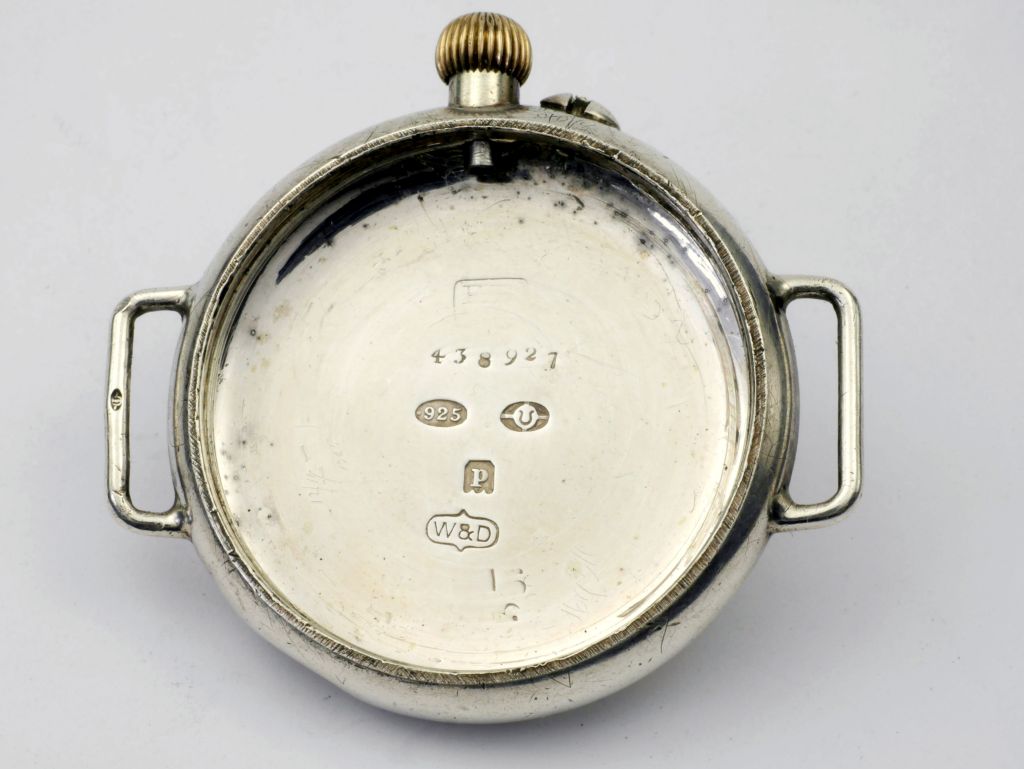
Borgel case with London hallmarks for 1910 to 1911 and W&D sponsor's mark: Click image to enlarge

Borgel wristwatch
In 1891 the Swiss watch case maker François Borgel (1856-1912) patented a case design where instead of having a jointed back cover allowing access to the movement, the normally separate case back and middle part are made in one piece.
The movement is mounted in an externally threaded carrier ring, to which is attached to the bezel and crystal, and the whole assembly screws into the one-piece case from the front on a very fine thread. With careful manufacture and assembly the bezel can be made to screw down quite securely against the middle part of the case.
The crown is held by a spring against the end of the tube carrying part of the split winding stem, creating a seal, and even the hole in the case for the push-pin for the hand setting mechanism is covered on the inside by a flat steel spring, so these Borgel cases are more waterproof than many people give them credit for. I have taken one and held it under water for a few minutes and it didn't let in water. Not a dive watch maybe, but much better than the standard jointed snap back case of the time.
To remove the movement of a Borgel cased watch, you first pull out spring loaded crown so that the winding stem is clear of the movement, and then the movement and bezel with the crystal unscrews out of the front of the case in one piece. Because of this, the method of setting the hands is unusual. The crown in its normal position winds the spring as usual, but obviously the pulled-out position is now used to release the movement. To allow setting of the hands, a pin just below the crown is pressed in and the crown then moves the hands.
One photo here shows a Borgel cased watch with the movement unscrewed from the case. You can see the screw thread on the movement, and the holes where the winding stem and pin-set engage with the movement.
The other photo here shows a Borgel case with London Assay Office import hallmarks for 1910 or 1911 with the W&D sponsor’s mark that was registered with the London Assay Office on 25 June 1907. The movement was made by Aegler. It is a savonnette (hunter) movement stamped on the dial plate ‘Rebberg Deposé’.
Back to the top of the page.
Hermetic Cases
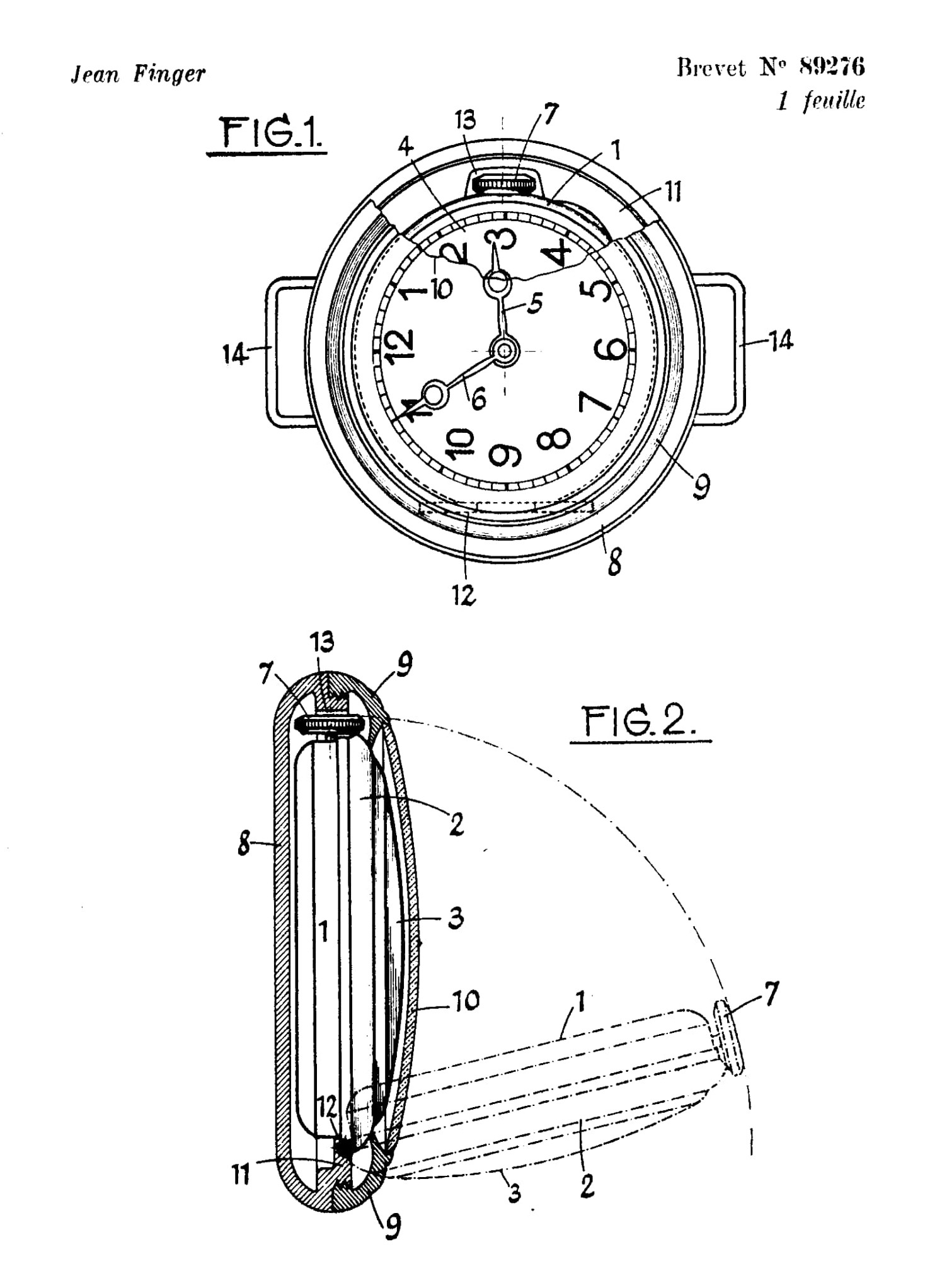
Jean Finger Patent 89276: Click image to enlarge
In January 1921 Jean Finger, a watch case maker of Longeau, Berne, Switzerland, was granted Swiss patent number CH 89276 for a “ Montre à remontoire avec boitier protecteur” literally “a stem winding watch with a protective box”.
This design of waterproof watch has the virtue of simplicity. In fact it is brutally simple. The problem of sealing the hole where the stem enters the case was not solved, it was simply avoided. A small watch is placed inside a larger case that has no hole for a stem and no opening back. The one-piece outer case has a screw-down bezel and forms a complete hermetic envelope around the watch.
There is no gasket between the screw down bezel and the middle part of the case, so the degree of water resistance depends on the two mating surfaces being very flat, and on the tightness with which the bezel is screwed down. The seal between the two parts is therefore nominal rather than highly pressure resistant, but it is effective at shielding the watch from dust, moisture and humidity.
To wind the watch or set the hands, the outer bezel is unscrewed and the movement flipped out on a joint (hinge). This allows access to the crown so that the watch can be wound and the hands set.
Although it achieves the desired waterproof effect, there is a major drawback on that the bezel of the outer case has to be unscrewed every day so that the watch can be wound. Apart from being a nuisance to the owner, the case threads and the milling on the bezel can wear out from this continuous use, especially if the case is gold or silver which are relatively soft, so this was a far from ideal solution. However, despite the drawbacks a number of manufacturers including Zenith and Eberhard produced watches using this case design.
Jean Finger evidently retained faith in his design, because he applied for a patent on a slightly improved version of his original design on 2 February 1929 and was granted an additional patent Swiss patent number CH 138244, published 16 April 1930. The differences between the two designs are small, the later patent uses a bezel that screws into, rather than onto, the front of the case, which allows the joint between the case and the screw in bezel to be concealed, and a different way of attaching the movement hinge to the middle part of the case. By this time the end of the road for the design was clearly in sight, and watches produced to the later patent are rare.
Rolex Hermetic

Rolex Hermetic Face and Bezels: Click image to enlarge

Rolex Hermetic Case and Cuvette: Click image to enlarge

Movement of Rolex Hermetic: Click image to enlarge
Wilsdorf must have liked the design of Jean Finger's hermetic case and come to some arrangement with Finger because Wilsdorf applied for a British patent on exactly the same case design on 26 May 1922, which on 10 May 1923 was granted British patent number GB 197208 for “Improvements in and Relating to Watches”. Wilsdorf's British patent doesn't mention Jean Finger, so the exact ownership of the patent is something of a mystery. It seems likely that Wilsdorf paid Finger a licence fee to use the patent.
Some hermetic cases bear the words “Double Boitier Brevet 89276” (Double Case Patent 89276), a reference to the Jean Finger patent. Some cases bear the initials JF showing that these were actually made by Jean Finger, but other case manufacturers such as the Borgel company of Geneva also made cases to this design. A virtually identical but completely unrelated design was also patented around the same time by Frederic Gruen in the USA in 1918, see Double Case "Hermetic" Watches.
A trademark “The Submarine” was registered in Switzerland by Hans Wilsdorf on 31 March 1922, which was soon after he had presumably come to some arrangement with Jean Finger. This name is also a bit of a mystery because a watch called the “Submarine” had been sold by Brook & Son of Edinburgh since 1915. Watches with hermetic cases were sold by Rolex under the name Submarine, but they were not made by Aegler and were not branded as Rolex watches. For more about these watches, see RWC Submarine.
Rolex watches with hermetic cases were made by Aegler from around 1922. The photos here, kindly provided by Gio who posts on Instagram as @orologeek, show one of these Rolex Hermetic watches. The overall watch diameter is 32.35mm and the movement is 21mm diameter, which is 9.3 lignes so this would probably have been called a 9½ ligne movement.
The first photo shows the case open with the outer and inner bezels removed. The owner would not normally remove the inner bezel when winding or setting the watch, which was done using the crown that can be seen adjacent to the 3 o'clock. The inner bezel has a small projecting tab between the 4 o'clock and 5 o'clock positions which, when the bezel is attached to the inner case, can be used to swing the watch out of the outer case on the joint at the 9 o'clock position.
The case has British hallmarks showing that it was made to be sold in Britain. At the time this watch was made, British retailers did not allow manufacturers, English or foreign, to put their names on watch dials, and it appears that the “Rolex” logo on the dial of this watch was added later.
The second photo shows the marks inside the outer case back and the inner cuvette.
The case has London Assay Office import hallmarks for sterling (⋅925) silver. The date letter is the Roman small Blackletter (Gothic) "h" of the London Assay Office hallmarking year that ran from 1923 to 1924. Date letter punches were changed at the London Assay Office when new wardens were elected at the end of May, so the London hallmarking year ran from June of one year until the end of May of the following year.
An item cannot be accepted at a British assay office for hallmarking unless it carries a sponsor's mark which shows under whose responsibility it is submitted. Note that the sponsor's mark does not show who actually made an item, that has never been its purpose. The sponsor's mark here is the “W&D” mark entered at the London Assay Office by Wilsdorf and Davis.
The case back and cuvette also have the Rolex name and reference to 7 World's Records, which was used in Rolex watches from around November 1923 until 1926.
The case back and cuvette are stamped with the number 397, and Gio tells me that he has seen two similar watches with the same number, so this might be a reference number for the case type.
The final photo shows the movement, which is an Aegler Rebberg, the movement that was used in Rolex watches at the time. This movement is a Rolex Prima, a designation that Aegler appear to have begun using on higher quality movements supplied to Rolex from about 1923.
The movement has a jewelled straight-line Swiss lever escapement and 15 train jewels. The balance is a cut brass and steel bimetallic temperature compensation balance. The balance spring is thermally blued carbon steel.
There is no obvious mechanical or physical difference between ordinary 15 jewel and Prima grade Rebberg movements, but the legend engraved on the barrel bridge, “Timed 6 positions for all climates” shows that the movement received more adjustments than an ordinary movement. Adjustments were made by adding or removing mass from the balance so that the rate was the same in all positions, and adjusting the overcoil of the balance spring so that the rate was the same at different amplitudes, from the greatest amplitude with the movement horizontal and the mainspring full wound to the smallest amplitude with the movement vertical and the mainspring run down over 24 hours.
The six positions are the two horizontal positions of dial up and dial down, and four vertical positions; pendant up, down, left and right. The “all climates” means that the rate was checked and the adjustments done at two different temperatures to ensure that the temperature compensation was correct.
The use of two screws to hold the crown wheel to the barrel bridge is a notable feature that was granted Swiss patent CH 97101 in 1922.
Back to the top of the page.
Swing Ring or Semi Hermetic

A 1924 Swing Ring Case with the Borgel FB-key Trademark
A case design that is sometimes thought to be a variant or development of the Borgel case had a screw on front bezel and no rear opening. The movement is held in a carrier ring hinged to the case and when the bezel is unscrewed and removed, the movement can be swung out to be wound and set.
This case design has been attributed to a Francis Baumgartner, but this name is an error based on the conflation of François Borgel and Frédéric Baumgartner due to their common initials of FB. The semi-hermetic case bears a strong resemblance to one patented in 1924 by Charles Rothen, an employee or associate of Borgel, which you can see on my Borgel Cases page.
The earliest design of swing ring case that I have found was the subject of a patent granted in 1879 to Ezra Fitch.
Several companies used swing ring cases in the 1920s, including Omega, Longines and Rolex. However, they still were not sealed at the winding stem opening.
These watches are sometimes called ‘semi-hermetic’ because of a superficial resemblance to the Hermetic watch described above, but they are not waterproof; the crown is on the outside of the case and there is no hermetic seal where the stem enters the case. In my view the name semi-hermetic is erroneous and misleading, and therefore should not be used.
Back to the top of the page.
The Rolex Oyster

In late 1926 Rolex launched on to the market a new watch with a waterproof screw-down crown and waterproof case. It was named the "Oyster" by Hans Wilsdorf, he said "because, like its namesake it could remain under water for an unlimited time without detriment."
To what extent was the Rolex Oyster an original Wilsdorf or Rolex design? There had been many previous waterproof watches reaching back as far as the mid nineteenth century, as described on my page Waterproof watches, but none of these had gone on to great commercial success. The Oyster was not the first waterproof watch, or even the first waterproof wristwatch (as was incorrectly claimed in Rolex adverts).
Wilsdorf appears to have been stimulated to create the Oyster by patent CH 114948 for a screw down crown granted to Perregaux and Perret in 1925. It would soon have been realised that the Perregaux and Perret screw crown design was essentially useless, because of the problems with the left-hand thread, and it would have been Wilsdorf who cracked the whip to get the technicians at Aegler to come up with a workable design incorporating a clutch, reinventing an idea that had been patented in America in 1881.
The Oyster case was almost certainly inspired by the 1903 Borgel 3 piece screw case, the similarities are obvious and Rolex watches had been made using these Borgel cases, as well as the original Borgel patent screw case.
Although neither the crown or the case were original designs, it was probably Wilsdorf who had the idea of pulling these two ideas together and creating a waterproof watch. Why did the Rolex Oyster achieve commercial success when many earlier waterproof watches, even the 1915 Tavannes Submarine wristwatch, had not?
Wilsdorf was not a watchmaker, but he was a marketing genius who was prepared to invest so much on advertising the Rolex name that by the 1920s he had created a known brand from a name that didn't even exist before 1908. The previous designs of waterproof watches were created by watchmakers but they were not advertised and promoted in the same way. Hans Wilsdorf was a restless marketing genius who really propelled Rolex and the Rolex Oyster, his flagship product, towards the heights it eventually reached. He did this by spending huge amounts of money on advertising direct to the public, which is something that watchmakers had not been done before.
Back to the top of the page.
The Earliest Oysters

Oyster Case Hallmarked Glasgow 1926 to 1927
Image courtesy of and © Ben Eastwood

Registration of "Oyster" July 1926
The exact date that the Rolex Oyster was in the stores and available to purchase is not known. In the Vade Mecum Wilsdorf says ‘in 1927 the waterproof ‘Rolex-Oyster’ was launched’ but there is evidence suggesting that it was on sale late in 1926. The launch referred to by Wilsdorf was probably the start of the expensive advertising campaign.
Wilsdorf acquired the patent that started his quest for a waterproof watch from Paul Perregaux and Georges Perret, both of La Chaux-de-Fonds. They applied for the patent on 30 October 1925 and it was granted Swiss patent number 114948 on 17 May 1926. The patent was transferred to Wilsdorf via C. R. Spillmann & cie, watch case makers, on 24 July 1926.
Wilsdorf registered the name Oyster on 29 July 1926, as shown by the extract from the Archives de l'Horlogerie shown here.
Dowling and Hess report that they have seen Rolex Oysters bearing the Glasgow Assay Office import hallmarks and the date stamp ‘d’ for 1926/27, and an image of one such case is shown here thanks to Ben. The Glasgow year date letter was changed on 1 July every year when new wardens were elected, so Oysters carrying the Glasgow date letter ‘d’ were hallmarked at the Glasgow assay office between 1 July 1926 and 30 June 1927.
The case back shown here is stamped with "114948", the Swiss Federal cross and number of the Perregaux and Perret patent, and also ‘Patent Applied For’ above the Swiss patent number. This appears at first puzzling, because the official patent number is not known before a patent is granted and endorsed with the next number available in the patent office sequence, so this cannot refer to the Swiss patent. It must refer to a patent that had been applied for but not yet granted, which must be the British version of CH 114948, which has an application date of 1 September 1926 and was granted British patent number 260554 on 21 April 1927.
The Perregaux and Perret patent design of screw down crown, with its left handed thread, no clutch and poor sealing arrangement, was essentially useless and never used. So although the presence in an Oyster case back of the Swiss Federal cross and number 114948 with ‘Patent Applied For’ above it could suggest a date as early as August 1926 (for the application for the British patent to be submitted on 1 September) the design of the screw crown that was actually used had not been finished at that time.
As soon as the designs of the case and the improved screw down crown with clutch had been created, Wilsdorf would have wanted to get watches onto the market. The applications for the patents would have been submitted as soon as the designs were finalised. Inventors cannot reveal their inventions to the public before a patent application is submitted, because this would allow someone to claim that the invention was not original. However, as soon as an application is received at the patent office, its date and time of submission is registered. When, and if, a patent is granted, that date becomes the ‘priority date’ from which the period of protection of the invention runs. At the time in Switzerland that protection lasted for only fifteen years, so it was in an inventor's interest to get products into production and sold as soon as the application was in, rather than allow a whole year or more to elapse before the patent was granted.
The application for a Swiss patent on the Oyster case was submitted on 21 September 1926, and was granted as CH 120851 on 16 June 1927. Arriving at the design of the case was simpler than that of the screw down crown, it simply needed a screw back and bezel, which was well established technology. The only new feature was a thread on the pendant for the screw down crown, which a drawing in the patent shows was a right-hand thread, unlike the left handed thread of the Perregaux and Perret patent. So the designers must have been working on a crown with a right handed thread.
Evidently the design of the screw down crown and clutch mechanism took a little longer. The first application for a patent on the successful design of screw down crown was lodged on 18 October 1926. This would have been within days of the design being completed and, since Oyster watches could not have been made before the design of the crown was finished, this gives the earliest date that an Oyster could have been made as early October 1926. Prototypes would have been made in great secrecy to test the design, but the first time that the successful design could be revealed to anyone outside the design team was after that all-important application had been lodged and the priority date and time recorded. Swiss patent number CH 120848 for this design was granted on 16 June 1927.
The application dates for the patents on the screw down crown mean that the successful design of screw down crown with clutch must have been arrived at in early October 1926, with the patent application drawn up and submitted on 18 October, securing the priority date although the patent would not be granted and numbered 120848 until 16 June 1927. The earliest Oyster watches with the Swiss Federal cross and number 114948 with ‘Patent Applied For’ above it must have therefore been made between 18 October 1926, when the application was made for a patent on the successful design of the screw down crown, and 21 April 1927 when British patent number 260554 was granted, meaning that the wording Patent Applied For was no longer needed because the number of the patent was then known.
Back to the top of the page.
The Screw Down Crown
The part of a watch case that is most difficult to make waterproof is where the winding stem enters the case. Some early designs of waterproof watches, such as the "explorers watches" produced for the Royal Geographical Society in the late nineteenth century overcame this problem by the simple expedient of a cap that enclosed the crown and screwed down onto the case, totally encapsulating the crown and stem, and the hole in the case where the stem entered. This was a bit of a nuisance because the cap had to be removed whenever the watch needed to be wound or set, and there was always the danger of dropping it. An alternative design that made the crown itself function as the cap was invented and patented in the United States by Ezra Fitch around 1880, but this was not a commercial success. You can read about these and other early designs of waterproof watch on my page about The evolution of the waterproof watch.

Perregaux & Perret Patent 114948

On 30 October 1925 in La Chaux de Fonds, Switzerland, Paul Perregaux and Georges Perret, registered Swiss patent No. 114948 for a winding system where the crown could be screwed down on to the case to create a waterproof seal. The patent was granted and published on 17 May 1926. There seems to be very little known about Perregaux and Perret, who are sometimes described as watchmakers and prototype makers.
When Hans Wilsdorf saw this patent, he must have thought he had found the solution he had been searching for. He bought all rights to the patent and had it assigned to him, and then applied for a British patent on 1 September 1926, which was granted as No. 260554 on 21 April 1927. He also patented it in Germany No. 443386, and the United States No. 1,661,232. You can see the Swiss and British patents referenced in the 1929 Oyster case back shown here.
Alongside the British patent number 260554 is stamped the year 1925, the year before the Swiss patent was granted, and before even an application for a British patent was lodged. This is valid because agreements between Britain and Switzerland meant that the application date of the Swiss patent was recognised as the "priority date".
However, although the Perregaux and Perret patent is often referred to as the patent that made the waterproof Oyster possible, not least by Rolex as can be seen from the Oyster case back pictured, it has some serious practical problems that prevented Wilsdorf from putting it into production.
Referring to the figure from the patent reproduced here, it can be seen that the way the Perregaux and Perret design works is as follows: the stem 4 and socket 6 are screwed together so that they are effectively one piece. The crown 8 is coupled to the stem and socket by the two screws 9 and 10 screwed into the crown. The ends of these two screws can slide in the longitudinal grooves 11 and 12 in the socket that I have highlighted in yellow. This permits the crown to move axially with respect to the stem and socket, screws 9 and 10 sliding up or down in the grooves as shown in the difference between figure 1 and figure 2.
Figure 1 shows the crown screwed down onto the case, the two screws are at the bottom of the yellow slots. Figure 2 shows the crown unscrewed from the case and now the screws are at the top of the yellow slots. The socket attached to the stem has not moved outwards with the crown as it unscrews, the two screws have just slid up the yellow slots. However, the two screws ensure that the stem and socket are locked together rotationally: the stem must follow any rotation of the crown and so while the crown is being unscrewed or screwed back down the stem has to turn.
The crown is threaded internally 15 at its lower end, and this thread engages with the thread on the tube 3 that projects from the case. The thread on the tube and the corresponding thread inside the crown are left handed.
This is quite clearly stated in the patent: "The present invention relates to improvements in keyless watches and more particularly to improvements in and connected with the winding mechanism of such watches and is concerned with improvements in that type of winder in which the winder is secured in a moisture proof manner to the pendant or equivalent by means of a left hand screw-thread on the winder engaging a left hand screw-thread on the pendant and then screwed down on the pendant compressing packing means. " (my bold emphasis)
The reason for this is as follows: when the watch needs winding the crown is unscrewed clockwise, in the direction of winding. Once the watch is fully wound, and the hands set if required, then the crown is screwed back down anti-clockwise, which the winding ratchet allows. It can't screw down in the right hand direction because the spring is fully wound, preventing any further rotation of the crown in that direction. The crown has to be screwed down in the direction allowed by the winding ratchet, which is anti-clockwise, or left handed, a very unnatural action!
There are some further undesirable consequences of this design. Once the watch is fully wound and the crown screwed down, the crown cannot be unscrewed until the watch has run down somewhat, because the action of unscrewing the crown also winds the watch, and if it is already fully wound it cannot be wound any further without breaking. So if the owner winds the watch fully, screws the crown down, and then realises that the hands need setting, he is stuck for an hour or two!
Another poor feature of this design is that the waterproof seal is formed by the base of the crown compressing the gasket 16 against the case, which is in a very exposed position, and would not have lasted long given the gasket materials available in the 1920s; leather, cork or felt.
A Better Design: CH 120848

Wilsdorf Patent CH 120848

Rolex Oyster Stem Clutch: Mouse Over to Operate
The Perregaux and Perret design was impractical to say the least, requiring a fair amount of education and care on the part of the customer if disaster was to be avoided. Wilsdorf must have soon realised that this design was not suitable to be released to the public. He put on his thinking cap, or more likely got his “technical assistants” at Aegler and Spillmann working on it, and by October 1926 they had come up with an improved design. The application for a patent for this was registered by Wilsdorf on 18 October 1926 and the patent was granted on 16 June 1927 as Swiss patent CH 120848, a figure from which is reproduced here.
The clever bit of CH 120848 was that a dog clutch was incorporated between the stem and the crown. This allowed the crown to rotate freely while being screwed down and unscrewed from the case, but it became rotationally locked to the stem by the dog clutch when it was clear of the threaded tube on the watch case. This meant that the crown could be could be unscrewed at any time to wind the watch or set the hands, and then screwed down onto the case by a right-hand thread that would be familiar to any customer.
Referring to the FIG. 1 from the patent, a clutch cylinder numbered 6 is fixed into the crown. The base of this clutch cylinder has a square hole numbered 9 in it, which I have ringed in red. The winding stem has plug 10 screwed onto its upper end. This plug has a circular flange 11 to centre it within the clutch cylinder and to support the spring 13, and a square section 12 at its base which I have also ringed in red.
When the crown is unscrewed from the threaded stem tube 2, which is fixed into the case wall, the crown is pushed away from the case by the spring. The square hole 9 in the base of clutch cylinder 6 rises to meet the square section 12 on the stem end plug. When the square on the plug enters the square hole, the stem and crown are locked together rotationally as shown in FIG. 2.

NAWCC Bulletin, December 2010
Rolex screw down crown and its antecedents.
As soon as the crown is pushed back towards the case to screw it down, the cylinder is pressed downwards and the square section on the stem pulls free of the square hole in the base of the cylinder. The crown is then free to rotate and can be screwed down on to the case without turning the stem.
To make the operation of the clutch easier to understand, the second figure shows, when you move the mouse cursor over it, what happens when the crown is unscrewed from the case. The initial position is with the crown screwed down to the case. The square on the stem plug is shown in yellow, the square hole in the base of the clutch cylinder attached to the crown is shown in red.
When the mouse cursor is moved over the image, the crown and the clutch cylinder attached to it spring free from the case. The square hole in the base of the clutch cylinder rises so that it is at the same level as the square on the stem plug. When the square on the stem plug enters the square hole in the clutch cylinder, the stem and crown are locked together rotationally, so that turning the crown now also turns the stem and winds the watch.
Because of the shoulder on the stem above the square plug, if the crown is pulled out, the stem is also pulled out - this enables the keyless work to be put into the hand setting mode.
When the watch has been wound and the hands set, the crown is pushed back towards the case, which disengages the yellow plug on the stem from the red square hole in the clutch cylinder. The crown is then free of the stem and can be screwed down onto the case.
A longer version of this history of the development of the Rolex screw down crown was published in the NAWCC Watch & Clock Bulletin in December 2010, "The Rolex Screw Down Crown and its Antecedents", as shown in the picture here.
Back to the top of the page.
The Oyster Case

Oyster Case Cross Section
For the Rolex Oyster a new waterproof case was designed and patented. If you look in the case back of an early Rolex Oyster such as the one pictured here you will see four patents listed: two "Great Britain Patents" 260554/1925 and 274789, and below them two "Swiss Patents" 114948 and 120851. These are a British and a Swiss patent for each of two inventions. The first British / Swiss pair (260554 / 114948) were for the waterproof screw down crown; the second pair (274789 / 120851) were for the waterproof Oyster case.
The Oyster case was made waterproof by having a screw back and bezel, and the screw down crown. How the glass was made waterproof in the bezel is not described, but presumably it was simply made a tight fit. The Oyster was not intended to be a dive watch!
An interesting feature of the patent for the case is that it begins by saying that the invention refers to a shaped or "forme" watch case (i.e., different from the usual round or circular form). The patent goes on to illustrate and describe an octagonal case and the means by which such a case can be made watertight. The only reason that I can think of for making the case octagonal shape is to make it more difficult to seal than a round case, and therefore to have something to patent.
Referring to the cross section below, the movement is held in an externally threaded carrier ring 5, which passes through the centre of the shaped case. The front bezel and case back, both numbered 11 in the drawing, screw onto the external threads of this carrier ring, rotating in opposite directions and clamping the middle part of the case between them to form the water tight seal.
The design of the threaded carrier ring is so reminiscent of the screw cases designed by François Borgel that it is not surprising that many people think the Borgel company, then owned by the Taubert family, must have been involved in the design, but no link has yet been proven, although Borgel cases were used for watches imported by Wilsdorf and Davis.
Borgel case with London hallmarks for 1910 to 1911 and W&D sponsor's mark: Click image to enlarge
In their book on Rolex, Dowling and Hess note that Rolex produced a small series of watches using the original one-piece Borgel screw case in 1922. In fact, the relationship between Borgel and Rolex goes back to way before the 1922 date mentioned by Dowling and Hess. The image here shows a Borgel case with London import hallmarks for 1910 and the W&D sponsor's mark entered by Wilsdorf and Davis.
The Borgel company also supplied Rolex with three piece 1903 Borgel patent screw cases in the 1920s. The Oyster case was virtually identical to the earlier Borgel design and it seems obvious that the Oyster case was based on the 1903 Borgel design. The question is, why weren't the Oyster cases made by the Borgel company, then in the ownership of the Taubert family?
Wilsdorf was working on the Rolex Oyster in the years before it was revealed in 1926, and the Borgel company was taken over by the Taubert family in 1924, so perhaps Wilsdorf didn't want to approach what was essentially a new company. The Tauberts would also most likely have insisted that their Borgel trademark of the initials FB over a Geneva key to appear in any cases they made, which wouldn't have suited Wilsdorf.
Screw Thread Problems
In the first Oyster case the screw thread for the crown was cut into a pendant made as part of the middle section of the case. If the case was gold or silver, as the vast majority of watch cases were in the 1920s, the threads in these soft metals wore very quickly as the crown was unscrewed every day to wind the watch.
This was overcome to a degree by making the pendant a separate steel tube that was harder wearing, and could be replaced if necessary. Many early Oysters cases have been converted to this design.
The problem of thread wear was only really overcome when automatic winding was introduced, which dramatically reduced the number of times that the crown needed to be unscrewed, because the crown then only needed to be unscrewed to change the time.
Tightening the Back and Bezel
The screw backs and bezels of Oyster cases are milled or knurled with small radial grooves like the edge of a coin. These provide the grip needed to tighten and release them by hand, the same as François Borgel had been using on the bezels of his screw cases since 1891.
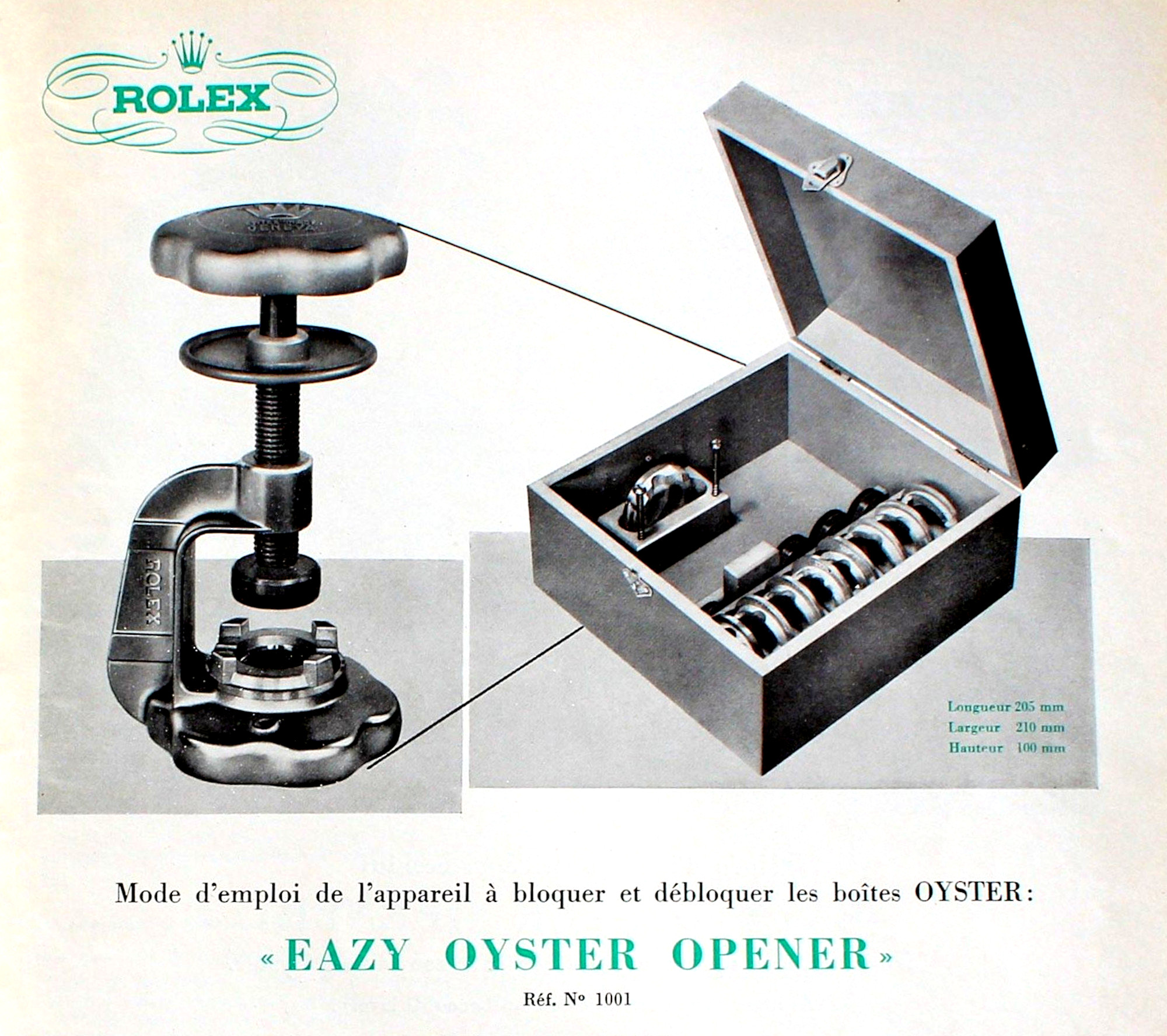
Rolex Eazy Oyster Opener: Click image to enlarge
To get a tighter seal than possible by hand tightening, in 1926 Wilsdorf designed a tool that engaged with the millings and enabled greater torque to be applied. On 3 October 1929 Wilsdorf applied for a patent for this tool, which was accepted and registered on 15 November 1930 as “Outillage pour visser les fonds moletés sur les corps de boites de montre hermétiques” (Tools for screwing knurled backs onto hermetic watch case bodies) under Swiss patent number CH 143449. The tools were sold as the “Eazy Oyster Opener”. The tool came in a box with a set of dies to fit the millings of different size cases.
Referring to the photo here, the case is placed in the holder with four upward projecting fingers. The lower wheel is then turned, turning the threaded tube which lowers the die holder with one of the dies onto the case, holding it there firmly so that its internal millings engage with those on the case back or bezel. The upper wheel is then turned to rotate the die, breaking the seal and unscrewing the back or bezel slightly. The case is then removed from the tool and the back or bezel unscrewed the rest of the way manually.
The millings on the case backs of modern Rolex watches, and the case openers used today, derive from these early designs.
Oyster Patents
Oyster cases accumulated a series of patent numbers inside their backs over the years as listed below. If you know of one I have missed, please let me know. Later models simply had “Patented in all Countries” rather than the long list, perhaps to save on the cost of engraving, or because there wasn't room to fit them all in!
- Great Britain Patents
- 260554: Hans Wilsdorf, “Improvements in Keyless Watches” (British version of CH114948), application date 1 September 1926, granted on 21 April 1927
- 274788: Hans Wilsdorf, “Improvements in or relating to Keyless Watches”, application date 2 June 1927, granted on 28 July 1927
- 274789: Hans Wilsdorf, “Improvements in or relating to Watch Cases”, application date 2 June 1927, granted on 28 July 1927
- Swiss Patents
- 114948: Paul Perregaux and Georges Perret, “Montre à Remontoir” (screw down crown), application date 30 October 1925, granted on 17 May 1926
- 120848: Hans Wilsdorf, “Montre à Remontoir” (screw down crown), application date 18 October 1926, granted on 16 June 1927
- 120851: Hans Wilsdorf, “Boîte de Montre de Forme” (octagonal waterproof case), application date 21 September 1926, granted on 16 June 1927
- 122110: Philippe Weiss, “Montre hermétique à Remontoir” (screw down crown), application date 24 November 1926, granted on 16 December 1927.
- French Patents
- 638179: Hans Wilsdorf, “Boîtier de Montre” (octagonal waterproof case), application date 23 July 1927, granted on 14 February 1928
- 638180: Hans Wilsdorf, “Montre à Remontoir” (screw down crown), application date 23 July 1927, granted on 14 February 1928
- USA Patent
- 1661232: Georges Perret, “Keyless Watch” (USA version of CH114948), application date 19 October 1926, granted on 6 March 1928.
- D.R.P: German "Deutches Reich Patent"
- 471002: Hans Wilsdorf, “Staub und Wasserdichtes Uhrgehaeuse” (dust and waterproof watchcase - octagonal waterproof case), Swiss priority date 21 September 1926, published in Germany 18 September 1927
- 443386: Hans Wilsdorf, “Staubdichter Kronenaufzug fuer Uhren” (dustproof crown for watches - German version of CH114948), Swiss priority date 30 October 1925, published in Germany 18 September 1926
Back to the top of the page.
Who Made the Oyster Cases?


PdM No.2 with number 136

PdM No. 1 with number 136
Rolex do not reveal information such as the identity of the case maker who supplied the cases for the first Rolex Oysters. However, beginning in the mid 1920s Swiss watch cases of gold and platinum had to be marked to identify the case maker. These marks, called Poinçons de Maître, were very small, and the identity of the maker was encoded, so they are not well known.
There is more about the system of marking watch cases on the page Poinçons de Maître, but the important point is that these marks can in principle be read to identify the maker of a watch case. The problem is that they are so small they usually can't be read from photographs, at least not at the resolution of photographs commonly published on the internet.
Thanks to Crispin at Oldetimers.com, I was able to examine nine high resolution pictures of early Oyster cases. From these I was able to date the cases from the date letter of the British import hallmarks, all impressed by the Glasgow Assay Office, and to read the symbols and numbers of the Poinçons de Maître (PdM). Since then I have also seen a case with Glasgow Assay Office import hallmarks and the date letter "d" for the year 1926 to 1927. All the cases bore the sponsor's mark of "R.W.C.Ltd" inside an oval surround, both the letters and surround being incuse, that is impressed into the plate rather than being in relief or cameo.
The image shows a typical Glasgow Assay Office import hallmark for 1927 to 1928. Reading from the top there is the sponsor's mark R.W.C.Ltd which shows who or what company submitted the item for hallmarking, then below that the sideways "9" and "·375" standard mark for nine carat gold, Glasgow Assay Office town mark for imports of two prone and opposed "F"s and finally the date letter "e" for 1927 to 1928.
Date letter punches, also called the “assayer's mark”, show who was responsible for the assay and therefore were changed each year when new Wardens were elected. This was part way through the calendar year, so a hallmark date letter refers to parts of two years. For brevity most tables of hallmark date letters show only the first year in which the date letter punch was used. The Glasgow date letter was changed on 1 July each year, so a case with a Glasgow Assay Office date letter “d” was marked between July 1926 and June 1927. There is more about this type of mark on my page at British import hallmarks.
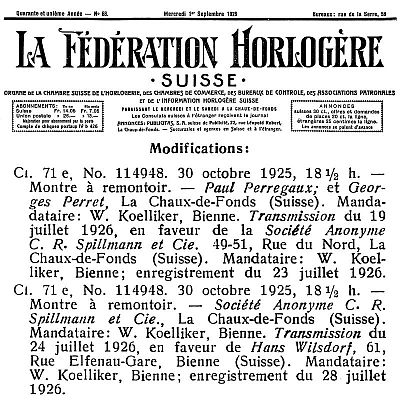
Transfer of patent 114948 to Spillmann, and then to Wilsdorf
| Oyster case hallmarks | ||
|---|---|---|
| All hallmarks Glasgow Assay Office | ||
| Date letter | Year | PdM |
| d | 1926/27 | 136 |
| e | 1927/28 | 136 |
| e | 1927/28 | 136 |
| f | 1928/29 | 136 |
| h | 1930/31 | 136 |
| k | 1933/34 | 136 |
| l | 1934/35 | 136 |
| m | 1935/36 | 136 |
| n | 1936/37 | 136 |
| o | 1937/38 | 10 |
The hallmarks cover the ten year period shown in the table here, from July 1926 to June 1937. All the cases, except the last, have the Poinçon de Maître or PdM of a hammer head bearing the number 136. This mark shows that the cases were made by the company of C. R. Spillmann & Co SA of La Chaux de Fonds, and that C. R. Spillmann & Co SA were the makers of the first Rolex Oyster cases.
The company C.R. Spillmann & Co SA was involved in the acquisition by Wilsdorf and Rolex of the rights to the Perregaux and Perret patent for the screw crown, CH 114948.
The record from La Fédération Horlogère Suisse shown here records the transfer in July 1926 of the rights to the Perregaux and Perret patent CH 114948, first to C.R. Spillmann et Cie, and then five days later onwards from Spillmann & Co to Hans Wilsdorf.
Together with the Poinçons de Maître from the Oyster cases dating back to 1927 this shows that Spillmann & Co not only made the waterproof cases of the first Rolex Oysters but was heavily involved in the design of, in fact probably were the actual designers of, the Oyster waterproof case.
The PdM No. 2 mark of a hammer with handle and the number 136 shown here is in the case of a Rolex Oyster with Glasgow Assay Office import hallmarks for nine carat gold, the date letter "d" for 1926/27. This is interesting because the vast majority of early Rolex Oyster cases that I have seen have PdM No.1, the hammer head. The registrant of PdM No. 2, the hammer with handle, with the number 136 is not recorded in the 1934 list, but given the registration of PdM No. 1 with number 136 to C.R. Spillmann & Co S.A., It is safe to say that PdM No. 2 the hammer with handle No. 136 must also have been registered to C.R. Spillmann & Co SA.
In later years C. R. Spillmann & Co SA specialised in cases for chronographs, making the cases for all of the early Omega Speedmasters and most of the Rolex Daytonas, until Rolex bought the Spillmann company to bring case production “in house” exclusively for Rolex. Thanks to James Dowling for this information.
The company of C.R. Spillmann & Co SA were listed as makers of gold watch case in la Chaux de Fonds. An obituary in La Fédération Horlogère Suisse recorded that Charles-Rodolphe Spillmann died on September 7th 1938. He was the founder and managing director of the company. He was also a founder and member of the executive committee of the Society of Swiss watch case manufacturers. The factory building still exists in la Chaux de Fonds, it is listed as a Swiss heritage site of national significance.
In the list of PdM from the Swiss Central Office of Precious Metal Control, the entry for PdM1 No. 136 shows an address of Chêne-Bourg. A new company “C.R. Spillmann SA” was founded in Chêne-Bourg in 1977, but there was no application for a renewal or transfer of the PdM from the “C.R. Spillmann & Co SA.” to the new company.
The C.R. Spillmann & Co SA Poinçon de Maître PdM No. 1/136 was cancelled on 5 April 1988, presumably as a result of the takeover of the company by Rolex. The address given in the notice of cancellation is La Chaux-de-Fonds.
Back to the top of the page.
Oyster Case Serial Numbers

Oyster CaseSerial Numbers: Click to enlarge.
There seems to be no pattern at all to really early Rolex serial numbers. This might be because Rolex simply bought watches from Aegler which carried Aegler serial numbers and, since Aegler also sold watches to other customers, the ones that Rolex received did not form a constant sequence. However, early serial numbers seem to be even more jumbled than this simple explanation would result in.
When I started to examine early Oyster cases in detail, the serial numbers seemed to follow no pattern at all and appeared to be completely random, which I mentioned at the time. James Dowling remarked to me “I disagree with you about the Oyster case numbers, I very firmly believe that they are sequential.” So I went back to the data and had another look, and an interesting pattern appeared.
I plotted the data from a number of cases to produce the chart shown here. The dates of the cases are taken from their British hallmarks, and it must be remembered that hallmark date letters span two calendar years. For the Glasgow Assay Office, where most of the cases were hallmarked, this was from 1 July to 30 June. The dates I used for this chart are the first year in which the case could have been hallmarked. Also, a hallmark date letter shows only when the case was hallmarked, not when the case was finished after it had been hallmarked and fitted with a movement to make it into a watch.
When looking afresh at the data again, I noticed that the reason for the apparent randomness is that the gold and silver cases appear to have completely different series of serial numbers. In the plot here I have separated out the gold and silver, and it can be seen that their serial numbers do show consistent trends (if I exclude three “outliers” shown in blue).
The silver cases, plotted in yellow, have lower serial numbers than the gold cases, plotted in red. It appears that the silver case serial numbers might have started at zero and the gold cases at 20,000. There are linear regressions lines plotted for the gold and silver case data. Their associated equations have slopes of 3316 for gold cases and 3771 for silver, which suggest approximate annual production rates. Because so few watches with gold cases of any make survive from this period in comparison to those with silver cases, it is natural to assume that watches with silver cases were made in larger numbers, but in fact production data from Swiss case makers shows that gold and silver cases were made in similar numbers. It is the intrinsic value of gold that has led to the loss of many gold cases to the bullion refiner's melting pot over the years.
There is a table of Oyster case serial numbers in the back of the Dowling and Hess Rolex book, also based on hallmark dates but whether the cases were gold or silver is not recorded. I plotted on the chart the data from the book up to 1939, which appears in green. The resulting plot is quite interesting - certainly the general trends are in the same direction. The green line is not a regression line, it simply joins the dots. It shows a notable flattening between 1930 and 1934, reflecting slow sales of expensive watches due to the economic recession that followed the Wall Street crash of 1929.
Back to the top of the page.
Oyster Movements

Unusual Rebberg marked Rolex on Ratchet Wheel: Click to enlarge.
Thanks to Tim N. for the image.

Typical Rebberg Movement marked Rolex on Ratchet Wheel: Click to enlarge.
The movements or ébauches for Rolex Oyster watches were made by Aegler at their factory in the Rebberg district of Bienne, because of which they are called “Rebberg” movements.
The first image here shows a typical Aegler Rebberg movement marked Rolex on the ratchet wheel. The centre bridge is a very distinct shape and makes these Rebberg movements easy to identify. Putting all the train wheel bearings into one plate makes the movement more difficult to assemble than one with separate cocks, but is more rigid and dimensionally secure. This was the standard movement used in most Rolex wristwatches, including most manually wound Oysters, until the late 1920s.
The second image shows an unusual Aegler Rebberg movement marked Rolex on the ratchet wheel. This movement was used in small numbers of Rolex watches, including Oysters, for a few years in the mid 1920s. The most obvious difference is the sweeping curved centre bridge, but the setting lever screw is also in a different position indicating that the keyless work is different from the standard Rebberg model.
The keyless work of the later movement was the subject of Swiss patent N° 97101 Mécanisme de Remontoir et de Mise à l'Heure.
Movements were graded Prima, Extra Prima and Ultra Prima. There is no visible difference between the three grades of movement, they were graded after they were finished on the results of timekeeping tests and the ratchet wheel exchanged for one with the appropriate engraving.
Back to the top of the page.
Advertising Oysters
Once he had a fully waterproof wristwatch in the Rolex Oyster, Wilsdorf was determined to promote it in any way possible and embarked on an extensive and expensive advertising campaign.
Mercedes Gleitze
On 7 October 1927, Mercedes Gleitze became, at her eighth attempt, the first British woman to swim the Channel. She swam from France to England in 15 hours and 15 minutes. Because of a hoax claim (which was soon proven to be false) by Dr Dorothy Cochrane Logan (using her professional name, Mona McLennan), to have swum the Channel on 11 October in the faster time of thirteen hours and ten minutes, Gleitze’s own claim was cast into doubt. To silence the doubters, Gleitze decided to repeat her feat in what became known as ‘the vindication swim’.

Mercedes Gleitze
Recognising a tremendous opportunity to demonstrate the durability of the Oyster watch, Wilsdorf offered a new Rolex Oyster watch to Miss Gleitze if she would carry the watch during her swim, to which she agreed. Although it has often been said that she wore the watch ‘strapped to her wrist’, in fact she wore it on a ribbon around her neck. On 21 October at 4:21 am, Mercedes Gleitze once again entered the water at Cap Gris Nez. But this time the water was much colder, and she was unable to complete the crossing. At 2:45 pm, after swimming for 10 hours and 24 minutes, she was pulled semi-conscious from the water about seven miles short of the English shore.
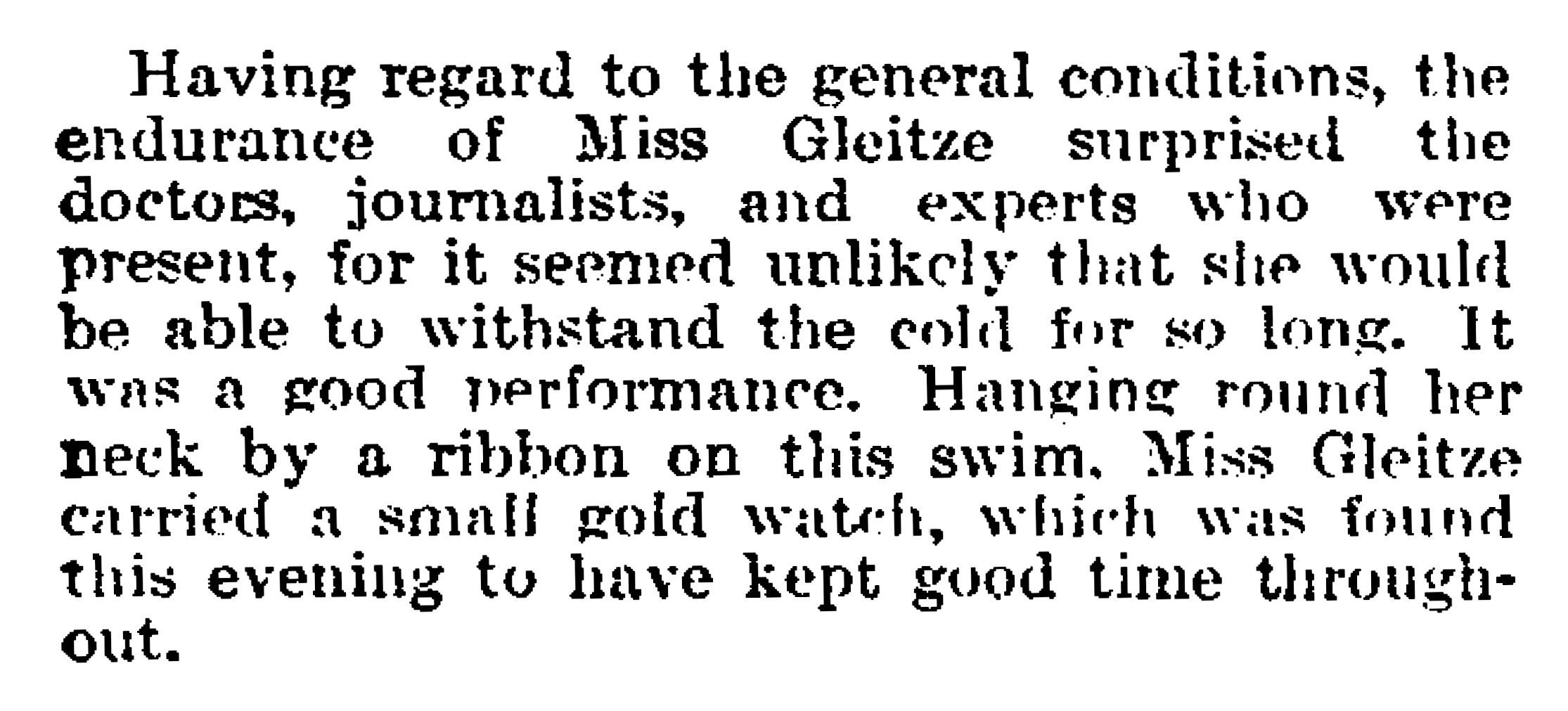
The Times, Oct 22, 1927
Click image to enlarge
Although she did not complete the second crossing, a journalist for The Times of London wrote, ‘Having regard to the general conditions, the endurance of Miss Gleitze surprised the doctors, journalists, and experts who were present, for it seemed unlikely that she would be able to withstand the cold for so long. It was a good performance.’ This silenced the doubters, and Mercedes’ earlier claim was believed.
As she sat in the boat, The Times' journalist made a discovery and reported it as follows: ‘Hanging round her neck by a ribbon on this swim, Miss Gleitze carried a small gold watch, which was found this evening to have kept good time throughout.’ When examined closely, the Oyster watch was found to be in perfect condition, dry inside and ticking away as if nothing had happened.
One month later, on 24 November 1927, Wilsdorf launched the Rolex Oyster watch in the United Kingdom as the focal point of a full front page Rolex advert in the Daily Mail, and the Rolex Oyster began its rise to fame.
Malcolm Campbell

1930 Rolex advert in Punch
Old Bond Street House
6-8, Old Bond Street
London, W.1.
13th May 1930
Dear Sirs.
I have now been using my Rolex Watch for some little while, and it is keeping perfect time under somewhat strenuous conditions.
I was wearing it on the occasion of the J.C.C. Double 12 Hours Race on Friday and Saturday last, and the vibration which this watch had to withstand during this long period has not upset its time-keeping properties in the least.
I would like to congratulate you on having produced a very first-class Watch, suitable for really rough treatment.
Yours faithfully, Malcolm Campbell
Wilsdorf also co-opted various sporting personalities into endorsing the Oyster. This advert appeared in Punch on the 18 June 1930. In it is reproduced a letter from Captain Malcolm Campbell (he was knighted as Sir Malcolm Campbell in 1931).
The Junior Car Club (J.C.C.) Double Twelve Hours race was a 24-hour endurance event held at the Brooklands circuit on 9 and 10 May 1930. To avoid complaints from local residents about noise during the night, the race was split into two 12-hour heats over consecutive days.
Note that although Campbell says that the watch is suitable for really rough treatment, this was still before the widespread use of shock protection jewel settings for the balance staff pivots. Early Oysters do not have shock protection, so a sharp blow could, and still can, break the balance staff pivots, so don't take Campbell too literally.
In another marketing coup, in 1935 a Rolex Oyster went over 300 miles per hour on the wrist of Sir Malcolm Campbell as he set the world land-speed record in his race car at Salt Lake Flats.

1950 Rolex Advert in Punch
The investment of a watch in Miss Gleitze's attempt proved a typically shrewd move by Wilsdorf, and Rolex were still using the event in adverts into the 1950s. The advert here from Punch in August 1950 states that the Rolex Oyster was the first waterproof wristwatch in the world, which is not true, there were other waterproof wristwatches made before the Rolex Oyster, but it was the first that was advertised to a mass audience through an extensive advertising campaign, Wilsdorf's forté.
The Rolex Perpetual
Now that the problem of water-proofing had been solved, there was just one small remaining issue; namely, that the owner had to unscrew the crown each day in order to wind the watch. There were two side effects of this; (1) sooner or later the owner would forget to screw the crown down tightly again and the watch would no longer be hermetically sealed, and (2) in time the waterproof seals or the threads would wear out. Wear of the threads on the outside of the stem tube that the crown screwed down onto was a serious problem with manually wound Oysters. Many have had the stem tube repaired or replaced. Initially the stem tube was made of the same material as the case, gold or silver, which are both quite soft metals that wore very quickly. Later, a threaded steel tube was designed that was inserted into the case in place of the integral stem tube and lasted longer.
These problems were finally solved by Rolex in 1931 with the introduction of the ‘Perpetual’ self-winding movement.
The concept of a self-winding watch had first been introduced in 1770s. For many years it was generally believed that the rotor self winding mechanism was invented by the Swiss watchmaker Abraham-Louis Perrelet, but information uncovered by Richards Watkins includes a report from 1778 that is a clear indication that it was Hubert Sarton, of Liège in Belgium, who invented the rotor wound watch.
However, Perrelet independently designed a self-winding watch at the end of 1775 or at the beginning of 1776. The winding mechanism worked on the same principle as a pedometer, using an reciprocating weight inside the watch that moved up and down as the owner walked, which through a set of gears wound the mainspring. Perrelet was the first person to create a working, practical mechanism.
The Parisian clock and watchmaker Abraham-Louis Bréguet improved the mechanism in his own version, calling his watches ‘perpetuelles’; the French word for perpetual, and possibly an inspiration for Rolex's name for its ‘Perpetual’ automatic or self winding movements.
The first self winding wristwatch was invented in 1923 by a watch repairer from the Isle of Man named John Harwood. He took out a UK patent with his financial backer, Harry Cutts from Cheshire, on 7 July 1923, and a corresponding Swiss patent on 16 October 1923. The Harwood system used a semi circular weight that pivoted at the centre of the movement and swung through a 300 degree arc as the wearer moved his wrist or arm, and through a train of gears wound the mainspring. This was called a ‘bumper’ design because the weight ran into a spring bumper at the end of its 300 degree travel, which the wearer could feel. When fully wound, the watch would run for 12 hours. It did not have a conventional stem winder, so the hands were moved manually by rotating a bezel around the face of the watch.
Harwood formed the Harwood Self-Winding Watch Company and commissioned the Swiss firms Fortis and A. Schild to make the watches using the Adolf Schild Calibre Cal. 350 as the base movement. The watches went on sale in 1928. They were not a runaway success in the market, and only some 30,000 were made in total. However, the presence of the patent meant that from 1923 no one else could develop a similar or improved version, so progress was essentially halted at a time when the wristwatch was becoming more and more popular. The Harwood company collapsed in 1931 during the Great Depression and, although the patent still existed, there was no one to exercise it, so other companies were free to develop their own versions.
Emile Borer, nephew and ultimately successor to Hermann Aegler and head of research and development at the Aegler Bienne factory, took up the Harwood design and used it as the basis for a self winding mechanism. He improved on Harwood's design so that the centrally mounted semi-circular weight became a rotor which could rotate smoothly through a full 360 degrees and was able to turn both clockwise and counter clockwise, rather than running the 300 degrees and then hitting the bumpers of the Harwood design. This improved its performance, durability, and feel for the wearer, although it only actually wound in one direction. The amount of energy stored in the mainspring was increased, allowing the watch to run autonomously for up to 35 hours.
Felsa introduced the patented 410 calibre "Bidynator" (bi-directional winding) in 1942; Aegler did not produce a bi-directional automatic winding movement until 1950 with the calibre 1030.
As a result of automatic winding it was no longer necessary to manually wind the watch every day, and the crown was used principally to set the time. As this did not require doing often, due to the accuracy of the watch, the waterproof seal was only disturbed occasionally and there was much less wear in the threads or likelihood of forgetting to screw the crown down. Consequently, Rolex Oyster Perpetual watches were now not only accurate but also durable. The automatically wound watch was even more accurate than the hand wound version because the tension put on the mainspring by constant automatic winding whilst the watch was worn was more even than that provided by winding once a day, maintaining a high amplitude.
Back to the top of the page.
Rolex Pocket Watches
Although Rolex is best known today for wristwatches, in the early days they also sold pocket watches. Some of these were supplied by Aegler, but Rolex pocket watches are also seen with movements by other manufacturers, such as the Montilier calibre 663.
If you have any comments or questions, please don't hesitate to get in touch via my Contact Me page.
Copyright © David Boettcher 2005 - 2026 all rights reserved. This page updated July 2026.
Back to the top of the page.