
Blog: Robert Meylan, Rolex case maker and thief
Copyright © David Boettcher 2005 - 2026 all rights reserved.First published: 30 January 2026, last updated 01 April 2026.
I make additions and corrections to this web site frequently but, because they are buried somewhere on one of the pages, the changes are not very noticeable. I decided to create this blog to highlight new material.
Note that these articles also get updated, especially soon after they are posted when additional information may be added. Check the “last updated” date to see when the article was last updated.
The section below about Robert Meylan is from the page about Rolex.
If you have any comments or questions, please don't hesitate to emal me at .
Robert Meylan
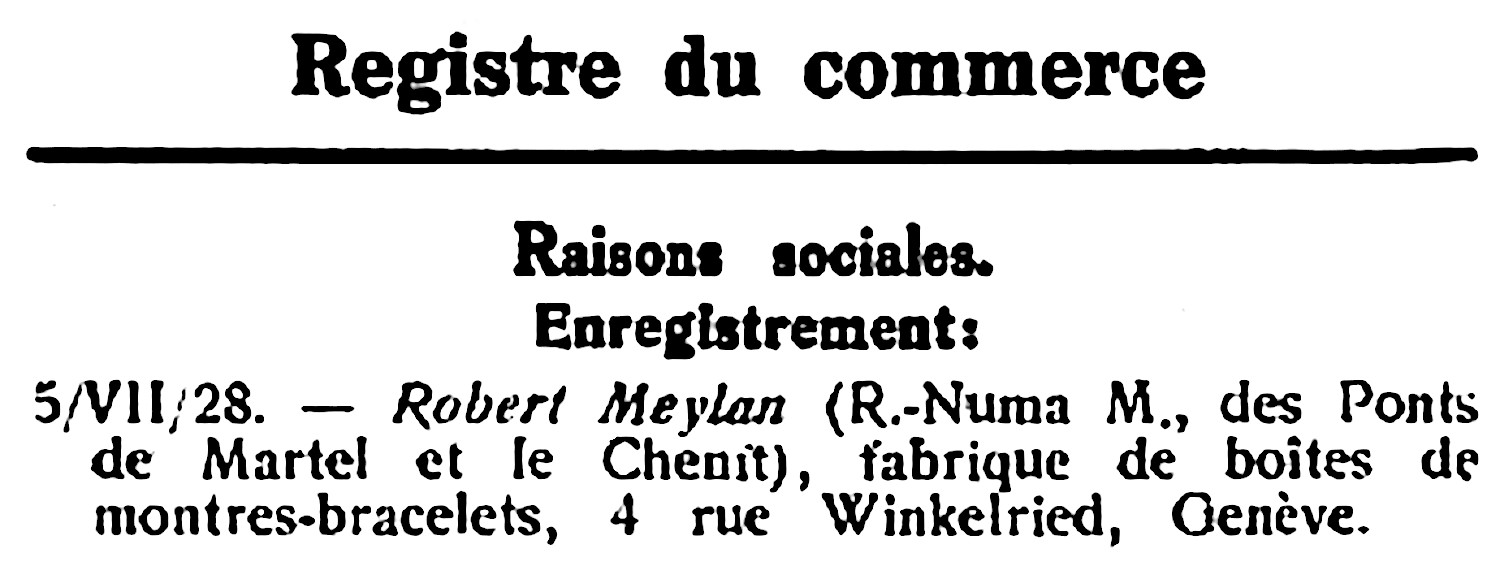
Robert Meylan registration 1928
Click image to enlarge
The company Robert Meylan, a Geneva based watch case manufacturer, was first registered on 5 July 1928.
The registration details say that Robert Meylan specifically manufactured wristwatch cases – boîtes de montres-bracelets. The address of the company is 4 rue Winkelried, Geneva.
The registration also gives R.-Numa M, des Ponts-de-Martel and le Chenit in brackets. This means that the company Robert Meylan was legally domiciled in Geneva, but carried out case manufacture through workshops or subcontracting in La Chaux-de-Fonds (Rue Numa-Maire), Les Ponts-de-Martel, and Le Chenit.
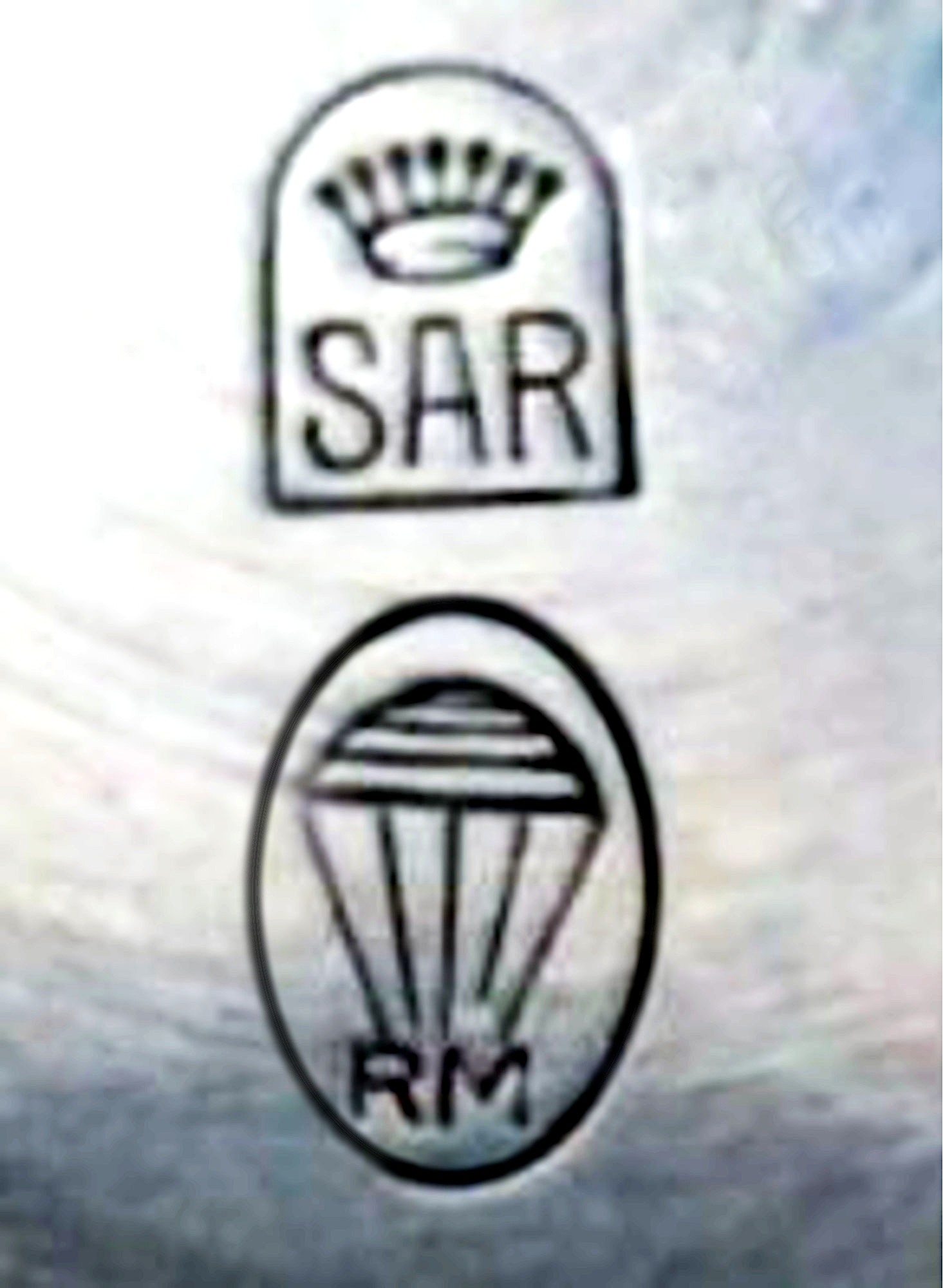
SAR with Robert Meylan parachute trademark
Click image to enlarge
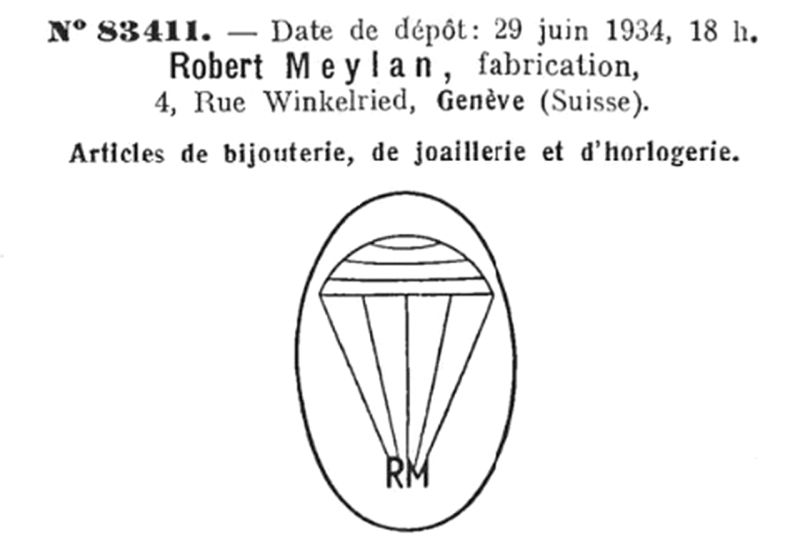
Robert Meylan parachute trademark
Click image to enlarge
Robert Meylan trademarks
Robert Meylan registered the trademark of a parachute carrying the initial ‘RM’ on 29 June 1934.
The registration includes articles of joaillerie and bijouterie, which both translate to ‘jewellery’ in English. In French, joaillerie refers to jewellery featuring precious metals and gemstones, while bijouterie covers less expensive jewellery made from materials including base metals, plastic and glass, which is called ‘costume jewellery’ in English.
Meylan specialised in gold watch cases, but the trademark is frequently seen in stainless steel watch cases. These required specialised techniques to produce, involving a lot of capital expenditure on powerful machinery. Not many companies made both gold and stainless steel cases because the cost of the raw materials and the manufacturing techniques were so different.
The parachute trademark is also frequently seen accompanied by the trademark of the letters ‘SAR’ beneath a crown with seven points. This mark looks somewhat like the crown trademark of Rolex, but that has five points and there is no record of Rolex registering or using the crown with seven points.
The association of the crown with seven points and the letters SAR suggests that this trademark might have been registered by Robert Meylan, but no record of such a registration has been found.
Robert Meylan's Poinçon de Maître
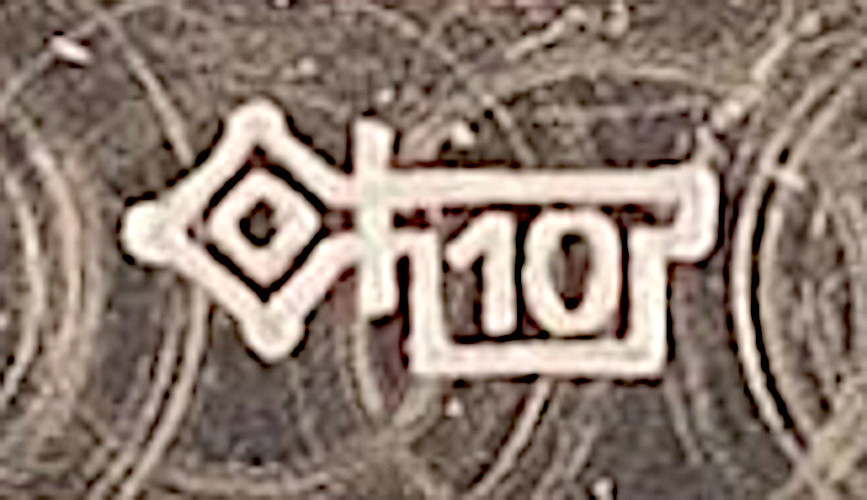
Robert Meylan's Poinçon de Maître PdM 5/10
Click image to enlarge
Robert Meylan's company was entered onto the central database of Poinçons de Maître of Swiss watch case makers on 8 September 1934 with registration number 10 in the list PdM5, the Key of Geneva, the symbol for gold, platinum and palladium watch cases of thickness 0.3mm or greater made in Geneva. Note that this was the date that the registration was entered onto the central database; it is almost certain that Meylan was registered before the centralisation took place, most likely from the founding of the company in 1928.
Although the PdM 5 Key of Geneva mark was defined as being for gold, platinum and palladium watch cases, Meylan's mark PdM 5 /10, that is the Key of Geneva with the number 10 on the lever, is seen stamped on stainless steel and Rolesium cases. This was not supposed to happen, but Meylan was evidently not someone who respected rules and regulations.
Thanks to John Goldberger, I have seen a Rolex case made by Robert Meylan in sterling 0·925 silver. This case doesn't carry a Poinçon de Maître. Although the system of Poinçons de Maître included provision for marking silver cases, very few have such marks. It was evidently only gold and platinum cases that the authorities were particularly keen to see marked.
Robert Meylan Patents
Robert Meylan was granted three Swiss patents for watch cases in 1932/33 :
- CH 153544 : Boîte de montre. Priority date 21 February 1931, Published 31 March 1932. A water resistant watch case with screw back and bezel that screwed onto a threaded carrier ring, clamping the outer part of the case between them. Very similar to the original Oyster case, which itself was very similar to a 1903 Borgel screw case.
- CH 161355 : Boîte de montre étanche. Priority date 28 April 1932, Published 30 April 1933. A water resistant watch case with the bezel and middle part made in one piece, the movement held in place by a spring under a screw back, very similar to the Taubert Decagonal Case patented in 1931.
- CH 163946 : Boîte de montre hermétique. Priority date 16 November 1932, Published 15 September 1933. A water resistant watch case with the bezel extended through the middle part of the case and a screw back, clamping the middle part of the case between the extended bezel and back.
None of these patents were particularly original and shouldn't have passed the ‘prior art’ test as new inventions.
The first Oyster cases were made by C. R. Spillmann & Co, before the company Robert Meylan was founded. However, many Oyster cases from the 1930s were made by Robert Meylan.
Burglary at Rolex
On the night of 25 July 1938, two men broke into the workshop of Rolex in Geneva on the fifth floor of No. 18, du passage du Terraillet, a passage between Rue de la Rôtisserie and Rue de Marché, and stole 100,000 Swiss francs worth of gold and platinum watch cases.
Rolex had offices on the third floor and a large workshop on the fifth floor. The burglars attempted to break into the third-floor offices, where many finished watches were stored in safes, but the locks held. They then went to the fifth floor and easily broke into an architect's office. From there, they broke through a sliding partition separating the architects' offices from the Rolex workshop. They ransacked the workshop, discarding all the plated watch cases and selecting only those of solid gold or platinum.
In February 1939, Robert Meylan was arrested in connection with this burglary, which he confessed he had carried out with Yves Le Gallou, a notorious French criminal wanted in France for fraud amounting to 500,000 francs carried out in Tahiti, identity theft, and draft evasion.
Meylan admitted to having melted down, in his own factory, the greater part of the watch cases stolen from the Rolex Watch Co, which was his main client. It was revealed that an ingot mould had been brought into the workshop so that the watch cases, which would easily be recognised, could be turned into anonymous ingots and thereby sold.
Robert Meylan was held at Saint-Antoine prison. A few days after his arrest, he informed Mr. Foex, the investigating judge, that the remaining stolen jewellery that had escaped being melted down had been buried near the Chalet de la Dôle by Yves Le Gallou, with the intention of retrieving it later. A first expedition was organized on 24 February, but heavy snowfall frustrated it. A second, better equipped, expedition managed to reach the site despite the heavy snow.
Police officers, equipped with shovels, cleared the snow and then, with pickaxes, excavated the ground. After an hour and a half of effort, they found some gold watch cases buried nearly a metre deep. They eventually retrieved about fifteen kilos of gold and platinum, representing thousands of watch cases, some with their movements still intact, and numerous platinum pieces set with diamonds.
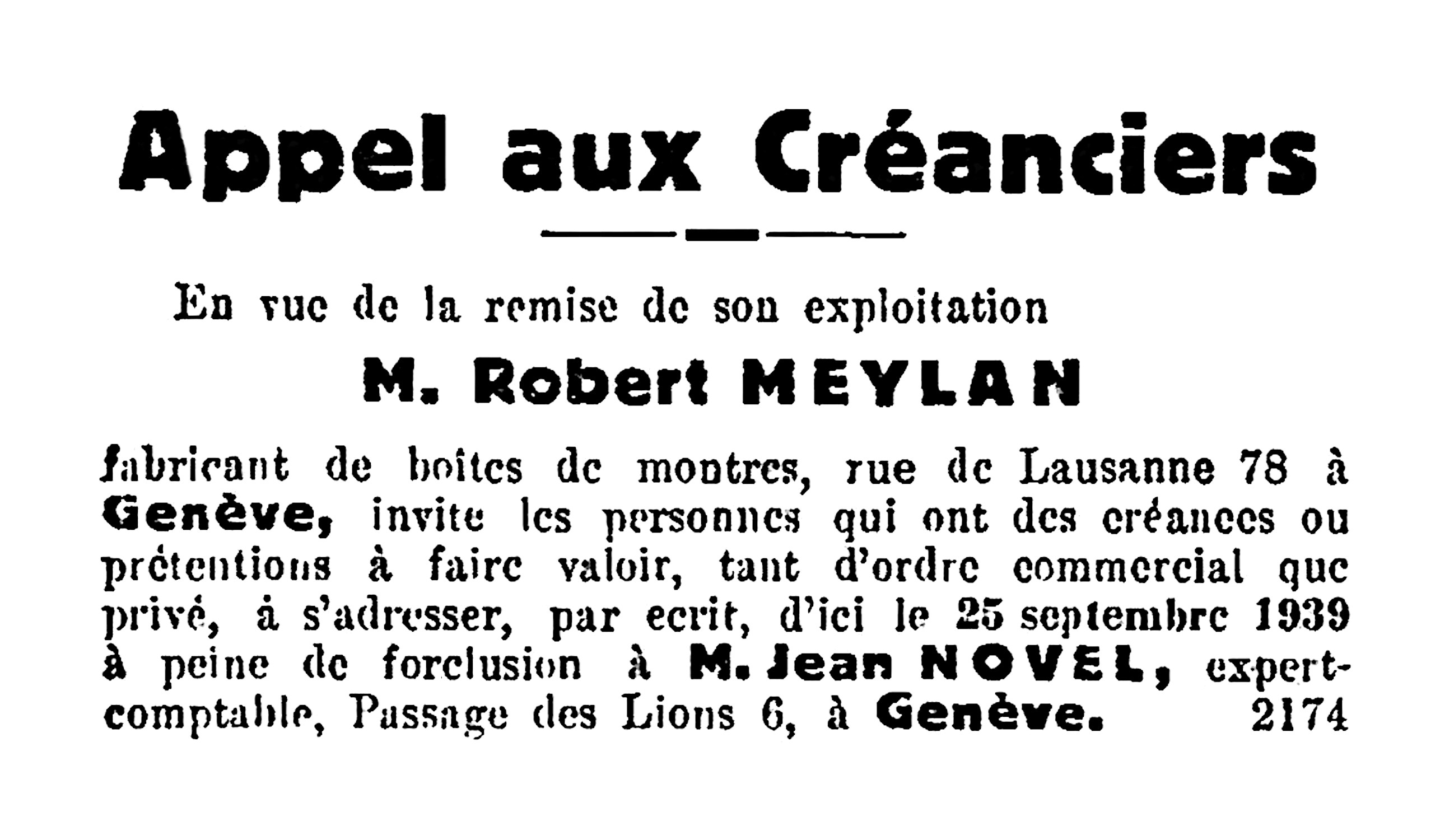
Robert Meylan Notice to Creditors
Click image to enlarge
At a subsequent appearance before the investigating judge, Robert Meylan learned, to his considerable astonishment, that a safe deposit box he owned at a financial institution in Lausanne had been opened and that 25,000 francs in gold coins and platinum plates worth 23,000 francs had been found inside. ‘That's my savings,’ he coldly declared, adding that he certainly hadn't declared this ‘nest egg’ to the tax authorities!
During one of the hearings, Hans Wilsdorf was praised for keeping the Meylan factory working and maintaining the jobs of the employees.
The company Robert Meylan, then at 78 Rue de Lausanne, Geneva, closed down operations and called in creditors in September 1939. The notice reproduced here is a call to all creditors to submit claims, ‘In view of the transfer of his business’.
Genex S.A.
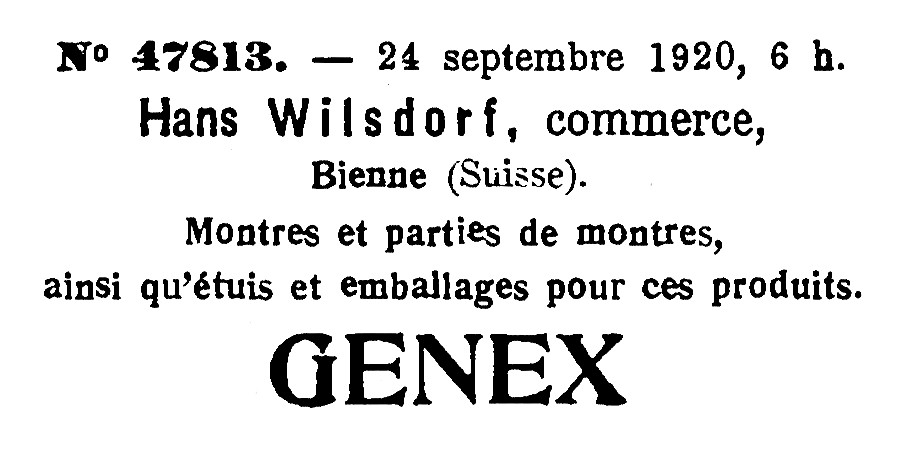
Registration of Genex, September 1920
Click image to enlarge
In February 1940, a new company, Genex S.A., was registered with the purpose of manufacturing watch cases of all kinds, jewellery items and all related business. Hans Wilsdorf had registered the name Genex in September 1920 for watches and watch parts, as well as cases and packaging for them.
Genex S.A. was formed with the explicit purpose of taking over the operation of Robert Meylan's workshop, located at 78 Rue de Lausanne, Geneva, and the assets specified in an inventory dated 30 September 1939.
The first board of directors of Genex consisted of the brothers Jean and Noël Gay, and Hans Wilsdorf. Jean Gay was appointed president and managing director, Hans Wilsdorf, secretary, and Noël Gay, director. The Company address was 18, Rue du Marché (office of M. Fernand Lilla, lawyer), the registered address of Montres Rolex S.A.
On 28 February 1940 the Meylan patent No. 161355 ‘Boîte de montre étanche’ was sold to Montres Rolex S.A., the transfer of title was registered on 9 April 1940.
On 12 January 1943, the registered office of Genex S.A. was transferred to 12, Rue des Glacis de Rive, the address of Gay Frères, the chain and watch bracelet maker.
Although the formation of Genex has been seen as a move towards vertical integration by Rolex, taking case making in-house, Hans Wilsdorf resigned from the board of directors of Genex on 30 October 1945. Werner Ryser was appointed member and secretary of the board of directors. In December 1945, Charles Gygax was given joint power of attorney. In January 1952, Charles Gygax was appointed sole director of Genex.
Robert Meylan's company registration was struck off the list of Poinçons de Maître on 29 June 1940 following the dissolution of the company. The registration number 10 for PdM5, the key of Geneva, (PdM 5/12 ) was reassigned to the Union Suisse pour l’Habillage de la Montre (USH), the name shown in the current list. On the same date, Genex S.A. was assigned the PdM5 registration number 12 (PdM 5/12).
The company of Robert Meylan was struck off the official list of Swiss registered companies on 11 April 1940.
Many Genex branded watches, particularly from the 1950s-60s, are fitted with movements from A. Schild (AS). It is widely believed that Rolex sold the Genex brand to A. Schild in 1933. However, the Genex trademark was renewed by Montres Rolex S.A. in 1940 and 1960, so that is not the complete story.
If you have any comments or questions, please don't hesitate to get in touch via my Contact Me page.
Copyright © David Boettcher 2005 - 2026 all rights reserved. This page updated April 2026.
Back to the top of the page.