
Blog: Oyster Watch Co.
First published: 9 August 2023, last updated 31 March 2026.
Copyright © David Boettcher 2005 - 2026 all rights reserved.If you enjoy this website,
why not buy me a coffee?
I make additions and corrections to this web site frequently but, because they are buried somewhere on one of the pages, the changes are not very noticeable. I decided to create this blog to highlight new material. Here below you will find part of one of the pages that is either completely new or I have recently changed or added to significantly.
This entry is from the page about Wilsdorf's Other Brands, which is about the myriad of other brands and companies that Hans Wilsdorf created in addition to Rolex.
As always, if you have any comments or questions, please don't hesitate to get in touch via my Contact Me page.
Oyster Watch Co.
Significant Revision
It seemed to be clear that Wilsdorf intended Oyster Watch Co. watches to be a separate, cheaper, brand than Rolex watches. However, Raphaël pointed out to me that this is not the whole story. There are some genuine Rolex Oyster branded model lines that have Oyster Watch Co. branded cases.
The full implications and understanding of this are the subject of ongoing research, but the first section below describes the latest findings. The ‘Original Text’ that follows requires modification as a result, but for the moment has not been altered.
This section will be revised as further evidence comes to light. First published: 9 August 2023, last updated 31 March 2026.
Rolex Oyster Watches in Oyster Watch Co. Cases
Based upon the observation that many watches marked Oyster Watch Co. have movements made by Fontainemelon rather than Aegler and low quality zinc-alloy cases, and also simple business and marketing logic, it has been assumed that Oyster Watch Co. watches were a separate, cheaper, product from the genuine Rolex Oyster, and that the two should not be confused. This view was reinforced by James Dowling's treatment of the subject in his book Rolex: The Unauthorised History, where he is explicit that Oyster Watch Co. watches were not intended to compete with the Rolex brand.
However, evidence has come to light showing that this is not the whole story. There are some genuine Rolex Oyster branded models that have Oyster Watch Co. branded cases.
A number of watches branded ‘Rolex Oyster’ have been identified which have Rolex movements made by Aegler in cases marked inside the case back ‘Oyster Watch Co.’ These include Rolex Oyster watches of reference 2416, stamped on the outside of the case back. At least three such watches with the same reference number and the same Oyster Watch Co. inside case back marking have been identified from separate sources, with serial numbers consistent with production in the mid-1930s, so this does not appear to be an isolated anomaly due to a one-off marriage of a Rolex movement with a case from an Oyster Watch Co. watch.
James Dowling illustrates two watches in the Rolex Oyster chapter of his book with Oyster Watch Co. cases: a Rolex Oyster Royal model 2280 and a stainless steel Oyster.
It is difficult to believe at first sight that Wilsdorf would authorise, or at any rate permit, the assembly of watches with genuine Rolex movements and cases branded Oyster Watch Co., since one of his central concerns was to protect the Rolex brand and to keep it separate from his other, cheaper brands. One possible, though purely speculative, explanation is that in cases where Rolex cases were in short supply to fill an order, watches were assembled with Oyster Watch Co. cases instead, on the assumption that most customers would never look inside the case back. This would represent, in effect, a factory marriage. However, it appears that there may be too many examples over too long a span of time for this idea to be likely, and further research is needed.
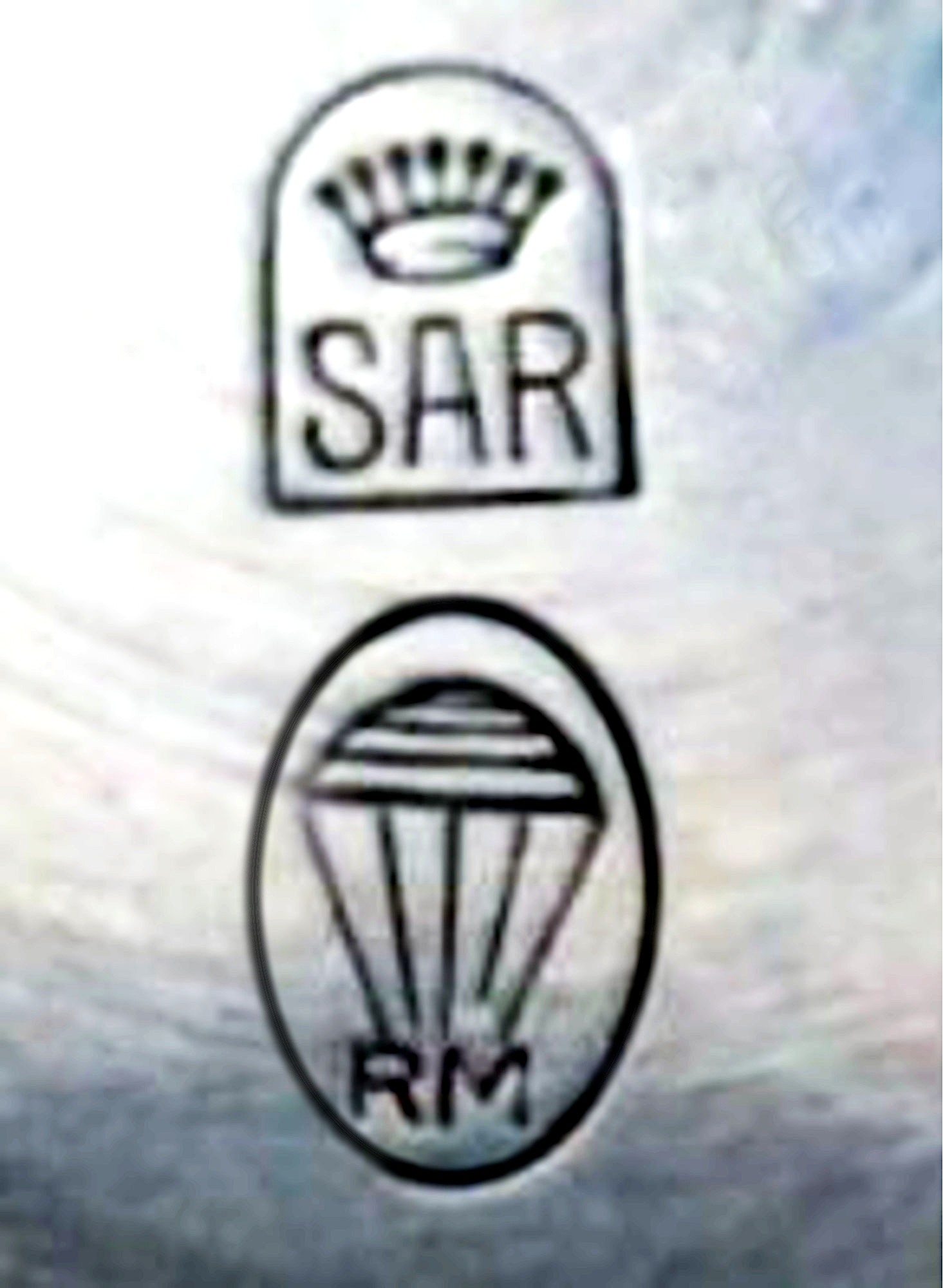
SAR with Robert Meylan parachute trademark
Click image to enlarge
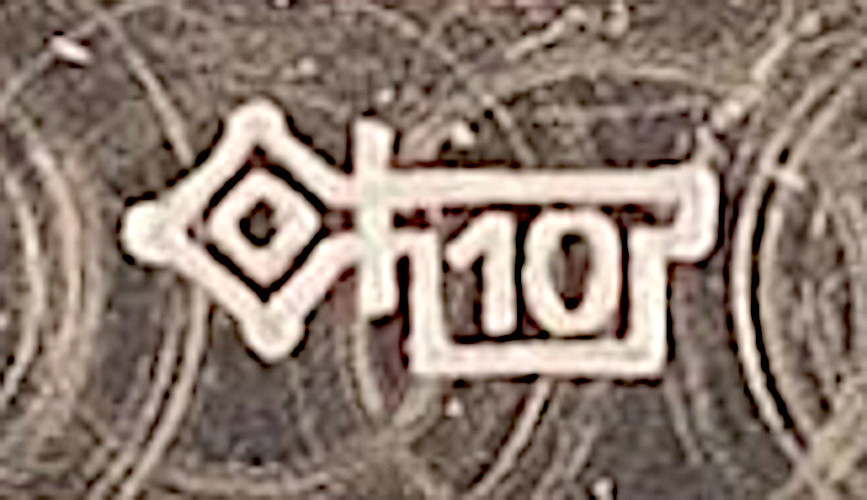
Robert Meylan's Poinçon de Maître PdM 5/10
Click image to enlarge
Most, if not all, of the cases of Rolex Oysters that as marked inside the case back Oyster Watch Co. were made by the case making company of Robert Meylan. Meylan used a trademark of a parachute with the initials RM. The mark of SAR under a crown with seven points is also frequently seen in Meylan cases and may have been registered by the company. Robert Meylan also had the registration number 10 for Poinçon de Maître No. 5, the key of Geneva.
Whatever the explanation, these watches present a question for the modern collector and researcher: they are watches with genuine Rolex Oyster movements, dials marked Rolex Oyster, and cases marked Oyster Watch Co. Are they Rolex watches, or are they Oyster Watch Co. watches? In terms of the definition used on this site — that a Rolex watch is one on which the Rolex name was placed during the manufacturing process — one might argue that the answer is yes, they are Rolex watches, since both the dial and the movement appear to have originally been marked Rolex when the watches left the factory.
However, the earliest Rolex Oysters are marked ‘Rolex Oyster’ in the case back, and these are unambiguously Rolex watches. But in later watches, when the case is marked Oyster Watch Co., the name of a legally separate company, that looks odd. There are no known adverts for Rolex watches naming the Oyster Watch Co.
Further research is needed. If you have a watch marked Rolex Oyster with an Aegler movement and case marked Oyster Watch Co., or any other evidence, please get in touch.
Original Text
The Rolex Oyster waterproof wristwatch was the watch that transformed Rolex from just another London based British company importing Swiss watches into a hugely successful and recognised name.
With Wilsdorf's extensive and expensive advertising campaign, people began asking for Rolex Oyster wristwatches by name, which enabled Wilsdorf to insist that every watch had Rolex Oyster on the dial. British retailers didn't like this, but to refuse to stock the watches was to lose out on sales, and no retailer wants to do that.
With the tremendous success of the Rolex Oyster wristwatch after its launch in 1927, in 1928 Wilsdorf decided to create a similar watch that could be sold at a cheaper price point. The Oyster Watch Company was created on 31 August 1928.

Oyster Watch Ltd, 31 August 1928: Click image to enlarge
The extract from the registration reproduced here shows that the company was formally named Montres Huître S.A., translated into English as Oyster Watch Limited, a public limited company with its registered office in Geneva. The purpose of the company was the manufacture, purchase and sale of waterproof watches related to various patents that were listed in the statutes and which the right to use was granted to the company free of charge. This meant that Oyster Watch Limited was legally a completely separate company from the Rolex Watch Company and not just another sub-brand.
The first board of directors of Montres Huître S.A. had three members: Hans Wilsdorf, Marguerite Gagnebin and Cécile-Antoinette Gagnebin. At a meeting on 31 August 1928, May Wilsdorf (Hans Wilsdorf's second wife) was appointed as a director. After its formation in 1928, Montres Huître S.A. did essentially nothing other than be listed in Swiss watch trade directories. In 1940, it was recorded that the Board of Directors of Montres Huitre S.A. (Oyster Watch Ltd.) was composed of Mr. Hans Wilsdorf, Chairman and Managing Director, Mr. Fernand Lilla and Ms. Lucie Berger.
Watch cases are seen with Oyster Watch Co. rather than Oyster Watch Limited. This is puzzling, because no record has been found of ‘Oyster Watch Co.’ being registered as a trademark, but it seems reasonable to assume that Oyster Watch Co. refers to, or stems from, Montres Huître S.A.
Watches branded Oyster Watch Co. usually have movements made by ébauche manufacturers other than Aegler S.A., the company which made the movements for the real Rolex Oyster watches. However, the obvious connections between the Rolex Watch Company and Oyster Watch Limited, together with the free use of the critical patents for the oyster case and screw down crown, meant that the means of waterproofing, and even the appearance of the cases, were, in the eyes of customers at least, essentially indistinguishable.
Another strange feature is that silver and gold Oyster Watch Co. cases are marked with an incuse RWCLTD within an incuse oval surround, which is recognised as a Rolex Watch Company Ltd. mark, leading to the erroneous assumption that the watch is a Rolex watch. The RWCLTD mark is a actually sponsor's mark, a mark that has to be registered with a British assay office and applied to an item before it is submitted for hallmarking. Although an RWC sponsor's mark shows that an item was submitted for hallmarking under the responsibility of the Rolex Watch Company, it is not an absolute identifier of a Rolex watch.
It is curious that Wilsdorf and Rolex created a completely separate, legally incorporated, Swiss company in Montres Huître S.A., but didn't bother to register a separate sponsor's mark under that name with British assay offices. It is most likely that this is because the Oyster Watch Co. was not registered in Britain, and perhaps they didn't expect RWCLTD to become well known and recognised.
The Oyster Watch Co. was not a great idea. There was little attempt to hide the link between Rolex and the Oyster Watch Co. - how could there be, when the watches were virtually identical and both used the Oyster name. Indeed, it might even appear to some that the Rolex Oyster was made by the Oyster Watch Company for Rolex, which was certainly not what Wilsdorf had in mind.
The confusion created by this marketing blunder continues to this day, with Oyster Watch Company watches being advertised as Rolex Oyster watches, which is not what Wilsdorf had in mind. The ultimate test of whether a watch is a Rolex watch is whether Hans Wilsdorf would have called it a Rolex watch, and it seems unlikely he would have gone to the trouble of creating a completely separate company, Oyster Watch Limited, only to call its products Rolex watches.
Wilsdorf's idea was evidently that people would recognise the similarity of Oyster Watch Company watches to Rolex Oyster watches, which would make them easier to sell, but that they would realise that they were a similar but cheaper product without affecting sales of his premium Rolex Oyster watches.
Of course, what actually happened was that people thought that they could just get a Rolex Oyster cheaper. Today marketing companies avoid this “contamination” of the main brand like the plague, but marketing was not so sophisticated in the 1920s. Sales of Oyster Watch Co. watches inevitably hurt sales of the real, more expensive, Rolex Oyster.
The Oyster Watch Co. name was dropped during the Second World War, when Rolex dropped all the other non-Rolex brand names apart from Tudor. Because Montres Huître S.A. (Oyster Watch Limited) was a legally constituted company, when use of the name Oyster Watch Co. was dropped the company did not just simply disappear. On 28 August 1940, the company ceased to be active and Fernand Lilla and Lucie-Cécilc Berger were appointed administrators, replacing Marguerite Gagnebin and Cécile-Antoinette Gagnebin.
On 21 June 1943, a Foundation of the social and relief works of Montres Huître S.A. was constituted to create a relief, mutual aid and assistance fund to provide direct or indirect assistance to the staff of Montres Huître S.A. (Oyster Watch Limited). The board of the foundation was composed of Julie, also known as Juliette Ihne, president, of French nationality, residing in Geneva; Michel Pasche, secretary, of Geneva, residing in Thônex; and Marcel Magnenat, of Vaulion (Vaud), residing in Geneva. The correspondence address was 18, Rue du Marché, the same as the registered address of Montres Rolex S.A. Also in 1943, it was recorded that Montres Huître S.A. had a capital of 100,000 Swiss francs and that its president and director was Hans Wilsdorf.
In December 1969, The liquidation of Montres Huître S.A. was completed and the name removed from the official Swiss register of companies.
The registered trademark ‘Oyster Watch’ continued to be renewed by Montres Rolex SA into at least the 1990s, presumably to stop anyone else from using it.
Oyster Watch Co. Watches

Oyster Watch Co. Movement showing FHF trademark: Click to enlarge.

Movement marked ‘Oyster Watch Co.’: Click to enlarge.
Many Oyster Watch Company watches have movements made by the ébauche manufacturer Fontainemelon.
Although Oyster Watch Company watches were sold at a lower price point than Rolex Oysters with Aegler movements, there is not a lot of obvious difference in terms of specification between fully jewelled Fontainemelon and Aegler movements, and it might be thought that one mass-produced 15 jewel Swiss lever escapement movement would cost much the same as any other to manufacture. However, Rolex watch movements were carefully adjusted for timekeeping, which a Fontainemelon ébauche like this would not have been. Adjustment needed skilled watchmakers and was time consuming. This added significantly to the cost to a watch, but leaves no visible sign on the movement.
The movement and case back shown here are branded Oyster Watch Co. The case back has the same list of patents found in the case backs of Rolex Oysters, and the SAR under a coronet trademark, so there is no attempt to conceal its connection to the Rolex Watch Company. But this watch has a cheap injection moulded zinc-alloy case and was clearly intended to sell at a much lower price point than a Rolex Oyster wristwatch.
There is very little hard evidence on which to base a date for this watch. There are no mentions of the various numbers of world's records that are found in the case backs of Rolex watches, because of course this is not supposed to be a Rolex watch. Details of the Oyster Watch Co. are few and far between and there are no obvious clues from the watch itself. The US patent listed, No. 1661232, was the last to be granted in 1928, and use of the Oyster Watch Co. name was dropped before or during the second world war. It appears that most Oyster Watch Co. watches were made in the 1930s.
The bottom plate of the movement has the FHF trademark of Fontainemelon showing that they manufactured the ébauch. It's a 10½ ligne FHF 30 movement ticking at 18,000 vph. It has a Swiss straight line lever escapement and fifteen jewels, so it is a good quality basic movement. Fontainemelon mass produced ébauches so perhaps this would have been a little cheaper than an Aegler ébauch, but similar in quality to Aegler's own 15 jewel movements. This one is marked "unadjusted", which was put onto movements to make them cheaper to import into America, adjusted movements being charged a higher rate of import duty.

Oyster Watch Co. Case Back: Click to enlarge.

Oyster Watch Co. Case Back: Click to enlarge.
This Fontainemelon movement was also used in Tudor watches, when it was called the Tudor calibre 59. There was also a centre seconds version called the 59(SC). The Fontainemelon reference for this movement was FHF 30-1. Although the Tudor version is usually described as being “based on” the Fontainemelon movement, the only modification seems to be the engraving of the Tudor name on the bridge. This was almost certainly done by Fontainemelon as the ébauche was being made, it would not be practical or cost effective to engrave onto a completed movement.
The case of this Oyster watch is made from the "Snowite" injection moulding zinc alloy. This is a very poor quality material and, although it is chrome plated, the back very heavily pitted on the outside. I don't have the other parts of the case so I don't know how well they survived; the case back was against the wrist and some people's perspiration can cause corrosion damage, even on some grades of stainless steel. This case is particularly bad.
Later watches with Snowite front parts to their cases have stainless steel backs to avoid this. However, even the front parts of Snowite cases can suffer from heavy corrosion. It is not a good material.
If you have any comments or questions, please don't hesitate to get in touch via my Contact Me page.
Copyright © David Boettcher 2005 - 2026 all rights reserved. This page updated March 2026.
Back to the top of the page.