
Blog: Rolex Trench Watches
Copyright © David Boettcher 2005 - 2026 all rights reserved.First published: 30 January 2026, last updated 06 March 2026.
I make additions and corrections to this web site frequently but, because they are buried somewhere on one of the pages, the changes are not very noticeable. I decided to create this blog to highlight new material.
Note that these articles also get updated, especially soon after they are posted when additional information may be added. Check the “last updated” date to see when the article was last updated.
The section below about the hammer with handle mystery is from the page about Rolex.
If you have any comments or questions, please don't hesitate to emal me at .
Rolex Trench Watches

A ‘Proper Wristwatch’
British military officers began wearing wristwatches in the early 1880s, and subsequently a wristwatch was required as part of an officer's outfit. Ladies had soon taken up the idea and ladies wristwatches became fashionable and very popular by the end of the nineteenth century. However, civilian men did not wear wristwatches, preferring to carry a pocket watch.
Before the First World War, the British Army was a small, professional, force deployed around the Empire. When on leave, officers out of uniform followed the civilian male fashion of carrying a pocket watch. The sight of a British officer in uniform wearing a wristwatch was well-known to soldiers, but a rare sight for civilians.
During the First World War, many new officers were commissioned, and every one had to buy a wristwatch. Millions of men joined the army, and witnessed officers wearing and using wristwatches every day. The nickname of ‘a proper wristwatch’ was soon coined by these new soldiers to describe a smartly turned out officer.
Because many operation were carried out at night, it soon became obvious that a luminous wristwatch was a necessity. Watch dials and hands were made luminous with radium based radioluminescent paint, which glowed brightly all the time. A wristwatch with a luminous dial and unbreakable glass was an essential part of an officer's outfit and soon termed a ‘trench watch’. Many enlisted men, seeing an officer's wristwatch glowing eerily in the dark of the trenches, decided they would like to have such a wristwatch themselves.
Before the war, Rolex sold mainly ladies' bracelet watches, which meant it was not well placed to take advantage of a sudden huge increase in demand for men's wristwatches. The demand for trench watches from newly commissioned officers and enlisted men during the war was transformational for Wilsdorf and Rolex. Aegler already made 13-ligne lever escapement movements, the perfect size for men's wristwatches. Soon, Rolex was also selling significant numbers of men's wristwatches. However, from the nature and wide variety of cases of surviving Rolex trench watches, it is evident that Rolex struggled to find suitable men's-size wristwatch cases.
Soon after the First World War had begun, the whole Swiss watch industry turned to making trench watches, but was unable to ramp up production quickly enough to satisfy the sudden huge increase in demand. Watchmakers such as Longines, who already had an established business supplying wristwatches for military officers, were better placed, having existing case suppliers they could call upon, but Aegler and Rolex had not concentrated on this area before the war, so they had to almost start from scratch.
The best watch case for the conditions of the trenches was the Borgel screw case, but, like all Swiss manufacturers, Borgel could not increase production rapidly enough to satisfy demand, and existing customers were served first. Similarly, watch cases with screw backs, or even with double backs, which have an outer back and a second inner cuvette to give extra protection against dust and damp, were in high demand.
There are no known Rolex trench watches from the First World War with Borgel cases. Although some have better quality cases, such as hunter cases with screw backs, many Rolex trench watches have cases with only a single back. This is the most basic type of case, which gives the lowest level of protection against dust and damp. It is also the least expensive type of case, but it seems unlikely that Wilsdorf was being economical when there was such a huge demand for wristwatches. It therefore appears, from the evidence, that Rolex had difficulty in obtaining adequate supplies of higher-quality cases.
The difficulty Rolex had in obtaining supplies of cases for trench watches is evident in the cases of those that survive. From a sample, 57% have single backs, 36% have screw backs (all hunter cases), and 7% have snap backs.
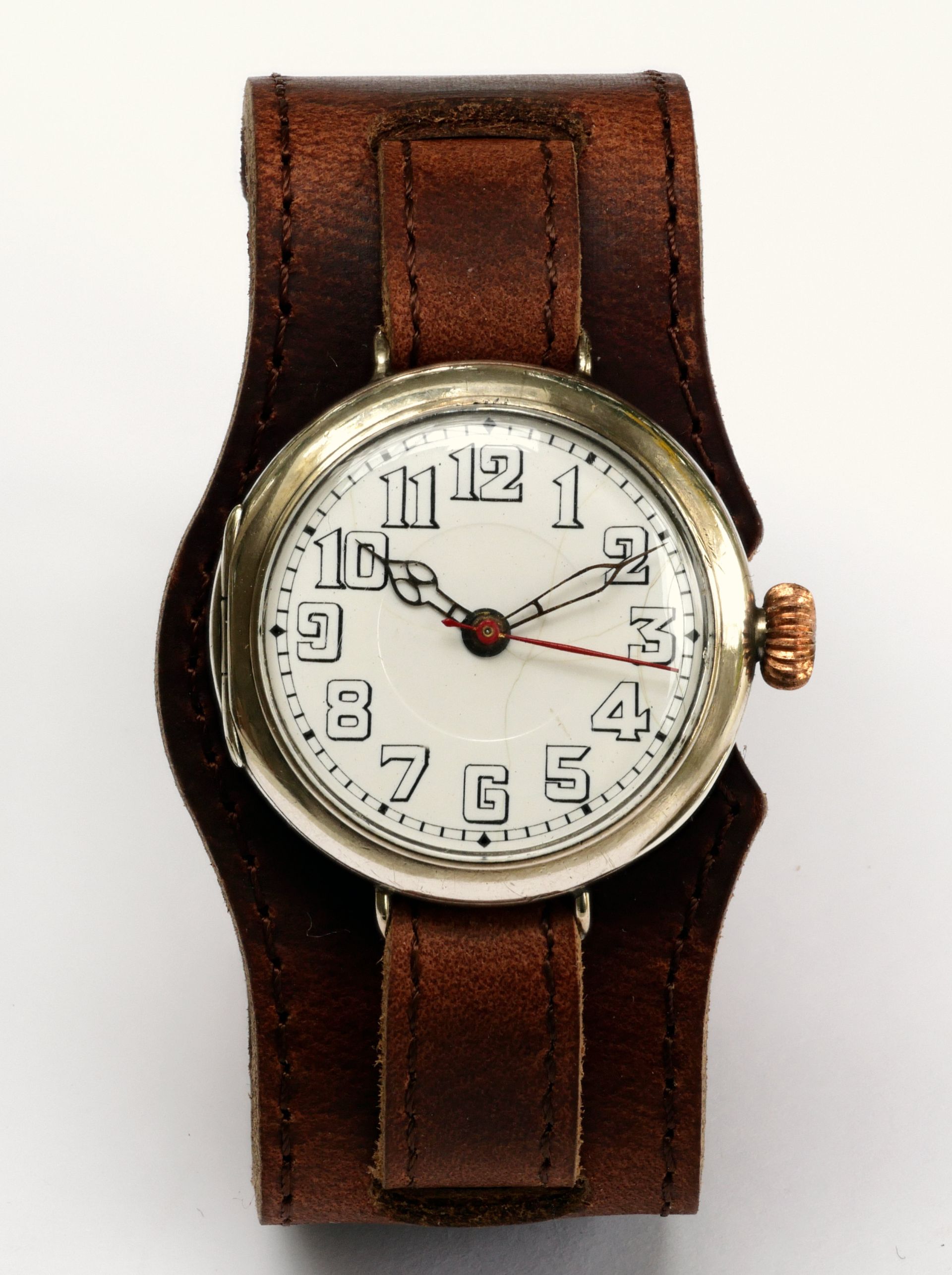
Rolex centre seconds trench watch
Click image to enlarge
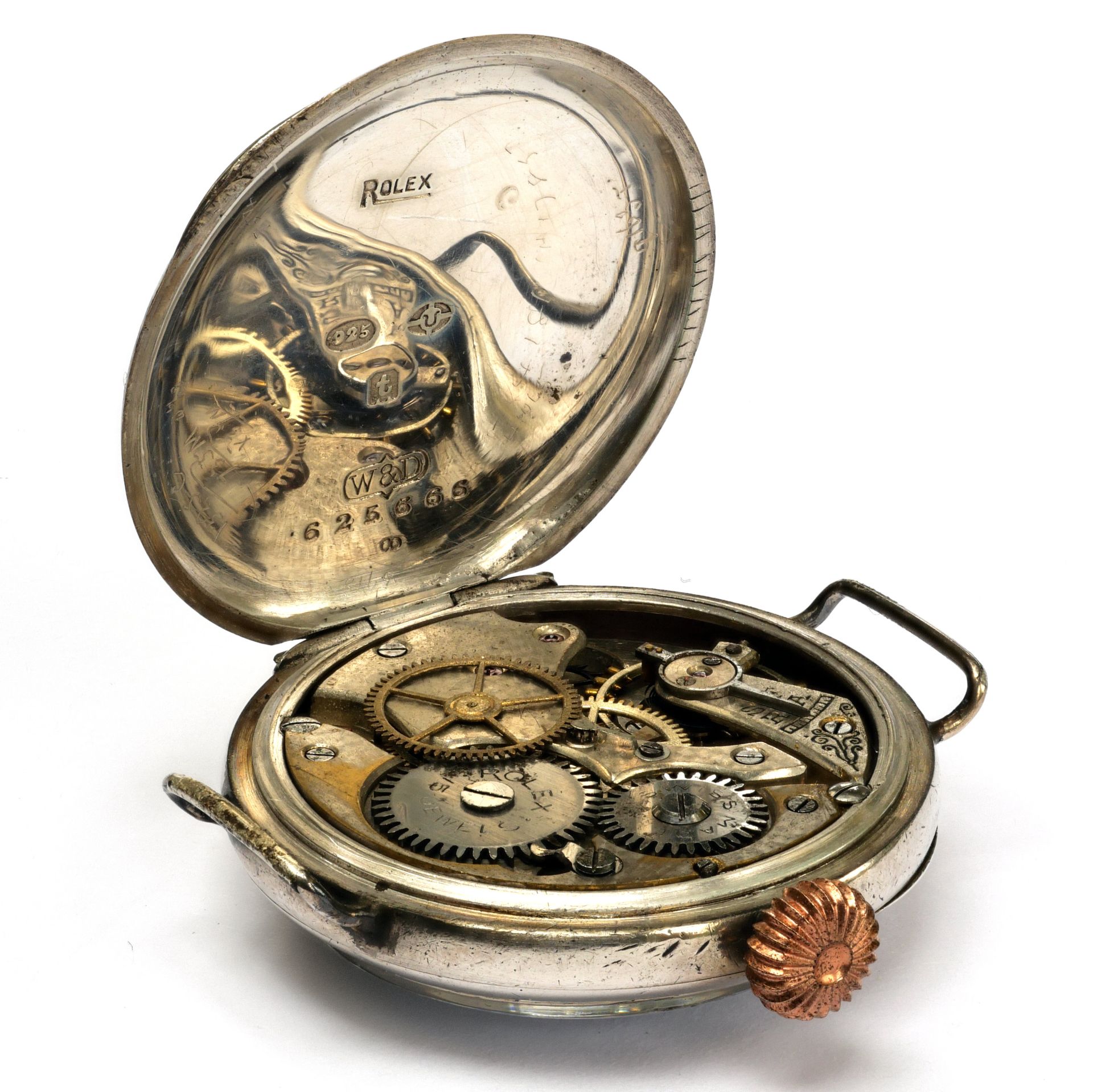
Rolex centre seconds trench watch, single jointed back
Click image to enlarge
The photos here show a Rolex centre seconds trench watch with a single jointed back case.
The case has London Assay Office import hallmarks for sterling silver with the date letter ‘t’ for the hallmarking year from May 1914 to May 1915. The sponsor's mark is the W&D mark entered by Wilsdorf and Davis at the London Assay Office. The case back is also stamped ‘Rolex’. The movement is a 13-ligne, 15 jewel, Aegler Rebberg with ‘Rolex - 15 Jewels’ engraved on the ratchet wheel.
The watch is mounted on an F-Type strap in brown oiled leather, which has the perfect aged look for an original trench watch.
Before the First World War, Wilsdorf and Rolex had concentrated on ladies' bracelet watches. This left them, at the start of the war, unprepared to supply large numbers of men's wristwatches. However, the First World War was the event that transformed men's wristwatches from something confined strictly to military officers in uniform into something that millions of civilian men were prepared to, indeed wanted to, wear. Wilsdorf quickly picked up on this trend, and men's wristwatches became not just a second line, but an increasingly important part of Rolex's range.
Hunter Cases
Some Wilsdorf and Davis trench watches have hunter cases, with a metal lid covering the dial that has to be opened to read the time. These usually carry the legend ‘Brevet  71363’. Brevet means patent in French and the Swiss federal cross shows that this refers to a Swiss patent granted to Charles Zurbrügg on 23 June 1915 for a ‘Boîte-savonnette pour montres-bracelet’, or hunter case for wristwatches.
Zurbrügg hunter cases have screw backs, which give good protection against dust and damp.
Reference to Zurbrügg's patent in hunter cased wristwatches with Wilsdorf and Davis' sponsor's mark and / or Rolex branding has led some people to claim that Hans Wilsdorf bought the rights to the patent. This would have been a bit pointless, because Rolex didn't make watch cases and therefore would have needed to find a watch case manufacturer to make them, something that Zurbrügg, a watch case manufacturer, was already doing. In fact, the story is much simpler; Rolex bought cases made by Zurbrügg's company.

Huguenin Frères Trademark
Huguenin Frères trademark, shown here, is sometimes seen in Rolex hunter wristwatches. The case is also usually stamped with “BREVET DEM”, the DEM indicating that a request for a patent (brevet) had been “demanded”, that is an application for a patent had been submitted but the patent had not been granted, so its eventual patent number was not known.
In September 1916, Huguenin Frères were granted Swiss patent number 72290 for a spring for a wristwatch hunter case, ‘Secret de boîte-savonnette de montre-bracelet’. The lid of a hunter case is normally held closed by a catch. When the catch is released, usually by pressing a button, a concealed spring causes the lid to open. Huguenin Frères invention was a small lever next to the crown, instead of a button, to release the catch. The application for the patent was registered on 20 August 1915.
Huguenin Frères' hunter cases have single jointed backs, which give poor protection against dust and damp.
The presence of Huguenin Frères trademark in the cases of Rolex hunter wristwatches sometimes leads people to assume that Wilsdorf acquired the rights to the patent from Huguenin Frères. However, the truth is simpler. Rolex bought cases from Huguenin Frères.
A Bad Idea
The hunter cased wristwatch was one of the worst ideas in watchmaking. Although it might appear at first sight that a hunter lid protecting a wristwatch's glass was a good idea, especially in combat situations, it was in practice of no real benefit and a downright nuisance.
The principal benefit of a wristwatch is to free the hands. A mounted officer can hold the reins of his horse in one hand, and his sword or revolver in the other, whilst simultaneously reading the time from his wristwatch. In a combat situation, this can be crucial, and a hunter lid defeats it. With a hunter watch, both hands have to be brought together to open the lid and see the time. This defeats the objective of wearing a wristwatch. A pocket watch is more accessible.
Although the dangers of breaking a watch glass were much smaller than the popular imagination conceived, in 1915, trench watches began to be fitted with unbreakable glass. The need for a hunter lid disappeared overnight. This meant that hunter wristwatch cases became easier to get hold of, which may be why so many Rolex trench watches have hunter cases.
If you have any comments or questions, please don't hesitate to get in touch via my Contact Me page.
Copyright © David Boettcher 2005 - 2026 all rights reserved. This page updated March 2026.
Back to the top of the page.