
Blog: Hallmarks on Wristwatch Lugs
Copyright © David Boettcher 2005 - 2026 all rights reserved.First published: 15 July 2025, last updated 16 July 2025.
I make additions and corrections to this web site frequently but, because they are buried somewhere on one of the pages, the changes are not very noticeable. I decided to create this blog to highlight new material.
Note that these articles also get updated, especially soon after they are posted when additional information may be added. Check the “last updated” date to see when the article was last updated.
The section below is from the page about British Hallmarks.
As always, if you have any comments or questions, please don't hesitate to get in touch via my Contact Me page.
Hallmarks on Wristwatch Lugs
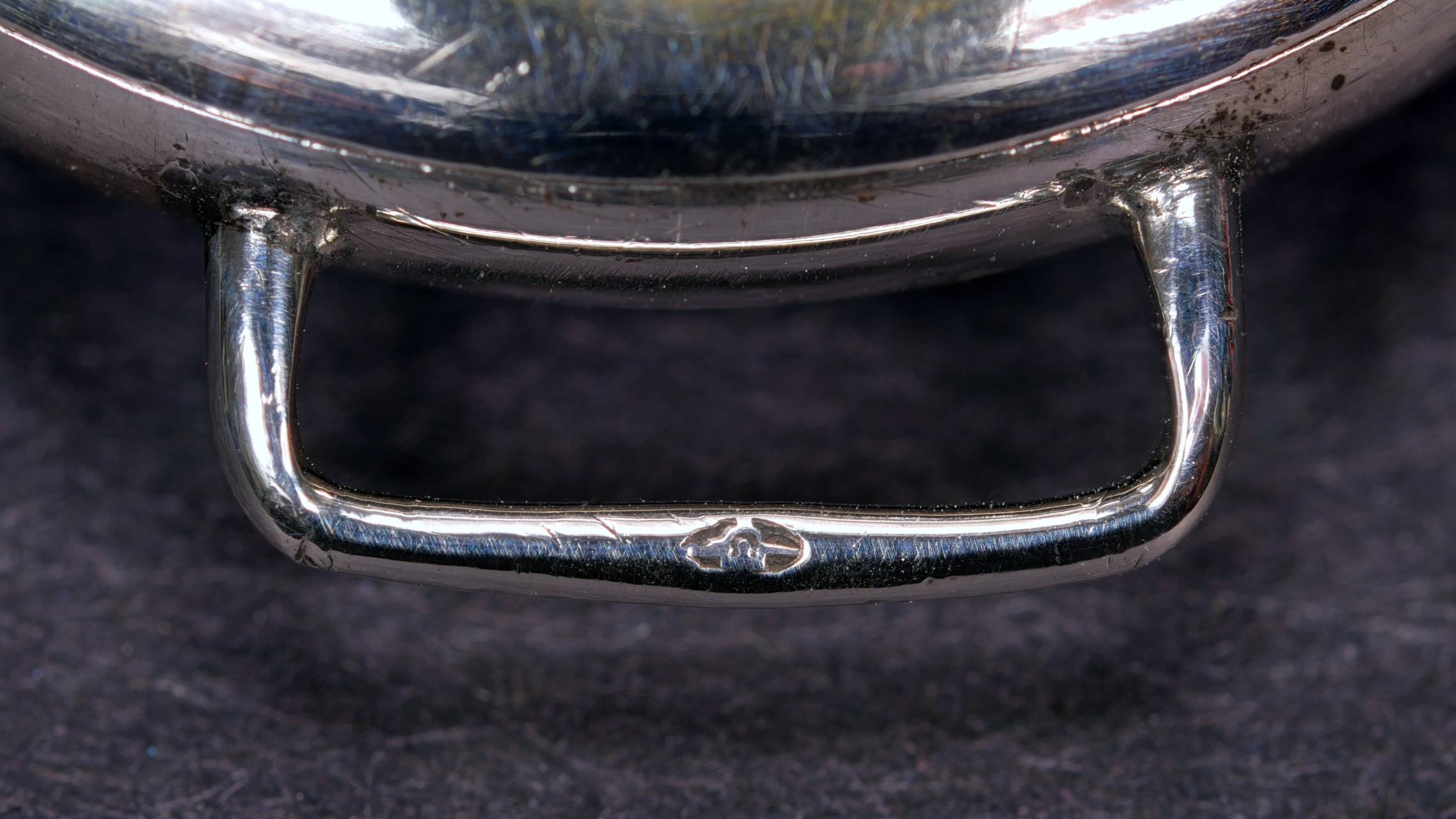
London Assay Office hallmarked lug.: Click image to enlarge
Gold and silver items are often made from several parts soldered together. For example, a cream jug has feet and handles attached to the bowl. When an item made of several pieces is hallmarked, each of the originally separate parts is tested for fineness. The full hallmark is applied to the major part, and part hallmarks are applied to the smaller, added on, parts.
Early wristwatches with gold and silver cases have wire lugs soldered to the middle part of the case. A watch case like this with a jointed back would have the complete set of hallmarks inside the case back, and part marks on the middle part of the case and the bezel. But what about the lugs?
When such wristwatches are examined today, sometimes the wire lugs carry part hallmarks, like the one in the photo here, which has the sign of Leo mark used by the London Assay Office on imported items. The inside of the case has a full set of London Assay Office import hallmarks for 1917 to 1918. Sometimes the hallmarks on the lugs are very faint and hard to make out. One sign that a lugs has a hallmark is that the hallmark punch flattens the wire of the lug a little, causing it to be a flat bottomed oval in cross section.
It is clear that at least some lugs were originally hallmarked, and it is unlikely that this would have been purely at random. A natural assumption would be that both lugs would originally have been hallmarked, and that lugs without hallmarks are replacements.
However, often only one lug carries a hallmark, such as on the watch in the photo, and there is some evidence that hallmarks were originally only applied to one lug.
In 1907, the British Government passed a law, the “Assay of Imported Watch-Cases” Act, which required that from 1 June 1907, all imported gold and silver watch cases had to be assayed and hallmarked in a British assay office.
Because taking samples to conduct the assay damages the surface of the case, Swiss watch case manufacturers sent unfinished cases to Britain to be hallmarked, which were then returned to Switzerland to be finished and incorporated into completed watches, which were then exported to Britain. At first, it seems like this would be a logistical nightmare, but good railway links between Switzerland and Britain made it possible, and Swiss watch case manufacturers simply sent parcels of watch cases to an assay office in Britain to be hallmarked instead of one in Switzerland.

1914 Swiss regulations concerning exports to Britain, Section 4. Highlighted “one of the lugs of wristwatches.”: Click image to enlarge
The outbreak of the First World War in 1914 caused problems with transport between Britain and Switzerland, so in December 1914, the Swiss Legation in London came to an arrangement with the Goldsmiths' Company to have the British hallmarks applied to finished watch cases in a way that any damage caused could be repaired in England.
This required some changes to Swiss hallmarking practice to bring it into line with British law, which are described at Swiss 1914 Decree. Watch cases were then assayed and hallmarked in Switzerland, made into their finished state by the case manufacturers, and then incorporated into completed watches. When these watches arrived in Britain, the movements were removed and the cases sent to an assay office to be hallmarked.
When the cases arrived at a British assay office, they were not assayed. Under the agreement between the British and Swiss authorities, the Swiss hallmark was accepted as evidence of fineness. The cases were then simply, and carefully, stamped with British import hallmarks. They then required only a light polish before being refitted with their movements.
The significant part of the agreement as far as fixed wire lugs are concerned is contained in section 4 reproduced here.
4° Gold cases with finenesses of “9 c.” and 12 c.”, verified by the bureaux de contrôle (Swiss official assay offices), will be provided with the official “federal cross” countermark; these cases must bear the indication of their fineness. The countermark will be affixed to the middles, in the backs and the bowls, as well as on the rings and one of the lugs of wristwatches.
The relevant provision is that the hallmark was applied to only one lug of wristwatches. Lugs were called anses in French, meaning handles.
Although the section is about hallmarking 9 and 12 carat gold cases, introducing for the first time testing at Swiss official assay offices and hallmarking with a federal cross, there is no reason to think that silver cases would be stamped on both lugs when gold cases weren't.
Because the assay and hallmarking in Switzerland had to meet British standards, in order for the agreement to work, the implication is that stamping hallmarks on only one of the two lugs of a wristwatch case was acceptable in Britain, and therefore is likely to be what the British assay offices did.
So it appears likely that gold and silver wristwatch cases with wire lugs originally had only one lug hallmarked. From a limited sample, it appears that this was usually the lower lug, the one beneath the six o'clock.
So, what can this say about the lugs on a watch? If one of them is hallmarked, they look identical and the solder joints are neat and well-finished, the lugs are original. If neither lug is hallmarked and they are identical, particularly if the solder joints are not well-made, then they are not original.
If you have any comments or questions, please don't hesitate to get in touch via my Contact Me page.
Copyright © David Boettcher 2005 - 2026 all rights reserved. This page updated July 2025.
Back to the top of the page.