
The "Invention" of the Wristwatch
Copyright © David Boettcher 2005 - 2026 all rights reserved.Who invented the wristwatch? In reality, it may have been a sixteenth century metal worker who around 1570 made a bracelet watch for Queen Elizabeth. Over the succeeding years, wristwatches were made many times as exotic jewellery for aristocratic ladies.
But then the wristwatch was invented again, this time as a useful way of seeing the time at any moment without having to haul a pocket watch out from a pocket.
So the wristwatch was really invented twice. But when they ask this question, most people mean who invented the man's wristwatch. Was it Rolex or Omega; or perhaps Girard-Perregaux?
Well it certainly wasn't Rolex, because I have men's wristwatches made by Omega and IWC that were made before Rolex existed. What about Girard-Perregaux, who claim to have supplied the German Navy with wristwatches in 1880? That story is apocryphal, which is a polite way of saying that it didn't happen.
Although many watch manufacturers claim to have invented the wristwatch, such a simple thing as strapping a watch to one's wrist didn't actually need to be ‘invented’ because it is an obvious thing to do.
Professor Jaquet and Doctor Chapuis were two very eminent Swiss horologists. Jaquet was Principal of the Geneva School of Horology and Chapuis was Doctor Honoris Causa of the of the University of Neuchâtel. In their monumental Technique and History of the Swiss Watch (ISBN 0 600 03633 2, and weighing in at nearly 2.5kg, truly monumental) they relate the following story about the invention of the wristwatch:
Much has been written about this subject, and we ourselves have heard the following story from an old engraver: A good woman, seated on a bench in a public park, was suckling her child. In order to observe the time, she had attached her watch around her arm. A passer-by was struck by this naive ingenuity. On his return home, he soldered two lugs on to a lady's watch, and added a strap.
Are Jaquet and Chapuis really expecting us to believe that the combined brains of the watch industry, which had produced such mechanical complications as the chronograph, minute repeater, perpetual calendar and the tourbillon, were unable to come up with the idea of soldering two bits of wire on to a watch case before they saw the ‘naive ingenuity’ of this good woman? No, they are certainly not.
Just about every watch manufacturer claims to have been the first to make a wristwatch, and this story is Jaquet and Chapuis poking fun at these claims. Notice how they say ‘... and we ourselves have heard the following story ...’, pretending to throw another (obviously ridiculous) story into the mix, whilst at the same time pointing out that strapping a watch to ones wrist is merely ‘naive ingenuity’ and not a massive technical breakthrough.
A wristwatch is an obvious thing to make. As David Landes points out in Revolution in Time, as soon as spring-driven clocks became small enough to be carried about and worn as an ornament, which happened in the sixteenth century, it was inevitable that someone would make one into a wristwatch.
There was never a patent granted for the invention of the wristwatch, because patents are not granted for inventions that are obvious. The earliest wristwatches were made in the 16th century, and they continued to be made for aristocratic ladies, but it wasn't until the twentieth century that men started widely to wear wristwatches.
Although a wristwatch is an obvious thing, the story of how the wristwatch made its way from the wrists of aristocratic ladies and eventually came to be worn on men's wrists is interesting.
To be most use, a wristwatch has to be open face, that is without a lid covering the front. Creating an open face wristwatch with the 12 in the right place on the wrist, the seconds display at 6 o'clock, and the crown at 3 o'clock, requires much more than just soldering a couple of wire lugs onto a lady's open face fob watch.
Purpose made wristwatches were created by the paradoxical move of putting a savonnette (hunter) movement into a specially made Lépine (open face) case, which I explain at purpose made wristwatches. But this was not technically difficult, and it certainly didn't hold up the creation of wristwatches, or their use by civilian by men.
If wearing a watch on one's wrist was such an obvious idea, as Jaquet and Chapuis point out, and in fact women had been wearing them for centuries, why did it take so long for men to catch on to the idea of the wristwatch? There are two aspects to this question, technical and social. They were;
- Would men wear something that looked like a bracelet?
- Could a watch small enough to be worn on the wrist keep accurate time?
Rather than a massive technical breakthrough where some genius had a flash of inspiration, the true story of men's wristwatches is of how these social and technical barriers were overcome.
If you have any questions or comments, please don't hesitate to get in touch via my Contact Me page.
Back to the top of the page.
The Earliest Wristwatches
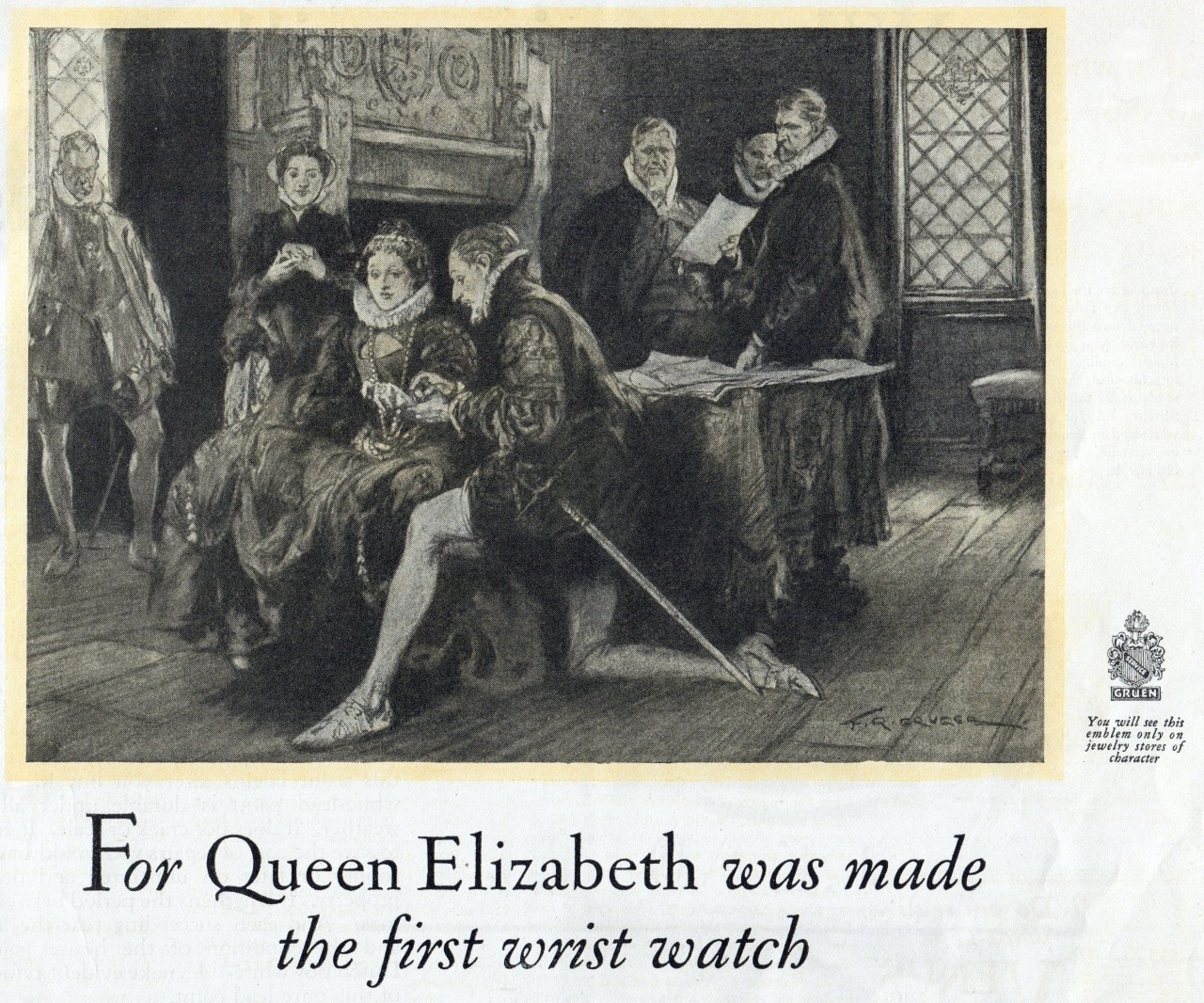
Queen Elizabeth Receiving a wristwatch in 1571. From a 1926 Gruen Advert.: Click image to enlarge
One of the earliest references to what we would perhaps now call a wristwatch was a new year gift received by Queen Elizabeth in 1571 from Robert Dudley, the Earl of Leicester. It was
a richly jewelled armlet, having in the closing thearof a clocke, and in the forepart of the same a faire lozengie djamond without a foyle, hanging thearat a rounde juell fully garnished with dyamondes and a perle pendaunt.
What exactly this item was is not known because it no longer exists, but it clearly contained a spring driven clock or watch, and was intended to be worn on the arm, presumably somewhere where the watch would be easily visible, which would mean the forearm or wrist. The imaginative illustration shown here is taken from a 1926 Gruen Guild advert and shows Robert Dudley presenting the queen with a wristwatch.
In addition to the watch referred to above, it is known that Elizabeth had a watch set in a ring. And it was not only a timekeeper, it also served as an alarm; a small prong gently scratched Her Majesty's finger at the set time. It was probably not a precision timekeeper, but it was certainly a tour de force of miniaturisation for the sixteenth century and showed that there was no technological reason preventing the making of wristwatches.
There is a story that around 1650, Blaise Pascal, the 17th-century French philosopher and mathematician, tied his pocket watch to his wrist with a piece of string for convenience. This does not mean that he wore it as a wristwatch - try attaching a pocket watch to your wrist with a piece of string; it can't be done. What Pascal did was to tie a piece of string to the bow of his pocket watch as a safety device, so that it didn't fall to the ground if he fumbled with it, such as when he was winding it. Blaise Pascal could be said to have invented the Albert or watch guard, but not the wristwatch.
Over the succeeding centuries, smaller and smaller watches continued to be worn by wealthy people as impressive novelties; bracelets, wristwatches, finger rings and even tinier still. These miniature watches were expensive trinkets of little useful purpose; more exotic jewellery than practical timekeepers.
In 1876 it was reported that the Duc de Penthièvre, a grandson of Louis XIV of France and his mistress Madame de Montespan, who had a passion for watches, wore watches in his waistcoat buttons, and had ordered a set for shirt collar and wrist studs.
Although such miniature watches existed, and were often worn by men as finger rings, it is notable that there are no reports from the period of men wearing watches on their wrists. Finger rings were often worn by men and gave rise to no comment, but it is evident that this was not the case for items worn on the wrist, which looked too much like ladies' bracelets for most men's tastes.
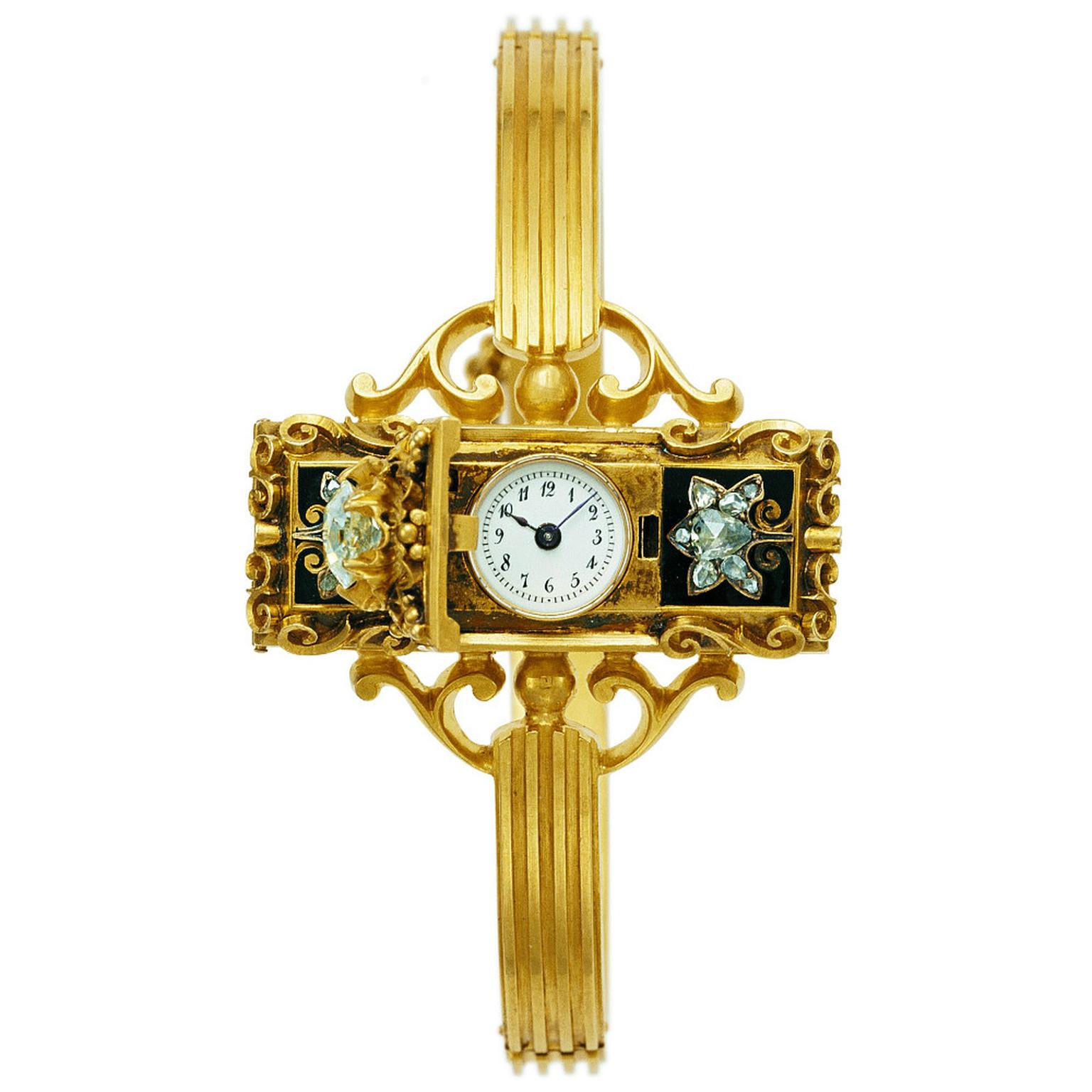
1868 Patek Philippe Bracelet Watch ©Patek Philippe SA Genève: Click image to enlarge
The first wristwatches we have details of were small watches on bracelets (bracelet-watches or montres-bracelets) made for aristocratic ladies, like the one given to Queen Elizabeth in 1571.
An account book of Jaquet-Droz and Leschot of Geneva mentions in 1790, ‘a watch to be fixed to a bracelet’. When Prince Eugène de Beauharnais married Princess Auguste-Amélie of Leuchtenbergin 1809, the Empress Josephine presented her daughter-in-law with two bracelets, one containing a watch, the other a calendar. These were made in 1806 by the Parisian jeweller Nitot.
In 1810 the famous French watch maker BréguetPronounced "Bre-gay" was commissioned by the Queen of Naples to make a wristwatch, which was completed in 1812. Patek Philippe made the key-winding bracelet watch shown here in 1868 for the Countess Koscowicz of Hungary.
These wristwatches were expensive, one-off, items made for extremely wealthy aristocrats. Some indication that this would not always be the case was given at the Great Exhibition of 1851, held in Hyde Park in London. In the Octagon Room, A. Bacher of Stuttgart exhibited a small watch set in a bracelet ‘after the Swiss fashion, which is much admired by the fair visitors.’ This implies that there was already a fashion in Switzerland for ladies' bracelet watches.
At the International Exhibition of 1862 a Swiss bracelet watch exhibited by Courvoisier was stolen. The report of the events records that it was worth £45, a considerable sum of money at the time, and that it was subsequently pawned by the thief for £10.
In the early 1880s, British military men in northern India began strapping watches to their wrists in leather holders called wristlets.
In around 1887, a fashion for wearing wristwatches began among wealthy women of the middle classes. Initially these were also small watches strapped to the wrist in leather holders like the one in the photograph here. In December 1887, the Horological Journal reported:
It has been the fashion for some time past for ladies, when riding or hunting, to wear their watches in leather bracelets strapped to the wrist, so arranged, with the dial of the watch exposed, that the wearer may at once see the time without removing the watch. Bracelets for a similar purpose are now made in gold, and form a pretty and, at the same time, useful ornament.

Wristlet, or Wrist Strap for Pocket Watch
The awkward and bulky leather wristlet watch was not feminine, and not something a watchmaker or jeweller would have spontaneously offered for ladies' wear at the time. Watchmakers soon noticed the fashion and began making ladies' wristwatches with metal bracelets.
This fashion soon spread across the channel into France. In August 1888 the Paris correspondent of the Daily Telegraph reported that ‘some months ago’ it had become fashionable for ladies to carry small watches, at first on their card-cases or in the handles of parasols, and more recently ‘... embedded in a bracelet of Morocco leather which is worn around the wrist.’
Purpose Made Wristwatches
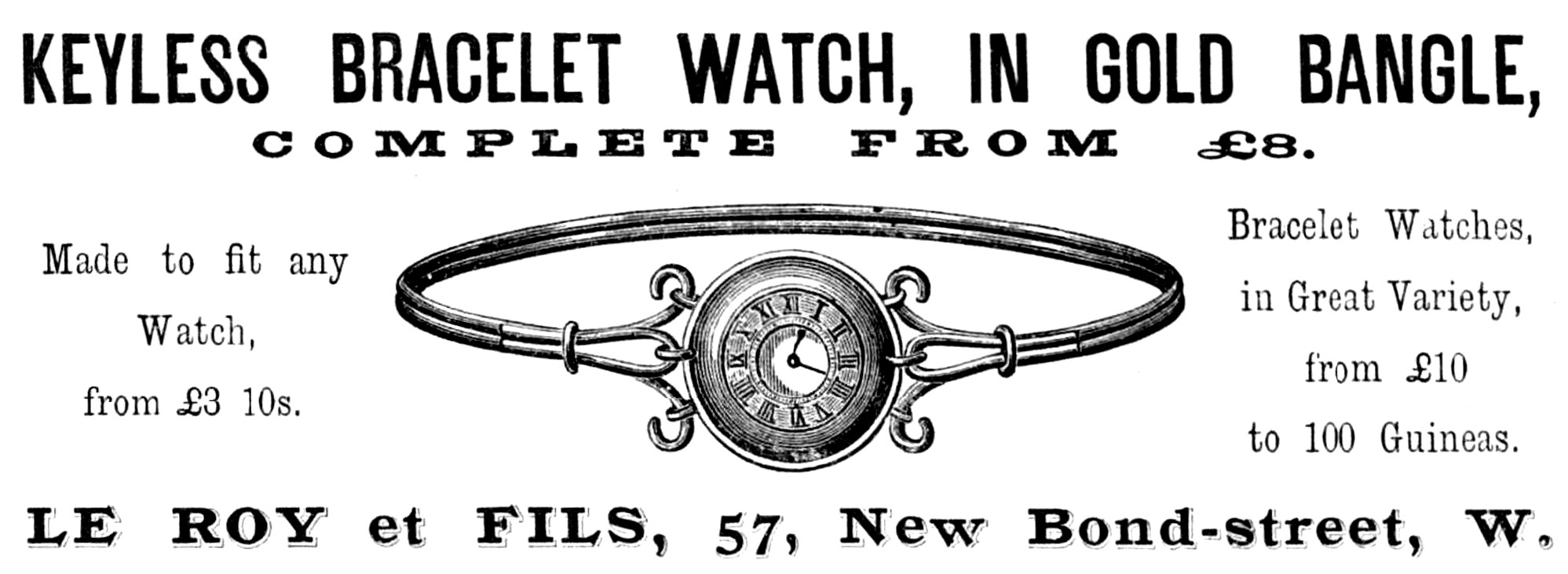
Le Roy Bracelet Watch Advert 1887: Click image to enlarge
The leather wristlet makes a bulky and clumsy wristwatch. Watch manufacturers such as Le Roy were quick to embrace the idea and produce purpose made wristwatches. These quickly became popular with ladies. The advertisement reproduced here shows an advert from December 1887 for one of Le Roy's bracelet watches. Men continued to wear watch wristlets.
Similar developments were taking place in Switzerland. In February 1889, Albert Bertholet of Bienne registered a claim, which was granted Swiss patent number CH 576 in April 1889, for a Montre bracelet simplifiée or simplified wristwatch, which implies that there must have previously been a more complicated wristwatch.
Bertholet's simplification was to do away with the winding and setting by crown and stem. The watch was wound by turning the bezel, which was geared directly to the mainspring barrel; to set the hands a gear, which engaged directly with the cannon pinion, was brought to a small slot in the side of the case so that it could be turned with a finger. This is prescient of similar arrangements in the Harwood self winding watch.
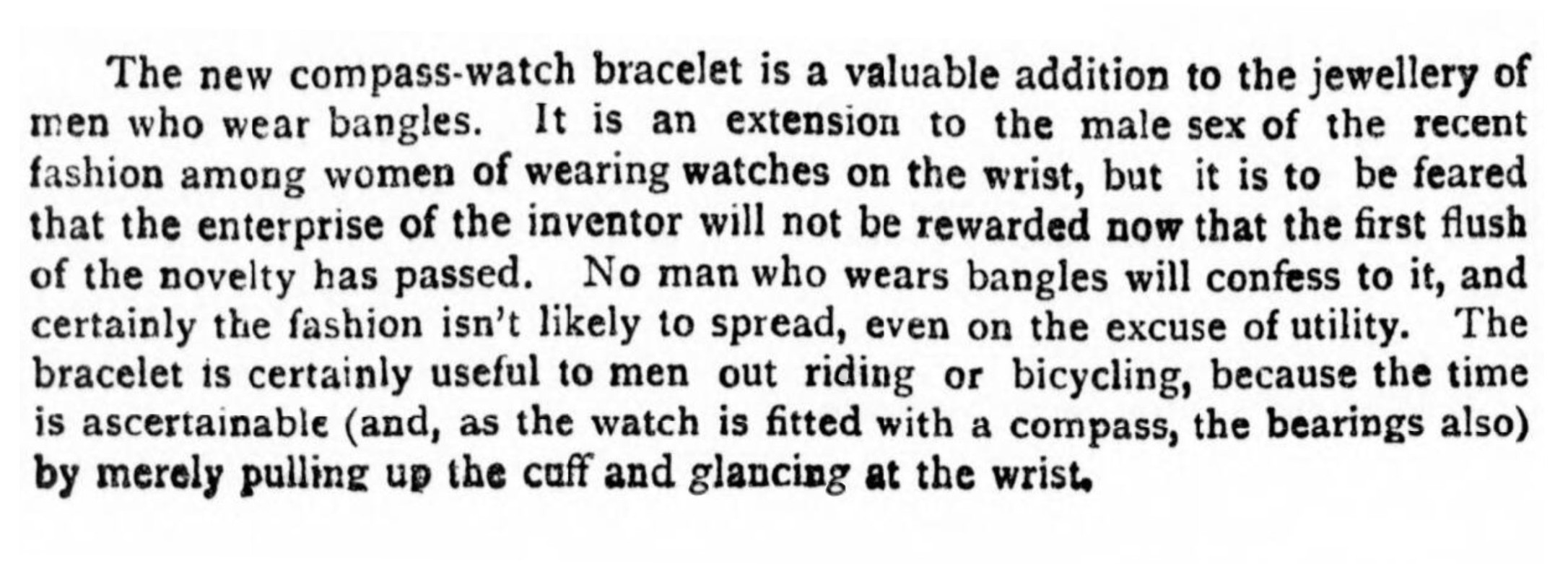
1889 derogatory comments about the Garstin compass-watch bracelet: Click image to enlarge
However, despite attempts to persuade civilian men of the utility of wristwatches, the prejudice against wearing something that appeared like a bracelet and therefore effeminate persisted. In 1889, a scathing comment about the ‘new compass-watch bracelet’ was widely reported in English newspapers. This was a type of wristlet made by Arthur Garstin of Queen Square, London, a large leather goods manufacturer, which included a compass as well as a watch holder.
In a highly derogatory tone, the anonymous writer said that it was a valuable addition to the ‘jewellery of men who wear bangles’, which no man would confess to, and considered it an attempt to extend to men the ‘recent fashion among women of wearing watches on the wrist’. The article opined that this would not persist once the novelty had passed, but did concede that it might be useful when riding a horse or bicycle.
At a time when comments like this could not only be made but were widely reported in the newspapers, it is hardly surprising that civilian men resisted the idea of the wristwatch.
In the week before Christmas 1888, J. W. Robertson-Scott, the Midlands correspondent for The Watchmaker, Jeweller And Silversmith, had a conversation with Louis Platnauer, who he described as the ‘Consul in Birmingham for Portugal.’ Robertson-Scott wrote,
I was somewhat surprised to see on Mr. Platnauer’s wrist one of those wristlet watches. On indicating as much, its wearer waxed quite eloquent on their manifold advantages to gentlemen in wintry weather. In summer men may wear their watches in their pockets if they choose, but surely in winter time it is a convenience to be able to tell the hour of day or night by lifting one’s hand, instead of having to unbutton and re-button a couple of coats in the face of rain or snow. The Consul for Portugal, in the city of Birmingham, has this idea anyhow, and doubtless many other men-folk will soon be thinking with him.
It is quite evident that among ladies these watch wristlets, whether in the form of leather, silver, or gold bracelets, are having a good sale just now. As an ornament, ladies can, of course, wear them upon all occasions at any time of the year, but for shopping expeditions they are of particular service.
For both ladies and gentlemen the wristlets have another no small merit, Pickpockets would find watch-snatching almost an impossibility, were the practice of pocket-carrying of timepieces generally superseded by the use of the wristlet watch-holders.
I understand that military officers find these wristlet watches a great convenience upon the parade ground.
Already the wristlet watches have been largely gone in for on the Continent, where they are now seen quite frequently. It is, too, some time since the wristlets made their appearance at Brighton and such places.
The comment that military officers found wristwatches useful is important. Although civilian men resisted wearing wristwatches for another 30 years, by 1889 a wristwatch had already become am essential part of an officer's outfit.
Back to the top of the page.
Technical and Social Challenges
By the middle of the nineteenth century many, if not most, watch makers were producing bracelet watches, often with elaborate enamelling and jewelling of saphires, rubies, or diamonds. These early pretty, jewellery like, bracelet watches were worn by ladies. Men considered that wristwatches were too small to be properly engineered in order to keep time accurately; and too prone to damage by shock, or contamination with dust and moisture due to their exposed location; and, perhaps most damning of all, effeminate: because wristwatches were only worn by ladies.
A gentleman who wanted to keep track of time carried a pocket watch, usually tucked into a pocket of a waistcoat, a garment introduced by King Charles II in the 17th century, on the end of a long “Albert” chain, a device named after it was introduced by Prince Albert, the consort of Queen Victoria, which had a clip at one end to attach to the bow of the pocket watch and a bar at the other to fasten it to a button hole to prevent the watch being dropped. This was a long standing fashion of how a true gentleman dressed to present himself to the world.
Apart from fashion, there was another challenge for makers of wristwatches to overcome. Portable watches had developed from miniaturised spring driven clocks in the 15th or 16th century, and had been gradually made smaller and slimmer. But there was a general perception, which had an element of truth about it, that an accurate watch needed to be of a certain size, and that to make it small enough to be worn on the wrist would be to sacrifice accurate timekeeping.
The final challenge that a wristwatch had to deal with was what safety engineers call "hazards". The environment within a waist coat pocket is relatively benign; warm, dry and relatively protected from shocks. But strapped to the end of an arm, the wristwatch is exposed to all manner of hazards and rough treatment, it is prone to getting knocked, exposed to dust and splashed with water. All of these hazards presented problems to watch movements of the time, which did not live in hermetic cases, and therefore would get gummed up if dust mixed with the oil, rusty if moisture got in, and were prone to shocks breaking the delicate pivots of the balance staff, only a few 10ths of a millimetre in diameter.
The true story of the wristwatch, or at least of the man's wristwatch (because as we know ladies wristwatches had been available for centuries) is of how it overcame these technical and social barriers to become an essential part of every man's wardrobe - just as the finest and most complicated wristwatches still are today, despite the fact that, with every gadget from phones to computers having a clock built in, they are no longer needed to tell the time!
To move on to the next chapter in the invention of the wristwatch, please go to the page about wristlets and converters.
Back to the top of the page.
If you have any comments or questions, please don't hesitate to get in touch via my Contact Me page.
Copyright © David Boettcher 2005 - 2026 all rights reserved. This page updated March 2026.
Back to the top of the page.