
The Borgel Watch Case Company of Geneva
Copyright © David Boettcher 2005 - 2026 all rights reserved.Pronunciation:
Borgel is pronounced with a soft “g” like mirage.
Although best known in the form of the Borgel officer's watch or Borgel trench watch, so called because they came into popular use during the First World War (The First World War or WW1), when many Borgel wristwatches were bought by officers and used in the trenches at the front, Borgel watches have a history that stretches back into the nineteenth century when in Geneva, Switzerland, a young François Borgel started a business making watch cases. He patented the eponymous Borgel watch case in 1891, making at first pocket watch cases and then later wristwatch cases as the fashion changed from carrying pocket watches to wearing wristwatches.

Borgel's registered trademark
François Borgel was a talented inventor and successful businessman, and the business he created was to grow into one of the most important Swiss watch case manufacturers. Early adopters of the Borgel screw case included Longines and the International Watch Co. (IWC). After François Borgel’s death in 1912 the business was carried on by his daughter Louisa. Louisa Borgel sold the business in 1924 to the Taubert family of Le Locle, who carried it on until the 1970s supplying many watch manufacturers including the illustrious Patek Philippe and Vacheron Constantin.
NB: If you want to know how to safely remove the movement from a Borgel screw case, jump to Removing the Movement.
There used to be a great deal of misinformation concerning the history of Borgel watches and the development of the waterproof watch case, such as the suggestion that one Francis Baumgartner made cases based on the Borgel patent, and was involved in the design and development of waterproof cases culminating in the Rolex Oyster. Francis Baumgartner is in fact a chimera: no watch case maker of this name ever existed. The name arose because two real Geneva case makers, François Borgel (FB) and Frédéric Baumgartner (also FB) had the same initials and the two identities became conflated, in the process turning "François" into the Anglicised "Francis". A further source of confusion is that after the business had been sold the Taubert family they continued to use François Borgel's famous trademark.

NAWCC Bulletin September/October 2012
Here I set straight the history of the Borgel and Taubert companies based on factual evidence. This page is about the company under François Borgel and his daughter Louisa, there is another page about the history of the company in the ownership of the Taubert family.
A longer version of this web page was published in 2012 and 2013 in four parts in the National Association of Watch and Clock Collectors (NAWCC) "Watch & Clock Bulletin".
- The first part of this article, concerning François Borgel and covering the period from about 1880 to 1912, was published in Volume No. 399, the September/October 2012 issue, the cover of which is shown here. The watches are top left - a Borgel wristwatch with a Longines movement, centre - a Borgel wristwatch with an IWC movement (the earliest Borgel wristwatch I have seen, IWC have verified that it was made in 1906), bottom right a Borgel pocket watch, and bottom left a Borgel pocket watch belonging to Ralph Ehrismann with an IWC movement and a type of case decoration patented by Borgel. This watch was made in 1894 and sold by IWC in 1895.
- The second part of my article, about Louisa Borgel and covering the period from about 1912 to 1924 including the huge take up of Borgel wristwatches during WW1, was published in Volume No. 400, the November/December 2012 issue of the NAWCC Watch & Clock Bulletin.
- The third part, about the takeover of the Borgel company by the Taubert family and their development of new waterproof watch designs, was published in Volume 402, the March/April 2013 Bulletin.
- The fourth part describing some of the many watch manufacturers who used Taubert cases, including Patek Philippe, Vacheron Constantin, Alpina, Mido, Movado and The West End Watch Co. was published in Volume No. 403, the May/June 2013 Bulletin.
I understand that copies of all NAWCC Bulletins can be purchased from the NAWCC.
If you have any questions or comments, please don't hesitate to contact me via my Contact Me page.
Back to the top of the page.
FB: Borgel Jewellery?
François Borgel's trademark
If you have come here looking for information about jewellery or earrings supposedly made by François Borgel, then I am sorry to disappoint you but there is no such thing. François Borgel and the companies that used his famous trademark shown here, the initials “FB” over a key of Geneva within a rectangular surround, only ever made watch cases; and they never stamped anything with just the initials FB.
The attribution of jewellery or earrings to François Borgel just because it is marked with the initials “FB” is based on an erroneous assumption. It is easy to see that these initials bear no resemblance to François Borgel's trademark. Just to be clear: François Borgel and the successor companies that used the “FB-key” trademark never, ever, made jewellery, rings or earrings.
There is a jewellery company that was founded in 1927 by Franz Breuning in Pforzheim, Germany, a town long known known for its jewellery and watch-making industries. It is most likely that the FB found on jewellery, rings and earrings are the initials of Franz Breuning. The Breuning company's web site can be found at Breuning which shows details of their current range of rings, wedding rings and jewellery.
François Borgel 1887
A new watch company set up in 2017 trading under the name “François Borgel 1887”. This company seems to claim a “heritage” from the original Borgel company stretching back to 1887, when François Borgel registered his trademark. This is a blatant lie; the new company has absolutely no connection with the original François Borgel company, which didn't make watches.
François Borgel

Towards the end of the nineteenth century in Geneva, Switzerland, François Borgel set up in business making watch cases. Not content with making ordinary watch cases, he soon developed a technique for making a steel case appear to be encrusted with gold, a process he patented in 1888. In 1891 Borgel patented the screw watch case design that most often bears his name today, the Borgel Case.
The Borgel screw case was first used for Borgel pocket watches before achieving wide use during the First World War (First World War, 1914 - 1918) for Borgel wristwatches. These were purchased by Officers to wear in the cramped and often damp conditions of the trenches, hence the terms Borgel Officer's watch or Borgel trench watch. A wristwatch with a Borgel case was significantly more expensive than one in an ordinary case, but it was the best wristwatch available at the time for life in the trenches and, just as much as now, military men didn't like to economise on kit on which their life might depend. Wristwatches from the time of the First World War with Borgel cases are usually in much better condition than those in ordinary cases, showing the wisdom of that choice.
François Borgel - Early Life

Borgel advert from 1886: Click image to enlarge
Dennis Harris1 records that François Borgel was born on Friday 22 August 1856, the son of Laurent Borgel and Marie Besson. He started in business under his own name in 1880 at age 24. Harris says that in local records he is described as a “watch case fitter”. This was most likely a “monteur de boites”, which translates literally aa s box assembler but was a term used at the time for watch case makers.
The first official record of François Borgel is dated 28 February 1883, the first year of official records of Swiss businesses. It is recorded that the head of the company F. Borgel in Geneva is Francois Bénédict Borgel, from Geneva, domiciled there. Type of business: manufacture of silver watch cases. Workshop: 25, Chantepoulet. Because 1883 was the first time records of Swiss businesses had been compiled, this does not contradict the statement that Borgel started in business in 1880.
The advert from 1886 reproduced here says that the Borgel factory at 17, Place Cornavin, Geneva, the old Tiffany Factory, makes steel watch cases “a verre”, that is open face (Lépine) and savonnette, with or without joints (charnières, or hinges). If joints are wanted, they can be in 9-carat red gold or metal (maillechort). There are oval or cylindrical assortments. Olivettes for push-pieces to set to the time are soldered and can be gold plated. There are ready-made cases for movements from the ébauche factories of Cortébert, Fontainemelon, Granges, Moutier-Grandval, Amann & Béguelin, etc., in 12, 13, 14, 18, 19 and 20 lignes, or cases can be manufactured for any kind of movements whatsoever.
The factory at 17, Place Cornavin had been occupied by a branch of Tiffany, the New York jeweller. It was equipped with a steam engine in the basment driving line shafts on the floors above which could be used to drive lathes and other machines. When Tiffany pulled out of Switzerland after only three years, they asked Patek Philippe to oversee the lease of the building. In 1884, it was occupied by an electrical wholesalers, but by 1886 François Borgel had taken it over.

Coat of Arms of Geneva with key

Borgel's registration of his trademark. From the Archives de l'Horlogerie.
Swiss patent specifications do not carry the address of the patentee, but the British version of Borgel's patent for the screw in watch case, No. 20,422 dated 1891, gives his address at the time as 1 Place Cornevin, Geneva. This address contains a spelling mistake and must refer to the Place Cornavin. I am not sure whether Borgel has moved from 17 Place Cornavin or whether this is simply another mistake.
Borgel registered his "marque de fabrique" or trademark in Geneva on 17th March 1887 as shown in the registration published in the official Swiss horological trademarks register, the "Archives de l'Horlogerie. Marques de fabrique et de commerce Suisse. Enregistrés par le Bureau fédéral à Berne."
The registration says that François Borgel is a manufacturer (fabricant), an important distinction from a mere reseller of others items, and his registered (déposée) trademark proudly bears his initials FB and the Clé de Genève (Key of Geneva), a symbol from the coat of arms of the town of Geneva, the ancient centre of Swiss watch making.
The registration shows that his line of business was making "Boîtes de montres" literally boxes for watches, or watch cases, in gold (or) silver (argent) and steel (acier), and also other horological items. The “box” is a term used in English watchmaking for the inner case of a pair cased watch, which fell out of use in favour of “case” on England when single cases took over from pair cases. However, box, or boîte, was retained in Swiss watchmaking.
Borgel's First Patent
On 3 December 1888 Borgel was granted Swiss patent number 16 (yes, this was the sixteenth Swiss patent, patent law was only introduced in Switzerland in 1888) on a new process for making metallic plates for watch cases, medallions and other jewellery. (Brevet No. 16: Nouvelle composition des plaques métalliques servant à la fabrication des boîtes de montres, médaillons et autres bijoux.)

Borgel black oxidised dragon case
Image by permission © Ralph Ehrismann
Borgel's process was to apply a layer of gold onto an iron or steel plate, then remove some of the gold with a graver (an engraving tool) to expose the iron or steel below. Depending on the amount of gold removed, this could give the appearance of a gold item with the contrasting base metal showing though, or a steel item with pieces of gold attached to it.
An addition to the first patent was granted on 28 March 1889, Brevet Additionnel No 9, for applying several layers of different colours of gold (green gold, red gold, etc.) so that these different colours could be selectively revealed by careful use of the graver, creating the effect of a rainbow of colours.
The picture here shows an IWC pocket watch with a case made by Borgel using this technique to create a striking dragon design. The watch was sold by IWC in 1895 to Didisheim Goldschmid of La Chaux-de-Fonds. The movement is an IWC caliber 52, 19 ligne H7, manufactured in 1884. The case is described in the IWC archives as acier è vis oxide, which means an "oxidised steel screw case".
The steel base metal revealed by paring away the gold to create the intricate dragon design has been blackened by a process called black oxidising which involves immersing steel in hot caustic soda to produce a surface layer of black magnetite. Because of the temperature and the caustic materials involved, it is a dangerous process. Borgel first removed part of an overlying layer of gold to form the design and then dipped the case in the hot solution to blacken the exposed steel. Presumably, he must have discovered that the blackening process did not affect the gold or that the gold could be polished after the steel was blackened. This must have been a difficult process to get right, but the results are stunning.
Harris1 quotes from a report by Mr Tripplin on the French International Watch and Clock Making Exhibition of 1889. Tripplin recorded that "A Geneva exhibitor, M. Borgel, shows artistic case making, a steel case with encrustations of gold struck us favourably..." Having established his own business, and now attracting favourable comment with this eye catching patented technique, Borgel was starting to forge his own way in the world and make a name for himself.
Back to the top of the page.
Borgel's Patent Screw Case

Borgel 1891 patent CH4001

Swiss announcement in 1891 of patent CH4001

Borgel Screw Case Advert 1894
Borgel's famous patent for the one piece screw in watch case design that now most often bears his name was published on 28 October 1891 with the Swiss "Brevet" or Patent, number 4001. (CH4001, François Borgel à Genéve. Nouvelle boîte de montre.)
This patent was also registered in Britain on 24 November 1891 with British Patent number 20,422, and in America with patent number US 478,734 dated 12 July 1892.
The image to the left here is the announcement in the Swiss trade press of Borgel's patent. The figure from an 1894 advert shows the principle of the invention.
The case is made in one part with no opening back to make it weaker or let in moisture and dust. The movement is held in a carrier ring with screw threads on the outside that screws into the case from the front. The bezel with the crystal is mounted on the outer end of the carrier ring. When the movement is fully screwed home, the bezel fits tightly against the case, sealing the front of the case.
The effectiveness of this design is evident today; the movements of watches a hundred years old or more with Borgel cases are usually in fine and clean condition, showing that the case is highly effective in keeping out dust and damp.
The larger diagram to the right here is a figure from the Swiss patent.
The Borgel screw case was an early dust and moisture resistant watch case. The case back and middle part are in one piece, so there is no opening at the back. The front opening of the case is thickened and threaded internally with a fine thread. In the diagram from the patent, the case back which is at the bottom in the photograph is labelled "A" and the threaded carrier ring "C". The threaded carrier ring "C" engages with a screw thread in the opening at the front of the case at "a".
The movement, complete with dial and hands, is mounted in the carrier ring, and the bezel carrying the crystal is pressed onto the end of the carrier ring. The assembly of carrier ring with movement, dial, hands, bezel and crystal is then screwed into the case from the front.
Because the movement screws into the case from the front, there has to be a way of withdrawing the stem, or part of the stem. Borgel achieved this by splitting the stem into two parts, one of which is mounted in the movement, the other of which is attached to the case. This split stem arrangement means that most Borgel screw cases are fitted with pin set movements.
At the time, the major concern of watch manufacturers was dust entering the case and contaminating the lubricating oil on the movement, causing it to thicken and become abrasive, slowing the action and wearing the pivots. The single front case joint which was closed tight by the fine thread of the carrier ring virtually eliminates the opportunity for dust or water to enter the case and the Borgel screw case was considerably more dust and water resistant than cases with jointed or snap on backs and bezels.
Although many Borgel screw cases now have a considerable degree of play in the threads of the case and carrier ring after 100 years or so of being screwed together and unscrewed, when they were new these threads engaged closely and the bezel screwed down tightly onto the case. The split stem arrangement meant that the opening in the case for the stem was also better sealed than on many cases. When it was new, a Borgel screw case was considerably better sealed than many people think – I describe below an experiment I did on one of my Borgel watches to see how waterproof it really was, and I was quite surprised by the result.
There are more details about the Borgel screw case, including how to remove the movement, in the sections beginning The Borgel Case in Detail.
Back to the top of the page.
World's Columbian Exposition

Borgel 1894 advert
Pritchard records that Borgel exhibited watches at the World's Columbian Exposition in Chicago, 1893. Named after Christopher Columbus, the Fair was a celebration of the 400th anniversary of Columbus' discovery of the New World.
The World's Columbian Committee on Awards recorded the following comments about Borgel's exhibition:
F. Borgel, Geneva, had something new in his waterproof cases made in a single piece without joints; many of them were made of oxidised steel inlaid with gold. A number of the smallest watches made, beautifully decorated with diamonds and enamels, in small globes, bracelets, and chatelaines were very attractive and showed great skill in this most delicate department of watchmaking.
The Jewelers' Circular and Horological Review report of the exhibition stated:
François Borgel shows the latest novelty in economical and waterproof watch cases. These are made in a single piece to screw without a hinge and are patented in all countries. The line is shown largely in oxidised steel with inlaid gold ornaments. One has the face of the Pope, another that of President Carnot. A line of oxidised steel and gold watch bracelets is also shown.

Tissot report 1894
In a report on the exhibition, Charles-Emile Tissot commented:
... a special kind of watchcase by François Borgel of Geneva. What he presents is of a construction completely different from that of the current cases, the movement is placed in a ring which is threaded on the outside and that screws into the case, the crystal and bezel fits onto the middle and this combination provides a tightly closed and waterproof case, bowl shaped, elegant and slim.
The advert reproduced here was published in the trade journal "La Fédération Horlgère Suisse" in 1894. After advertising that his new economical and impermeable watch case is patented in all countries (Brevetée dans tous les pays) and that counterfeiters will be prosecuted to the full extent of the law (Les contrefacteurs seront poursuivis avec tout les rigueurs de la loi) and that the case is made in all sizes and for all kinds of movements (Fabrication en toutes grandeurs et pour tous genres de mouvements), Borgel records a Great success at the Chicago exhibition. He was awarded a medal and diploma for his exhibit, recognising the impermeability, elegance, strength and economy of his watch cases.
The two notices at the bottom of the advert advise watch manufacturers that Borgel has signed up Dubail, Monnin, Frossard & Co. of Porrentruy, and Fabrique de Fontainemelon, a very large maker of mass produced ébauches (bare movements), to make movements specially designed to fit into Borgel screw cases. This means they would supply their movements with the short split winding stem and pin-set hand setting mechanism, ready to drop straight into the carrier ring of a Borgel case. All the "manufacturer" would need to source in addition would be the dial and hands, and he could then assemble complete watches!
Dubail, Monnin, Frossard & Cie was founded in Porrentruy in 1873. It it was the first Swiss watch company to register the design of a movement calibre. The company registered a trademark of a phoenix rising from a fire, first spelt "Phönix" then "Phenix" from 1887. On February 3rd 1900, Dubail, Monnin, Frossard & Cie and Société d'horlogerie de Bassecourt merged as 'Société Horlogère de Porrentruy. The new firm inherited the trademarks of the Phenix from Dubail, Monnin, Frossard & Cie and Rooster with Chickens from Société d'horlogerie de Bassecourt, which had been registered in 1883. The new firm won a gold medal at the Paris Exposition in 1900. The Société Horlogère de Porrentruy changed its name to the Phenix Watch Co. in the 1920s.
Fabrique d'Horlogerie Fontainemelon (FHF) was established in 1793 by Isaac and David Benguerel-dit-Perrenoud, with Julien and François Humbert-Droz, to supply Swiss manufacturers with the large volumes of ébauches they required. It was the first step towards large scale mechanised manufacture of watch movements. In 1879 the Journal Suisse d'Horlogerie said in a report L'Industrie Horlogère Suisse that in the preceding 40 years the Fontainemelon factory, along with Japy Freres in Beaucort, France, had supplied nearly all the ébauches used in the cantons of Neuchâtel and Berne. In 1880 the company employed 400 workers and produced 240,000 ébauches a year. In 1926 FHF merged with AD Michel SA of Grenchen and A Schild SA, also of Grenchen, to form ébauches SA. At the time these three factories manufactured more than 75% of all Swiss ébauches. ébauches SA eventually became ETA, the movement maker now part of Swatch Group SA.
Back to the top of the page.
Borgel Watch Types

A Borgel Open Faced Pocket Watch
For the first 10 or more years after the patent was granted in 1891 the only type of case produced by Borgel was for pocket or fob watches. The picture to the right shows a Borgel cased open faced or "Lépine" style pocket watch.
Because of the way the movement screws into the case it was not easy to make a Borgel case in the savonnette or hunter style, where a hinged metal cover protects the crystal, and I am not aware that any Borgel pocket watches with hunter cases exist. Some wristwatches had hunter lids added in England during the First World War, but I am sure that the Borgel company in Geneva never produced a savonnette or hunter case, for either pocket or wristwatch.
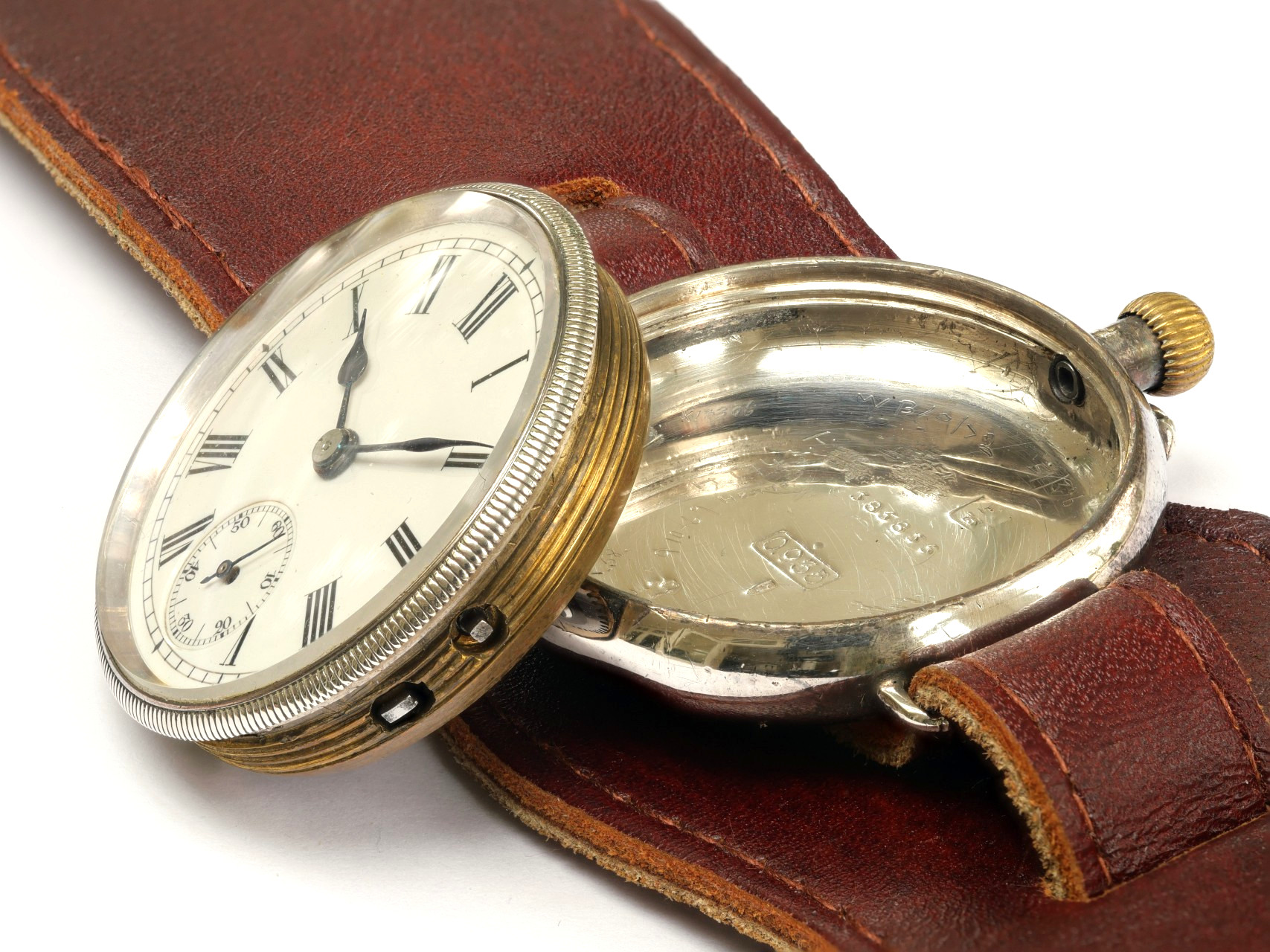
The picture below left shows a Borgel cased wristwatch with the movement unscrewed from the case. The case has London import hallmarks for 18 carat gold, the date letter "t" for the hallmarking year 1914/1915 and the sponsor's mark CN for Charles Nicolet of Stauffer & Co. The movement is an IWC calibre 64 "savonnette". The earliest Borgel wristwatch that I am aware of was made in 1906 by IWC.
The assembly leaning against the case shows the carrier ring complete with movement, dial, hands, bezel and crystal. The two holes visible in the carrier ring are where the winding stem and the push pin for hand setting, which are mounted on the case, engage with the movement.

A Borgel wristwatch in 18 carat gold
Another feature of the wristwatch is that it has a tube projecting from the case with the winding crown mounted on the end of it. This is a carry over from the pocket watch, where the tube is called the pendant. On a pocket watch the pendant carries the bow or ring to which is attached a chain or leather fob, and the watch hangs from this, hence the name pendant.
Most wristwatches do not have a pendant, the winding stem simply projecting straight through the wall of the case, with the crown mounted directly onto the end it. But in a Borgel watch, the stem tube is required to enable part of the stem to be withdrawn so that the movement can be screwed in and out of the case.
Even for wristwatches without any trace of a pendant, the term pendant is sometimes used instead of crown, causing great confusion for those not familiar with pocket watches. For instance timing trials of wristwatches such as those at Kew often refer to positions such as "pendant up" and "pendant down" as a carry over from testing pocket watches. If you mentally substitute "crown" for "pendant" you will understand the orientation.
Back to the top of the page.
The Borgel Screw Case in Detail

Exploded View of a Borgel Screw Case
Borgel screw case cross section: Click image to enlarge
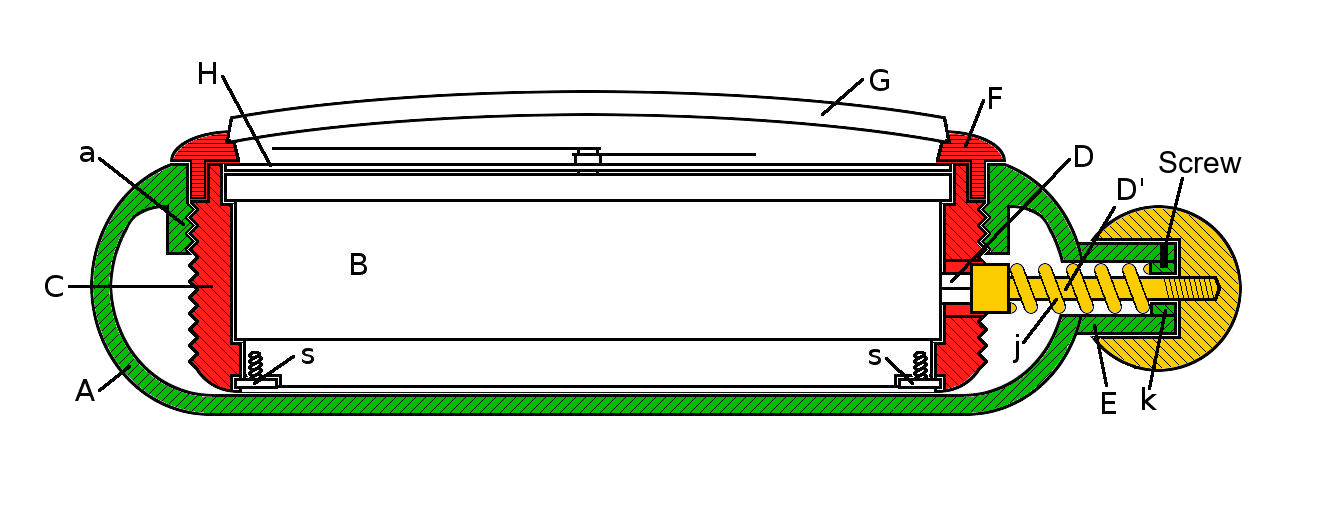
The diagram shows a cross section through a typical Borgel screw case when assembled - click on it to get a larger view.
The main part of the Borgel case is coloured green, the crown and part stem that pulls out are yellow, and the carrier ring and bezel that contain and hold the movement are coloured red.
The split stem has one piece of the stem D in the movement with a square section on its outer end. The other piece of the stem D' with the crown, is spring mounted in the stem tube E on the side of the case. This part of the stem has a hollow square in its end, which engages with the square end of the piece of the stem in the movement.
Normally the spring j keeps the outer stem coupled to the inner stem. When the movement is to be removed from the case, the crown is pulled outwards, which compresses the spring j.
The spring j is retained in the stem tube E by the collar K, which is held in place in the stem tube by a small screw as shown in the diagram. The screw and collar K should not normally be removed.
The movement B, with dial H, is carried by the carrier ring C which has a screw thread on its outer face. The thread on the carrier ring engages at a with a thread in the front opening of the case. The movement is held in the carrier ring by the case screws S. The bezel F with crystal G is a press fit onto the outer end of the carrier ring.
The picture to the right shows an exploded view of a Borgel screw wristwatch case. From the top we have:
The bezel and crystal.
The movement, complete with dial and hands.
The threaded carrier ring.
The case screws that hold the movement in place in the carrier ring.
The Borgel one piece screw case itself, complete with crown and case stem, and push pin for hand setting.
To assemble the watch from the disassembled condition, the movement is placed in the threaded carrier ring and secured in place by the case screws. The bezel is then pressed onto the upper end of the threaded carrier ring. The bezel is a friction fit on the end of the threaded carrier ring. There is usually a small key on the carrier ring that engages in a slot in the bezel, presumably to prevent it rotating although this is not necessary if the bezel is a sufficiently tight fit onto the carrier ring. If the bezel is not a tight press fit onto the carrier ring, it is likely to fall off in service so this must be corrected.
The assembly of carrier ring with movement and bezel is then screwed into the case. To do this, the crown, which is spring loaded into the position shown, is pulled away from the case. This withdraws the portion of the case stem which is just visible in the picture, clearing the way for the movement assembly to be screwed in. The movement assembly is offered up to the front case opening and, gripping the milled edge of the carrier ring, very gently rotated until the threads on the carrier ring and in the front opening of the case engage. This can be difficult because the threads are fine, so patience and a gentle touch is required. Once the threads are engaged, the movement assembly can be screwed fully into the case. As it approaches near fully home, with the 12 close to its correct position, let go of the crown and the stem will snap into place when the 12 is in the right position.
Back to the top of the page.
Removing the Movement From a Borgel Case
Borgel screw case cross section: Click image to enlarge
The correct way to remove the movement is by unscrewing the whole assembly of bezel, carrier ring and movement from the case.
Do not lever off the bezel and then try to unscrew the movement, see the “Caution!” below.
The cross section of a Borgel case gives an idea of how the movement is removed from the case. The parts coloured red, the bezel and carrier ring, and the crystal and movement which they hold, are unscrewed as a complete assembly from the front of the case by turning the bezel coloured red and labelled “F”. To allow the movement to turn, the case stem, shown in yellow, must first be withdrawn by pulling on the crown, also in shown in yellow. The spring coiled around the case stem allows this to happen.
To unscrew the movement from the case, first pull the crown outwards and hold it out with one hand. This is easiest if the thumb and first finger are used to hold the crown, with the case resting in the palm of the hand. This disengages the case stem from the movement and keeps it clear of the movement while it is being unscrewed from the case. Then with the fingers of the other hand, turn the milled bezel so that the movement assembly unscrews out of the front of the case. Do not press down on the bezel while you are doing this; if anything, try to pull it gently away from the case.
Inserting the movement assembly back into the case is the reverse of this procedure. The threads in the case and on the carrier ring are very fine, so be careful that they are properly engaged and don't get them cross threaded. If everything is lined up correctly the movement should screw back into to case easily. When the movement is nearly filly screwed in and the 12 on the dial is approaching the correct position, release the crown and continue turning the bezel, you will see and feel the stem snap back into place and the movement will stop turning.
If you have any doubts about doing this, please refer to the diagram and detailed explanation of the Borgel screw case so that you understand how it works. If you click on the diagram it will enlarge to give you a clearer view.
Caution!
Do not lever off the bezel of a Borgel screw case with the movement in the case.

Cut Borgel Screw Case - this is not supposed to happen!: Click image to enlarge.
It is a very bad idea to lever the bezel off a Borgel screw case watch with the movement in the case, and worse still to press the bezel on with the movement in the case. It is totally unnecessary and the Borgel case was not designed to have this done.
Vendors who show watches with Borgel screw cases with the movement in the case and the bezels detached alongside don't know what they are doing and should be treated with extreme caution - the movement, dial and case could easily have been damaged by their reckless actions.
When the movement is fully screwed home, the bezel fits tightly against the case, sealing the front. Inserting something into this joint to lever the bezel off can damage the sealing surfaces. The bezel was not designed or intended to be levered off like this. When the movement is out of the case there is a land on the carrier ring that is designed to be used for safely prying the bezel off the carrier ring.
Levering off the bezel with the movement in the case can not only damage the case and bezel, it leaves the hands and dial exposed to damage. Even if the hands are removed, it is difficult to unscrew the movement from the case by pressing on the dial and turning. The downward pressure actually opposes unscrewing, and there is a risk the turning force will tear off the dial feet, which will crack and ruin the enamel dial and bend or break the small seconds arbor.
The worst damage can occur if the bezel is pressed back on with the movement in the case. It is difficult, pretty well impossible, to get the bezel seated fully and correctly, which means that it might later drop off and get lost. Also, because the carrier ring is only supported by the case threads, these threads can be damaged or become crossed by the force applied to the bezel to get it to seat. This can make it impossible to subsequently unscrew the movement. I have a Borgel watch where this has been done. After many years of trying various ways to get the movement out, in the end the only way was to cut the case as shown in the image.
The only way that the bezel of a Borgel screw case can be pressed back onto the carrier ring properly and safely is with the carrier ring resting on the bench. It is not safe to do this with the movement in the case.
The Borgel case was not designed to have the bezel levered off with the movement in the case. It is unnecessary and can easily cause damage. DON'T DO IT!
Further Dismantling
If you wish to remove the movement from the carrier ring, and you have the right tools, technique and experience, then this is how you do it. The bezel is a friction fit over the front or top edge of the carrier ring. There is a land on the carrier ring just above the beginning of the threads and below the bezel. Insert a case knife into this joint and gently pry the bezel off the ring. Work around the ring to avoid the risk of twisting the bezel, and be careful not to slip because you might chip the dial.
Once the bezel with the crystal is removed, the movement can be removed from the threaded carrier ring by removing (or turning if they are half headed dog screws) the case screws. These are sometimes on the top plate, but are sometimes on the bottom (pillar) plate down in one of the channels between the bridges, engaging slots cut into the side of the ring. Once these screws are removed or disengaged, the movement can be pushed from the back out of the carrier ring just like from a normal case.
Reassembly
When reassembling, after inserting and fixing the movement into the carrier ring, line up the bezel correctly and put the movement assembly with the bezel upwards onto a firm, flat, surface. The bezel can then be pressed onto the carrier ring without any danger to the screw threads in the case.
It is best to press the bezel onto the carrier ring by using the flat of your hand to press down firmly on the bezel and crystal. The crystal will not break under the force that is necessary to re-seat the bezel on the carrier ring. Press down until you feel the bezel suddenly slide and fully engage with the end of the carrier ring. Check that it is fully and evenly down all round and the assembly is ready to screw back into the case.
Back to the top of the page.
Split stem and hand setting
In order to get the movement in and out of a Borgel watch case the winding stem is split, that is, it is made in two pieces. In the original 1891 patent specification Borgel shows a split winding stem with part of the stem D in the movement, and the other part of the stem D' in the stem tube E, attached to the crown. The part in the stem tube is held in place with screw e through the wall of the stem tube, which engages with a groove around the stem.

Borgel Split Stem
Detail from Patent
To insert or withdraw the movement it would have been necessary to undo screw e and withdraw part D' of the stem from the pendant, leaving the movement free to rotate as it was unscrewed. However, if this design was ever used, it must have been for only a short time because all of the Borgel watches that I have seen have the part of the stem in the pendant spring loaded, so that they can be held out of the way of the movement by simply pulling on the crown.
Borgel's original design with a screw to hold the stem in place would work just as well as the spring in normal use. In fact I have a Borgel watch where the spring retaining collar has been lost and someone has fitted a screw just like the patent design and it works perfectly. There is no reason for the stem to move axially during normal use, it only needs to move when the movement is to be removed from the case. However, using a spring to pull the crown onto the end of the stem tube ensures a better seal in that area than if the screw were used, and this was probably the reason the design was changed for the production models.
Because of the split winding stem, the method of setting the hands of a Borgel watch is unusual. The crown in its normal position winds the spring as usual, but obviously the pulled out position is now used to release the movement and so cannot be used to set the time. To allow setting of the hands, a pin just below the crown on the side of the case is pressed in, and the crown then moves the hands instead of winding the movement. This is called "pin set" or sometimes "nail set" because one has to use a finger nail to press in the pin. This method of hand setting looks unusual today, but not was not unique to Borgel watches and was quite commonly found on other types of watch before the current stem set mechanism was widely adopted.
Back to the top of the page.
How Waterproof is a Borgel Screw Case?
When I first started collecting Borgel watches I read statements that the Borgel screw case was not very waterproof; that it didn't have a waterproof crown, and that the pin-set was not waterproof. At first I went along with this view, but as time went on I started to question it more and more. I now think that Borgel screw cases were much better sealed than many people appreciate and were in fact waterproof in the way that that was understood at the time.
François Borgel advertised his screw watch case as "imperméable", which strictly means "not allowing fluid to pass through", so it is evident that he considered his screw case to be waterproof. Borgel and the people who worked with him were skilled craftsmen and inventive engineers. Although today we are surrounded by modern technical marvels that Borgel and his contemporaries would be amazed by, the laws of physics have not changed over the last one hundred years, and people haven't become any more intelligent, so I think it would be arrogant to simply dismiss the Borgel screw case as "not very waterproof" without considering it properly.

Three Potential Ingress Points
A note on terminology: we all know that standards of advertising have changed since 1891 and that the use of terms such as imperméable or waterproof has been tightened up since then, so that even the Omega Seamaster that I am wearing as I write this is called "water resistant to 600m/2000ft" rather than "waterproof". But in the context of a Borgel screw case watch what I think Borgel himself meant by imperméable is that it wouldn't let in dust or moisture during everyday use. And that is what is meant mean here by the term waterproof.
It is evident that by eliminating the case back joint (joint in terms of a junction between two parts, not the case maker's term for a hinge) in his 1891 patent design, Borgel had produced a watch case that was already better sealed than the typical case of the time with a jointed, snap-closed, case back. When new, the screw assembly of the case could also produce a tighter joint where the bezel meets the case, although today many of these are slack because the case has been unscrewed may times over the years.
So just how waterproof was Borgel’s one-piece screw case in principle? Ignoring the point where the crystal is set into the bezel, which can be made tight in the factory and does not need to be disturbed later, there are three areas where water might get in, as shown in the picture, (1) the joint where the bezel meets the case, (2) the pin-set used when setting the hands, and (3) the pendant or stem tube where the winding stem enters the case. Let's look at each of these in detail:
1. Bezel to case joint. The need for the movement to stop rotating when the 12 on the dial is exactly at the 12 o’clock position means that careful adjustment is necessary to get the bezel to screw down tightly onto the case. This is easily achieved by adjusting the height of the threaded carrier ring, a slight reduction in height makes a tighter seal. I haven't made a separate drawing to show this joint but if you want to see a cross section it is the joint where the red bezel meets the green case in the drawing in the section entitled The Borgel Case in Detail.
The tightness of the bezel to case joint relaxes due to wear in the screw threads over the years, and on some Borgel watches the bezel is now positively quite loose. This is made worse because most Borgel cases are gold or silver and their threads are more prone to wear because they are relatively soft materials. This gives a misleading impression about how good the seal would have been when the new case left the Borgel factory in Geneva. Borgel cases with unworn threads screw up smoothly and the joint between the bezel and the case is tight. All new, factory fresh, Borgel screw cases would have been tight like this.

Pin-Set Push Piece

Borgel Crown Detail
2. Hand-set push-pin. The push-pin for the pin set hand set mechanism is held in place by a flat piece of spring steel that wraps most of the way around inside the case as shown in the figure. The flat piece of spring steel is wider than the push pin that is welded into it. The flat spring covers the inside of the hole though the case for the pin. I don't think this happened by accident, I believe that the spring steel strip was carefully designed to close the hole and prevent entry of dust and moisture. Obviously this joint is open when the hands are being set, but that only happens relatively infrequently and the user can choose when to do it. The same consideration applies to a screw down crown, which must be unscrewed in order to set the hands. In both cases the owner is unlikely to do it when water might get into the watch.
3. Crown to pendant or stem tube joint. When the movement is screwed fully home and the crown released it is pulled onto the end of the stem tube by the spring that keeps the outer part of the split stem engaged with the part in the movement. This is shown in the figure "Borgel crown detail". I have made the spring red and added a red arrow showing how the spring pulls the yellow crown down onto the end of the green pendant, making quite a tight joint between the crown and the pendant or stem tube.
The Borgel crown is similar in this respect to a screw down crown where the screw thread keeps the crown tight against the end of the stem tube. In the Borgel screw case the spring holds the crown against the end of the stem tube. This is not described in Borgel’s patent but I think it was an intentional design feature that was included as an improvement to the patented design. Obviously the crown to pendant joint is opened if the crown is pulled away from the watch, but this only happens if the movement is being removed from the case.
More waterproof than you might think
These considerations made me realize that the Borgel screw case was carefully designed and does provide good resistance to the ingress of dust and water in all three areas; the bezel, crown, and push-pin joints.
This is evidenced by the usually excellent state of preservation of movements in Borgel screw cases, which is usually far better than those in ordinary cases.

A Borgel Case Under Water
Obviously all three joints are metal-to-metal joints with no gaskets. But there is nothing wrong with a metal to metal joint if the mating faces are smooth; in fact in many respects you are better off if you don't have to reply on a gasket, and there were no good gasket materials available in Borgel's day, it was a choice of leather or string. Natural rubber was too prone to perishing and modern "O" rings made of synthetic material only came along much later in the twentieth century.
Which all still leaves open the question "just how waterproof is a Borgel screw case?" To try to answer this question I decided to try an experiment. I took one of my Borgel watches, not one of my best ones for fairly obvious reasons, and removed the movement. This particular watch has suffered from someone trying to lever the movement out, so there are a few gouges around the bezel, and the crown and push-pin are well worn.
Even though it was not in “factory fresh” condition, when I submersed it in water in a sink for a few minutes as shown in the picture – you can see the water level at the top of my thumb – and it did not let in water, either through the bezel joint, the crown or the push pin. I think this vindicates the Borgel screw case as being designed and manufactured to be waterproof.
Of course I’m not about to go deep sea diving in any of my Borgel screw case watches, but it does show that the Borgel screw case, even a rather battered one like the one I tested, is more “waterproof” than many people today give it credit for. I am sure that a newly made case leaving the factory would be quite “tight”, and without doubt very much superior in this regard to the standard jointed watch cases of the time.
A Borgel Watch in the Modder River

A Borgel watch in the Modder river: Click image to enlarge
An inadvertent practical demonstration of the impermeability of the Borgel screw case is related in the article from “The Tatler” magazine of March 1915 reproduced here. It describes a Borgel cased watch that spent several days in the Modder river during “the South African War”, meaning the second Boer War (1899 - 1902).
The watch was rescued from the river and, after being used by the original owner's brother for many years on the West Coast of Africa, it was returned to the Goldsmiths and Silversmiths Company in 1915 as an interesting curio proving the excellence of their watches. It was exhibited at their showrooms and, although the case was very rusty and could not be opened, the watch was still a reliable timekeeper!
The article does not mention that the watch has a Borgel case. It was purchased from the Goldsmiths and Silversmiths Company Ltd. in the early years of the War, so probably in 1899 and is described as a “Service Watch” with an oxidised steel case that cost £2 10s.
The advert reproduced here is a page from the Goldsmiths and Silversmiths Company's catalogue of 1901 showing the Company's Service" Watch, described as “The most reliable timekeeper in the World for Gentlemen going on Active Service or for rough wear.” The watches illustrated all have Borgel screw cases, the watch in the centre clearly shows this.

1901 Goldsmiths Advert: click to enlarge.
The page shows that these watches were available in an oxydised steel case at £2 10s, exactly the same description and price as the Modder River watch. Taken together with the descriptions of the Modder River watch as a Goldsmiths and Silversmiths Company Service watch, there can be no doubt that the Modder River watch was one of these.
The same watch was also made with silver or 18 carat gold cases, at considerably greater cost. The silver and gold cased watches are illustrated with joints at the bottom of the case, an error by the illustrator.
Towards the bottom of the page, an “UNSOLICITED TESTIMONIAL” dated June 7th 1900 says "Please put enclosed Watch in a plain Silver Case. The metal has, as you can see, rusted considerably, but I am not surprised, as I wore it continually in South Africa on my wrist for 3½ months. It kept most excellent time, and never failed me. Faithfully yours, Capt. North Staffs. Regt.".
The Prince of Wales' North Staffordshire Regiment was formed in 1881 and served all over the Empire. The 2nd Battalion was mobilised to South Africa in 1899 and remained there until 1902. The captain's watch was cased in the oxidised steel case shown in the middle picture and worn in a leather wristlet. This was exactly the same model as the watch in the Modder river. The oxidised finish was intended to prevent rust, but this was not very successful in damp conditions, as both the Modder River watch and the captain's watch showed.
At £2 10 shillings, the price quoted in the Tatler article, the steel case was considerably cheaper than a silver case, which increased the price of the same watch to three pounds ten shillings, or the ultimate 18 carat gold case at twelve pounds. The process of oxidising the steel is described at Black steel watch cases.
A Borgel in a Washing Machine
A long standing Borgel collector wrote to me as follows:
Re: Borgel watches water-resistance
You mention how you carried out an experiment into Borgel's water resistance. Over the week-end I carried out an unintentional experiment. I left my latest Borgel (a Longines) in the pocket of my jeans when I washed them! Imagine my horror when I noticed a lump in the pocket when I took the jeans off the line and it was not my customary soggy tissue but the Borgel. When I opened it there was not a drop of water, the inside was bone dry. Who needs Rolex Oysters when you have a Borgel.
Yours Thomas, 7 June 2016.
An unsolicited and amazing demonstration of the waterproof capability of a Borgel case in good condition.
Conclusion: Waterproof!
The Borgel case was waterproof – to the standard understood at the time; it wouldn't let in water during everyday use. It must be remembered that people didn't expect to go swimming or diving wearing their watches, or rather carrying them in a pocket in their bathing costume since pocket watches ruled the day when François Borgel was designing his screw case. Recreational diving didn't come along until Commander Yves le Prieur invented Scuba diving in 1925, and Omega launched the first qualified "dive" watch in 1932 with the Omega Marine.
The Rolex Oyster is often regarded as the first waterproof wristwatch, although there were many other waterproof watches, and even waterproof wristwatches, before the Rolex Oyster, as I relate on my page about waterproof watches. The Rolex Oyster had a better sealed crown than the Borgel screw case, and there was no pin-set for setting the hands, but at first the Oyster case was screwed together by hand just like the Borgel case, using milling on the bezel and case back identical to that seen on Borgel cases. It wasn't until 1931 that the "Easy Oyster opener" was introduced to allow these cases to be screwed together more tightly than could be achieved by hand, and later still that slots or flats for keys for watch cases were introduced – most famously by Taubert & Fils who took over the Borgel company in 1924. Hans Wilsdorf didn't claim the Rolex Oyster was suitable for diving; it probably simply didn't occur to him, leaving the field open to Omega.
For use in the dusty, damp, and often very wet, conditions of the First World War front line trenches in France and Flanders, the Borgel screw case was well up to the job. This is why so many of the adverts during the war for "Service" or "Military" wristwatches, trench watches intended for Army officers getting their outfit together to go to the Western front, are for wristwatches with Borgel cases.
Back to the top of the page.
Stem Set Borgel Watches
The usual Borgel screw case split stem with pin set for hand setting was perfectly satisfactory and continued to be used for many years. However, winding and setting using only the crown, called stem winding and setting, became increasingly popular, especially after the sliding sleeve mechanism had been invented in 1845 by Adrien Philippe, later of Patek Philippe. This made watches with the pin set olivette and pin on the side of the case look increasing old fashioned.
Although François Borgel was granted a patent in 1894 for a stem set design that would have worked with the Borgel screw case, this appears to have never gone into production. The Borgel Company seem to have been reluctant to change the design of the Borgel screw case to incorporate stem setting, and pin set Borgel cases were made right up to the end of the 1930s. However, there were a few attempts to make Borgel screw cases with stem setting. This section discusses three of them.
Longines and Rolex watches are sometimes also seen in Borgel screw cases without the pin-set for hand setting. The design of the detent mechanism in these is not currently known. If you have one, please get in touch.
Borgel Patent CH 8232

Borgel's 1894 Swiss Patent CH 8232
It was not easy to make a Borgel screw case with stem winding and setting, but in 1894 François Borgel was granted Swiss Patent CH 8232 Montre perfectionnée à boîte vissée et tige brisée [Improved watch with screw case and split stem] for a Borgel screw case with stem winding and setting. The image here shows two of the drawings from the patent.
The essence of the idea is that part "B" of the case stem has a pair of jaws on its lower end that can grip the end of a short stem "F" in the movement, much like the square socket in the end of a normal Borgel case stem engages with the square end of the movement stem. The normal Borgel stem only couples the case stem and movement stem rotationally. The design shown in the patent adds axial coupling so that the crown and case stem can pull on the movement stem as well as turn it.
The jaws of part "B" are made so that they normally spring apart. The sleeve "C" has an internal taper and when it is pushed down over part B it causes the jaws to close and grip the end of the movement stem. This couples the case stem and the movement stem both rotationally and axially. The figure on the right of the drawing shows the arrangement with the plunger "E" withdrawn, which draws part "C" upwards and allows the jaws "B" to spring open. The figure on the left shows the case stem in place. Plunger "E" has been pushed down so the sleeve "C" has closed the jaws of part "B" onto the end of the movement stem "F".
A Borgel watch with this particular stem set arrangement has never been documented, and the reason seems obvious when considering that the whole mechanism would have to fit within the crown and stem tube, which are only a few millimetres across; the individual parts would be minute. Although the Swiss watch industry was capable of making parts on a small scale, this applied to only a few specific parts of a watch mechanism, and the techniques and tools for making these parts had been developed over many years. The tools and techniques were employed by specialists who spent their whole working life learning first how to make one specific part, and then practised making it over and over again. The Swiss watch industry at the end of the nineteenth century was not capable of general purpose micromachining, unlike today with computer controlled general purpose precision lathes and milling machines. The design in this patent was fine in theory, but probably impossible to manufacture economically at the time.
This design is along the same lines as the split stem design patented by the Tauberts but suffers from over-complication. The Taubert patent was for a stem to be used with a front or top loader case where the movement simply drops into the case from the front / top and is secured by the crystal. The patent envisaged various dove-tail type arrangements where the two parts of the stem engaged as the movement was dropped into the case, but in practice a simple arrangement was used where the outer part of the stem is snapped onto the inner after the movement is in the case.
Dimier Frères and Roth Patent CH 69988

Borgel Watch Without Pin Set
The Borgel watch shown in the image here does not have a pin set, so it must be stem wound set. Somebody evidently succeeded in producing a stem setting mechanism that works with the Borgel case.
The 15-jewel Swiss lever movement bears the initials D.F. & C in an oval which was registered by Dimier Frères & Cie in 1896. This company was founded as Georges Dimier SA in La Chaux-de-Fonds in the mid-nineteenth century. It became Dimier Frères & Cie when Georges died and his sons took over the company. It seems that Dimier Frères & Cie did not actually make any of the watches that bear their trademarks but were a large and important Anglo Swiss import / export company.
The clues to the working of the mechanism are contained in the case back. There are London Assay Office import hallmarks for silver with the date letter “b” for 1917/18, and the sponsor’s mark of “DBS,” which Priestley records was first entered in 1907 by George & Edward Dimier of Dimier Brothers & Co., Watch Importers of 46 Cannon Street, London.
There is also a reference in the case back to a Swiss Patent, No. CH 69988. This patent was applied for by Dimier Frères & Cie and Alfred Roth on 16 December 1914, and granted on 3 January 1916. It seems likely that the idea was generated by Roth who then approached Dimier Frères, who liked the idea and sponsored the patent application. The same invention was granted British patent No. 11997 in 1915 to Dimier Brothers & Co. of 46 Cannon Street, London.
The patent describes a way of applying stem setting to a Borgel screw case watch. The patent does not actually mention Borgel cases specifically; it merely says that the design is “applicable to watches with hermetically closed cases for which it is necessary to avoid a lateral constraint”. These are clearly cases that have the movement screwed in, where the “lateral constraint” imposed by a normal stem would not be possible.
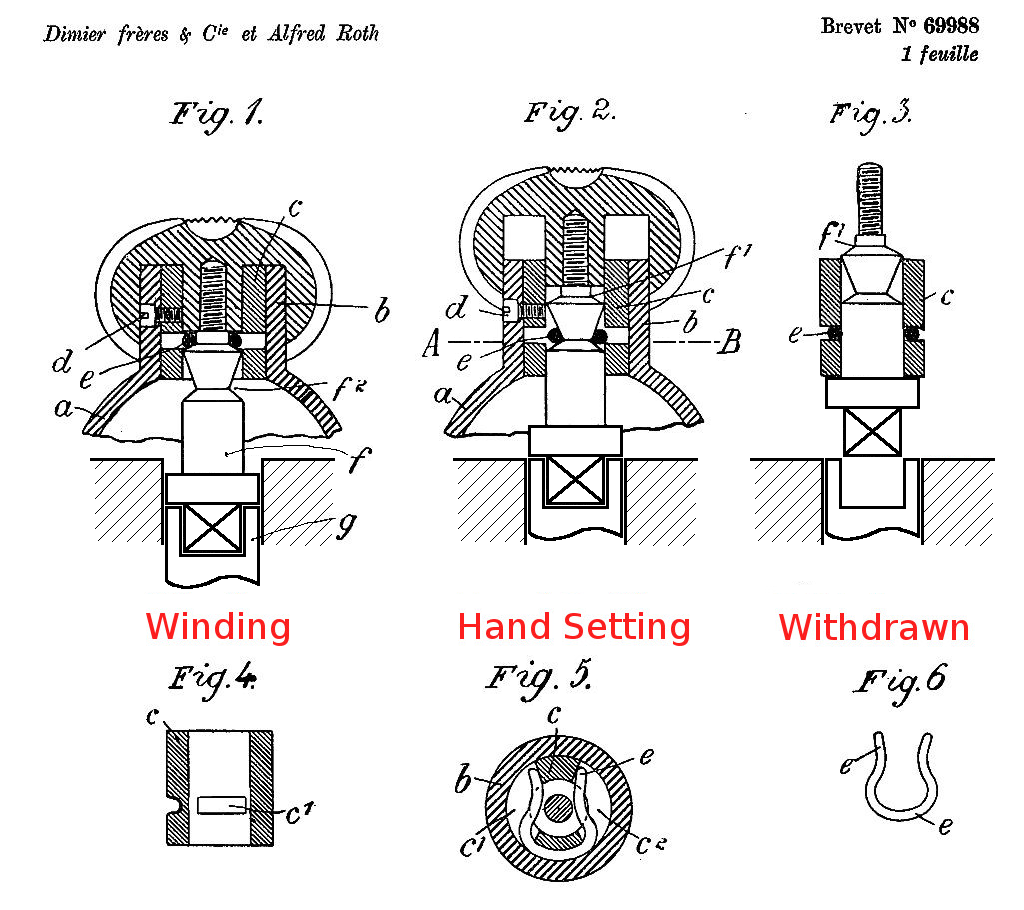
Swiss Patent CH 69988: Click image to enlarge
The diagrams from the patent show how this was achieved. The original figure was rather hard to understand, so I have moved its elements around to juxtapose them more logically. The draftsman made a mistake in showing the case stem and the movement plate, which I have corrected.
The patent shows the split stem we would expect to find in a Borgel watch, with the movement part of the stem labelled “g” and the case stem labelled “f”.
Instead of the two positions of the usual Borgel case stem and crown, this one has three positions: the normal one, Fig 1, with the crown against the case, a middle position, Fig 2, with the case stem partly withdrawn, and a fully withdrawn position that enables the movement to be unscrewed from or screwed into the Borgel case.
The movement has “negative set” keyless work. This is spring biased so that when the movement is out of the case, the keyless work is put into the hand-setting mode.
To put the keyless work into the winding mode, the case stem presses the movement stem inwards, against the action of the keyless work bias spring. This position is shown in Fig. 1. The case stem and the movement stem are held in this position, against the pressure of the bias spring, by a detent comprised of the spring “e” and a shoulder on the case stem.
Fig. 2 shows the case stem withdrawn to the hand setting position. The actions of pulling the crown outwards causes the taper on the case stem to force the spring open so that the shoulder can pass the spring, which settles into a groove on the case stem as shown in figure 2. The movement stem “g”, under pressure from the bias spring in the keyless work, has followed the case stem as it is withdrawn so that the keyless work is put into hand-setting mode.
In Fig. 3, the movement stem remains in the same position as in Fig. 2, but here the case stem is fully withdrawn to allow the movement to be unscrewed, or screwed into, the Borgel case.
Negative set mechanisms usually used a sleeve made of spring steel set in the watch pendant to achieve the same function as spring “e”. The sleeve has four slots cut into it to form spring “fingers” which grip the case stem and hold it in the winding or hand setting position. The Birch & Gaydon Land & Water wristwatches have this type of mechanism. It is not clear why the Dimier Frères patent design used the spring “e” instead of a sleeve. This spring is the Achilles heel of the design, being so small and without adequate provision for lubrication that it wears quickly.
The watch shown above has Dimier Frères' trademark on the movement and the “DBS” sponsor's mark entered by Dimier Brothers & Co. on the case, which ties in nicely with the patent and shows that this watch was made to Dimier’s orders.
Marcks & Co. Stem Set Watch

Marcks & Co. Ltd. Borgel Watch.
Image courtesy of and © Pierre Mannaert

Marcks & Co. Borgel Watch Case.
Image courtesy of and © Pierre Mannaert
The image here shows the case of a watch owned by Pierre Mannaert that is marked on the dial "Marcks & Co. LD, Bombay and Poona, Swiss Made". The dial is white enamel with radium luminous numbers, the yellow appearance is due to ageing of the crystal. The crystal may well be the original celluloid one, the ageing no doubt helped by radiation from the radium luminous paint.
Marcks & Co. described themselves as watchmakers, jewellers and opticians, although I think that they were pure retailers and certainly didn't make watches.
The case is marked inside with the Borgel Company FB-key trademark, and Swiss bear and 0·935 silver hallmarks. The movement was made by Fontainemelon and carries the Swiss patent number 51482. This patent is for a stem setting keyless work and appears on many Fontainemelon movements of this period. The movement is stem set, unlike the pin set movements found in most Borgel screw cases.
The case is identical in most respects to the normal Borgel screw case, except that it has no pin set and has a small threaded hole set into the back. This hole allows access to the setting lever screw of a conventionally stem set movement, which allows the long one piece stem to be released and withdrawn so that the movement can be unscrewed from the case. When the movement is screwed back into the case, the stem is inserted and secured in place by turning the setting lever screw. The hole is then filled with a threaded plug. The case back has been built up in thickness around the hole to allow several turns of thread to be cut for a secure fixture.
When I first saw this I wondered if it was a post-factory modification, but the case and the movement carrier ring have no holes where a pin set would have been. It is clear that the case was manufactured like this to take a stem set movement.
Making a hole in the case back to allow access to the setting lever screw of a movement with a conventional stem set movement, and then fitting this with a removable plug, would be a way of fulfilling a demand for stem set watches. There are no obvious objections to doing this and one has to wonder why there aren't more Borgel watches like this around. There seems to have been a reluctance within the Company to alter the original Borgel screw case in even a simple and obvious way like this.
Dating this watch exactly is difficult. The Swiss hallmarks of a single bear and fineness 0·935 allows quite a range of dates. It is also known that the 0·935 fineness mark was recommended to be discontinued in favour of 0·925 in December 1914, although this would have taken some time to work through. The radioluminescent dial suggests that the watch was made during the First World War. It seems likely that this was an early attempt to adapt the original Borgel screw case to take a stem-set movement. That this is the only one which appears to have been seen suggests that the project was quickly abandoned in favour of different or completely new designs. I wonder how many more examples are out there, it seems unlikely that only one was made.
Grossenbacher and Krill
Grossenbacher and Krill: Click image to enlarge
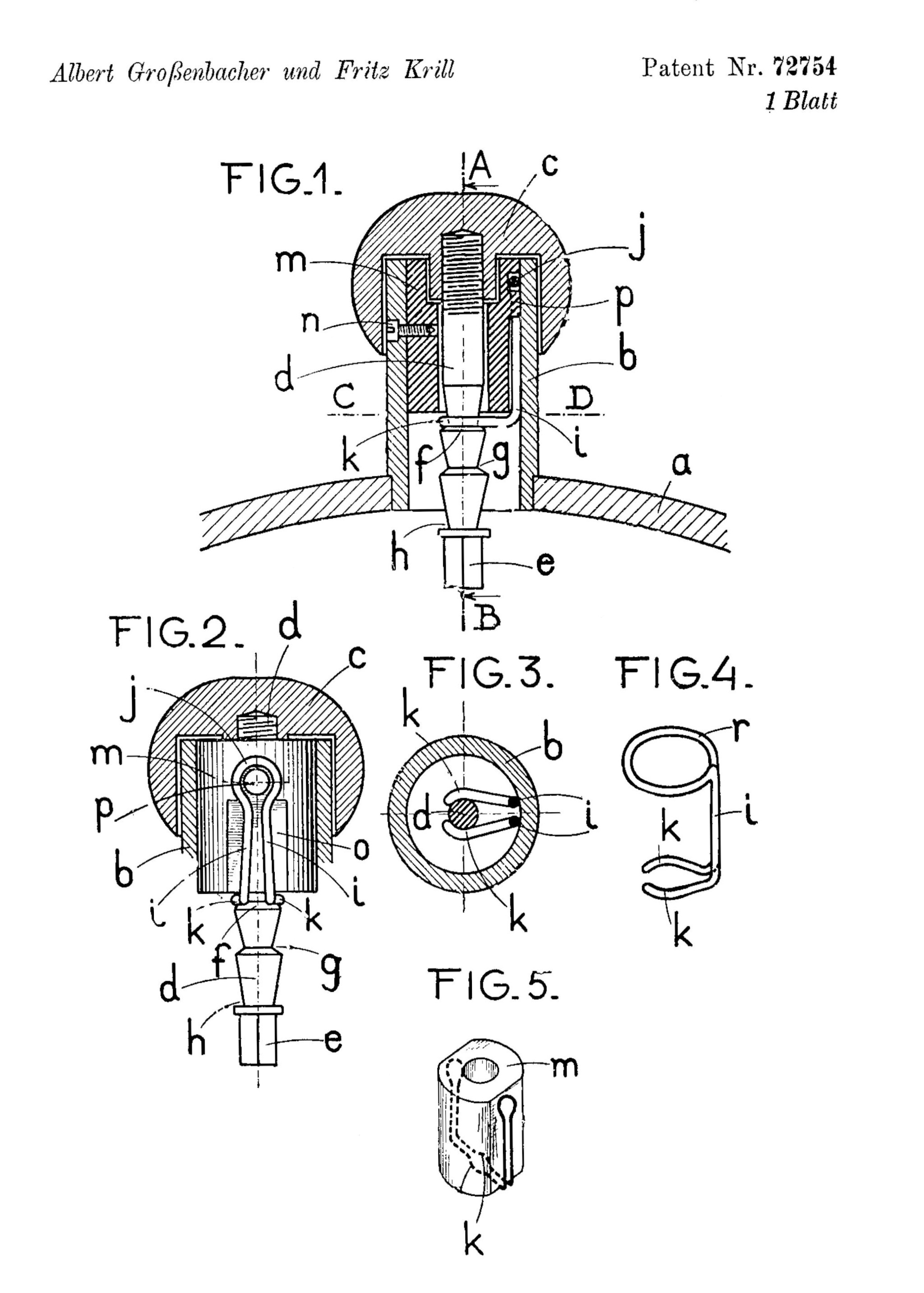
Another split stem design by Albert Grossenbacher and Fritz Krill of Biel, “Negative Aufzieh- und Zeigerstellvorriochtung an Uhren” or Negative winding and hand setting device for watches was granted Swiss patent CH72754 on 1 July 1916 with the priority date 25 January 1916.
As with the Dimier Brothers design, this works with a movement that has a negative setting keyless work.
The spring shown in Figure 4 of the illustration from the patent forms the detent which holds the stem in various axial positions determined by grooves on the stem. The spring is held in the stem tube by a small plug, which is itself held in place by screw n.
Overall it is very similar in concept the earlier Dimier Brothers design, but perhaps slightly more practical.
Only one Borgel screw case watch with this design of stem setting mechanism has been seen.
Back to the top of the page.
1903: A "New" Borgel Screw Case
In 1903 François Borgel patented a three piece screw watch case. The Swiss patent number CH 28389 was registered on 12 June 1903. The movement was carried in an externally threaded dust ring very similar to the movement ring in his earlier two piece case. Onto this dust ring was screwed the middle part of the case, and then the bezel and case back or bottom were screwed onto the parts of the dust ring that protrude from the screwed on middle part.
This advert appeared in 1905 in the La Chaux-de-Fonds trade journal "La Fédération Horlogère Suisse". You can see that it is quite different to the usual Borgel two piece case design, and I have never seen an actual watch with one of these screw together cases, If you have one, I would be really grateful if you would get in touch. Any information or pictures would be gratefully received and acknowledged.

Three Piece Borgel Screw Case 1903
The text is in watch industry jargon of the time, which would presumably be well understood by readers of La Fédération Horlogère Suisse, but doesn't make for easy translation. Here is an approximate translation:
New Borgel Screw Case
Hermetic in Three Pieces
Patented
This new hermetic screw case is formed of three pieces; the bezel, the bottom and the middle, all three are screwed on the dust ring in which is fitted the movement. The closures are hermetic and the case is very strong, due to the fact that the dust ring supports on each side the bottom and the bezel, once they are screwed on. These cases are made in all shapes and sizes, of ultra-thin cases very elegant. The casing is simplified, the winding stem fixes the middle part, which can be hollowed out internally as those for ordinary gold cases to be economical of material. Craftsmanship meticulous and faithful. Advantageous prices for large series. No case, to date, has been more practical, solid and elegant; they are made in gold of all grades, silver and gold plated steel and galonne.
The screw case of one piece, watertight, is also produced for movements with negative time set. New simplified casing.
No other house is authorized to make these various kinds of patented screw cases.
All counterfeiters will be pursued rigorously.
Insist that the trademark and patent numbers are stamped in the bottom of each case.
Factory and office in Saint-Jean, 6 - GENEVA.
Thanks to Joel Pynson for correcting my initial translation in several places. Joel has a specific interest in chronographs from 1860 to 2000, and you can find some of his articles on his website www.invenitetfecit.com.
The garde-poussiere, or dust ring, in which the movement is mounted will be very familiar to anyone who has examined a two piece Borgel case, as in that design it is the ring which carries the movement and is attached to the bezel. It would have been fairly easy for the Borgel factory to start producing these cases as they already had the tooling and techniques for the very similar two piece design.
Note the address: Factory and office in Saint-Jean, 6 - GENEVA. This is number 6, Rue de Saint-Jean in Geneva. Borgel has moved from the Place de Cornavin, presumably to larger premises where he can have an office and workshop.
The similarity between the 1903 Borgel three-piece screw case and the early case of the Rolex Oyster is readily apparent; the threaded movement carrier ring of the Rolex Oyster is very similar - I might even go so far as to say identical to the carrier ring used in the Borgel one-piece and three-piece screw cases and their later Taubert developments. The case back and bezel of the Oyster case screw onto the carrier ring that projects from either side of the middle part of the case in exactly the same way as they do in the 1903 Borgel three-piece case.
A correspondent sent me a photograph of one of these Borgel three-piece screw cases in silver with London import hallmarks for 1919/20 and the Wilsdorf and Davis “W&D” sponsor's mark, showing that these cases were being supplied to Rolex before they started work on the Oyster. By then the 1903 patent had expired at the end of its maximum 15 year life, and anyone was free to copy the design. You can read more about the Rolex Oyster case and its first maker at the Rolex Oyster case.
Back to the top of the page.
Borgel Produces Wristwatch Cases
1912 Borgel Advert: Click image to enlarge
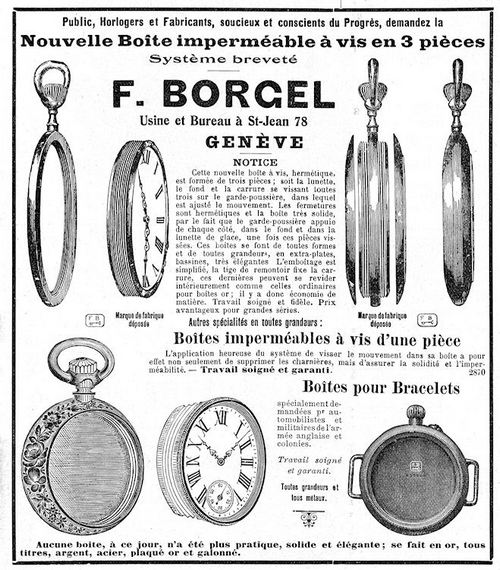
The advert reproduced here appeared in a 1912 issue of Revue Internationale de l'Horlogerie. Borgel is still promoting his “new” three piece screw together case. In fact, this is the most prominent item at the top of the advert, which would suggest that it was the company's best selling product, making it all the more curious that they appear to be so rare now. Perhaps the prominent position was actually an attempt to increase sales?
The 1912 advert is very similar to one published in 1908, but in the 1912 advert there is a new twist. Below the three piece case is the familiar one piece screw in pocket watch case, but to the right of this is shown an example of “Boîtes pour Bracelets” - a watch case which has been adapted with wire lugs to take a leather strap and be worn as a wristwatch.
The advert goes on to say that this wristwatch case design has been “specifically requested by motorists and members of the English and colonial army.”
From this difference between the 1908 and 1912 adverts we can infer that sometime between 1908 and 1912 Borgel recognised an increasing demand for wristwatches and started including wristwatch cases as part of their standard range, although they had certainly been making wristwatches for several years before 1908.
The earliest Borgel wristwatch I know of was made in 1906. But Borgel wristwatches made before WW1 are rare. The likelihood of finding a watch that can be confidently dated to before 1907 is limited because British import hallmarks, which include a date code, were not struck on imported watches before 1 June 1907. Swiss hallmarks do not carry a date. I know of several dated 1909, which corresponds with period of the advert, but the market for wristwatches was very small until demand suddenly took off for newly commissioned officers during the First World War.
At the bottom of the advert is stated “Aucune boîte, à ce jour, n'a été plus pratique, solide et élégante; se fait en or, tour titres, argent, acier, plaqué or et galonné.” which translates as “No case, to date, has been more practical, strong and elegant; it is made in gold, all grades, silver, steel, gold plate and galonné.”
Note the address towards the top of the advert, Usine et Bureau à St-Jean 78 (Factory and Office 78 Rue de St-Jean). The business has relocated again farther out, from number 6 Rue de St-Jean to number 78, presumably due to further expansion.
Thanks to Joel Pynson for supplying me with the scan of this advert.
Back to the top of the page.
The Cost of a Borgel Case

Goldsmiths and Silversmiths advert 1915
The advert here from 1915 by the Goldsmiths and Silversmiths Company Ltd. is typical of adverts of the period. Although it doesn't mention Borgel by name, the drawing of the watch, with its milled bezel, onion crown and pin set, together with the description ... a patent solid one-piece silver case into which the entire movement screws, thus making the watch securely dust and damp proof. makes it abundantly clear that this watch has a Borgel case.
The Borgel cased watch is priced at £3 3 0 or three pounds and three shillings. The advert also mentions that a large selection of other luminous watches are available from two pounds and two shillings. The Borgel cased watch is 50% more than the cheapest, and a large part of this must be due to the cost of the Borgel case. It is also true that Borgel cases were used by many manufacturers for their "top of the range" models. Borgel wristwatches were invariably fitted with the best movements, which at the time meant a movement with a lever escapement, temperature compensation, and at least 15 jewels. The movements were often also enhanced by extra jewels such as centre jewels or cap jewels on the escape wheel, and higher quality finishing such as perlage.
The advert persuasively says that the Borgel cased watch is .. the most satisfactory luminous watch, and is unequalled for Naval and Military service, for which it is specially adapted.
Many officers heading to the front in the First World War strapped a Borgel wristwatch onto their wrist before setting off. Then as much as now, military men didn't like to economise on the kit on which their life might depend; revolver, field glasses and most importantly, at a time before modern radio, when operations across the vast battlefields were synchronised by time, a luminous wristwatch with unbreakable glass, was an essential piece of kit, a large proportion of which were protected from the dust and damp in the trenches by their Borgel cases.
Back to the top of the page.
Borgel and the International Watch Co. (IWC)
From 1894 the London company Stauffer & Co., a branch of the Swiss watch manufacturer Stauffer, Son & Co. of la Chaux-de-Fonds, was supplied with watches by IWC and became their exclusive agent for Britain and the Empire. From 1898 IWC movements supplied to Stauffer & Co. bore the trademark "S&Co." under a crown inside an oval, together with the words "Peerless" and Swiss made. These were both Stauffer trademarks, the S & Co. mark with a crown inside an oval was registered by Stauffer Son & Co. in 1880, and Peerless was a trademark registered by Stauffer, Son & Co. in 1896. You can read more about Stauffer and IWC on my pages about the two companies, Stauffer, Son & Co. and IWC: The International Watch Co.
Both bare (uncased) movements and complete watches were supplied by IWC to Stauffer & Co. Some of the complete watches were supplied in Borgel cases, and many of the bare movements supplied by IWC were put into Borgel cases. Whether this was done by Stauffer & Co. in London, or in Switzerland before export to the UK, is not known. The cases were clearly made in Switzerland and imported to the UK, as evidenced by the UK Assay Office import hallmarks, but the hallmarks do not show where the movement was put into the case.
The Earliest Borgel Wristwatch?
1906 IWC Borgel case wristwatch: Click image to enlarge
The earliest Borgel wristwatch known to me was made by IWC in 1906. IWC records show that the order to the Borgel factory in Geneva for the case was made on 15 September 1906.
The finished watch was supplied to Stauffer & Co. on 9 January 1907, the IWC sales record showing that the Borgel case was in polished silver "avec anses", that is "with handles", the term used at the time for the wire loop strap lugs of a wristwatch. IWC have provided me with an official "extract from the archives" for this wristwatch, which confirms that it was supplied as a complete watch to Stauffer & Co.
The markings inside the case back are the FB-key trademark and "BREVETE + CH 4001", a reference to the Borgel screw case patent which doesn't appear in later cases. There are no UK hallmarks, because the date of supply to London in January 1907 was before it was discovered by the UK authorities that the Customs had been allowing complete watches into the country without being hallmarked as required by law. (You can read more about this surprising anomaly on my page about Cases and Hallmarks.) IWC records show that it was supplied to Stauffer as a single piece, not as part of a batch. Stauffer normally ordered watches from IWC in batches of six or a dozen, so it is tempting to think that this individual watch was ordered as a prototype to evaluate the wristwatch concept and design.
Back to the top of the page.
Borgel and Longines
Borgel was a long time supplier to Longines in St. Imier, beginning with case for pocket watches. Many Longines wristwatches from the First World War era have Borgel screw cases.
The earliest Longines wristwatch that I have has a Longines calibre 13.67 movement and London import marks for 1908 or 1909. This watch is a bit of a curiosity because Longines records show that the movement was made in 1909, and that the watch was invoiced to Baume in 1915. It is clear that the case was sent to Britain in 1909 to be hallmarked, with Baume acting as sponsor, and then returned to the Longines factory in Switzerland for assembly with the movement into the complete wristwatch, which was then held in stock until it was called off by Baume and invoiced to him by Longines in 1915.
Most Longines watches of the First World War era have Longines calibre 13.34 movements. The 13.34 movement was introduced in 1910 and superseded the 13.67 movement, like the one found in my 1909 Borgel wristwatch.
It is not known when the last Borgel screw case was made, but it may well have been for Longines; a Longines catalogue of 1939 lists a wristwatch with a Borgel screw case. By then the Borgel screw case had been in production for nearly 50 years!
Back to the top of the page.
Borgel and Rolex
With the end of the First World War in 1918, global trade resumed, and Rolex found that they were sending many watches to the far reaches of the British Empire. The humid tropical climate soon rusted the movements of watches in conventional cases, so a damp proof case was urgently required. In their book "The Best of Time: Rolex Wristwatches: An Unauthorized History" Jeffrey Hess and James Dowling noted that Rolex produced a small series of watches using the one-piece Borgel screw case in 1922. They remarked that Despite the small number of watches produced in this case style, it is a very important development in Rolex watch design. It was the first model produced by Rolex in which the case was specifically designed to give protection against some of the elements. These Borgel screw case watches were the start of a line of development that would culminate in 1926 in the Rolex Oyster. Just how much involvement did the Borgel Company have in developing the case of the Rolex Oyster? Rolex is famous for keeping its archives secret, so we don't have any direct evidence, but we do have some circumstantial evidence, including the Dowling and Hess information about the 1922 series of Borgel-cased Rolex watches, which shows that the two companies must have had some sort of commercial relationship.

Borgel Case, London Import Hallmarks 1910, W&D Sponsor's Mark: Click to Enlarge.
The relationship between Borgel and Rolex goes back to way before the 1922 date mentioned by Dowling and Hess. The image here shows a Borgel case with London import hallmarks for 1910 and the W&D sponsor's mark entered by Wilsdorf and Davis.
The similarity between the 1903 "new" Borgel three piece screw case and the early case of the Rolex Oyster is readily apparent; the threaded carrier ring is very similar - I might even go so far as to say identical - to the carrier ring used in both the Borgel one-piece and three-piece cases and later Taubert developments. The case back and bezel screw onto the parts of this carrier ring that project on either side of the middle part of the case in exactly the same way as in the 1903 Borgel three-piece case. A correspondent sent me a photograph of a 1919/20 Borgel three-piece screw case with a Wilsdorf and Davis "W&D" mark, showing that these Borgel cases were supplied to Rolex.
Of course by 1926 when Wilsdorf patented the Oyster case, the patents for both Borgel screw case designs had long expired. Although Wilsdorf and Rolex were therefore under no restriction on the use of this design, the similarity is striking. And the Borgel Company, then owned by the Taubert family, did not object to the Wilsdorf patent for the Oyster case on the grounds of "prior art," which they could easily have done given its obvious similarity to the 1903 Borgel three-piece case.
I have discovered evidence showing who made the first Rolex Oyster cases. A survey of eight early Oyster cases dating from 1927 to 1936 revealed that they all bear the Poinçon de Maître of a hammer head bearing the number 136, which shows they were made by C. R. Spillmann SA of La Chaux de Fonds and later Chêne-Bourg. I had noted in my December 2010 Watch & Clock Bulletin article, "The Rolex Screw Down Crown," the involvement of C. R. Spillman in the transfer of the screw crown patent CH 114948 from Paul Perregaux and Georges Perret to Hans Wilsdorf but I hadn’t realized then that Spillman was a casemaker for Rolex. It appears that the design of the early Rolex Oyster cases was a joint effort by Spillman and Rolex, funded by Rolex because the patent for the case was registered by Wilsdorf.
In 1929 Hans Wilsdorf of Rolex purchased the rights to one of the Taubert Company’s patents, which I discuss in part three of this series. I wonder if this was in some way compensation for work done on the Oyster case, or more likely for not objecting to the Oyster patent, which they could have done on the basis of the cases made by the Borgel company that the Oyster cases were very similar to.
Back to the top of the page.
Borgel Case Serial Numbers

Numbers inside a Borgel case back
If you own a Borgel screw cased watch, and here I am talking about the early screw in cases made to Borgel's 1891 patent CH4001, then after actually finding out that it was made by François Borgel, and deciphering the hallmarks, you may, like me, have wondered what the numbers stamped in the case back mean. I mean the long numbers like the 3130633 that you can see in the Borgel case back illustrated here.
After a number of years gathering data and seeing no pattern emerging, I came to the conclusion that Borgel cases left the factory with just Borgel's FB-key trademark and a few other single or double digit numbers in the bottom of the case back, but not with the long serial numbers seen in the middle of the back. The long serial numbers must have been applied to the case by the watch manufacturer to fit in with their recording and record keeping systems.
With hindsight this is quite logical. Cases are a component part of a watch. The individual parts of a watch are not separately numbered, it is the whole watch that the manufacturer needed to keep records for. I know that in some factories, e.g. Longines, the case was stamped with the same number as the movement. In others, e.g. IWC, the case was given its own unique number, and the number of the case was noted in the company records alongside the serial number of the movement. Why the case was given a different number to the movement I don't know (it must have been something to do with stock control) but it is clear that both serial numbers, movement and case, were applied by IWC.
For more information about numbers in the case backs of watches, including numbers scratched in by hand, and numbers on movements, see Numbers on Movements and Cases.
Back to the top of the page.
No FB-key Mark?
Occasionally Borgel screw cases are seen without the FB-key trademark. I am not sure why this is, but I don't think it was because these cases were made by another manufacturer. The Borgel company, and later the Taubert company, regularly published advertisements warning that action would be taken against people copying their cases, and in fact the Taubert company take action against one company who copied their decagonal screw back case design, which you can read about on the page about the Taubert company. I have not found any evidence of action being taken against anyone copying the original Borgel screw case. Very few screw cases are seen without the FB mark. The screw case would require a certain outlay to copy, the die to cut the screw threads in the case throat would be expensive. It would hardly be worthwhile for someone to set up but only make a few cases. These considerations persuade me that Borgel screw cases were not made by any other companies.
If the cases left the Borgel factory without the FB-key trademark, it is possible that this was done at the request of the company purchasing the cases. This was certainly done by Taubert & Fils on cases made for Mido, but there are so few Borgel screw cases without the FB-key mark that this seems unlikely.
It seems most likely that the cases were stamped with the FB-key mark before they left the Borgel factory and that the mark has since been obliterated or removed. One possible cause of this would be polishing cases after they had received British hallmarks. This process was called ‘rectification’ and it was something that English watchmakers complained about, saying that it contributed about one third of the cost of making the case. If the cases had been returned to the Borgel factory after hallmarking, then no doubt the FB-key trademark would have been stamped in after rectification and final polishing. But the number of different sponsor's marks seen shows that this was not done. Since no one else had any great interest in preserving the Borgel trademark, if it was already shallow struck it would be easily polished out during rectification. This is often the cause of Blurred or ‘Rubbed’ Marks, and faint FB-key marks are regularly seen.
If the theory about removal of the FB-key mark during rectification is correct, it will be only cases with British import hallmarks that are missing their FB-key mark. If you have a Borgel screw case without the FB-key trademark that does not have British import hallmarks, please let me know.
Back to the top of the page.
The Last Borgel Screw Case?

Longines Catalogue 1939
The Borgel one piece screw case had a long life. Even though the company under the new management of the Taubert family was producing other types of case by the mid-1920s, Dennis Harris' article1 shows the extract from a Longines catalogue of 1939 reproduced here, which clearly shows a one piece Borgel screw case with pin set for hand setting. It is described as a "screw in movement watch" and has the Longines design of swinging lugs.
The prices quoted in the advert is noticeably higher than the prices quoted during the First World War; eight pounds for a silver watch, twenty pounds and 15 shillings (£20.75) for a 9 carat gold watch, and twenty nine pounds five shillings (£29.25) for 18 carat gold. It is interesting to note that the gold watches were "slightly smaller" than the silver watch. This may have been because of the high cost of gold, and the gold Borgel wristwatches that I have seen do on the whole tend to be slightly smaller than the majority of silver ones, although smaller silver ones were also made.
By the late 1920s the fashion had become for much smaller watches, and in the early 1930s stainless steel cases were talking over from silver, so these Borgel screw cases would have looked decidedly old fashioned in 1939. One wonders if these watches were still being made at the time, or whether they were the last of some old stock that had been sitting on the shelf for many years; the latter I suspect.
Back to the top of the page.
Other Case Types made by the Borgel Company
Borgel's screw case was very successful and was made until the 1930s - Harris1 quotes a 1939 Longines catalogue advertising a wristwatch in a Borgel screw case. However, other case designs were also manufactured by the Borgel company alongside the screw case. These other cases were made either because they were cheaper, or because of a certain manufacturers preference for a particular case design. These cases were obviously stamped with the Borgel FB-key trademark and so get described as Borgel cases even though they were not designed by Borgel. These non-Borgel cases that were made by the Borgel company alongside but not superseding the original Borgel screw case are broadly as follows:
- Swing ring case - designed and patented in 1879 by Ezra Fitch.
- One piece case with a screw on bezel - designed and patented in 1920 by Charles Rothen.
- Hermetic double case - designed and patented in 1921 by Jean Finger.
- One piece case with screw on bezel - designed and patented in 1931 by 1931 by Schwob Frères & Cie SA.
In the mid 1920s to early 1930s, new designs of screw case were developed by the Tauberts, who took over the Borgel company in 1924. These cases were also stamped with the Borgel FB-key trademark, although by then the name of company had been changed to Taubert & Fils. I describe these cases in greater detail on the page about Taubert & Fils.
Back to the top of the page.
François Borgel Patents
François Borgel was obviously an inventive man, and he went on to patent numerous further ideas as shown in the following table.
| Date | Number | Title | Translation |
|---|---|---|---|
| 8 October 1891 | CH 4041 | Montre avec boîte à fond fixe et raquette renversée | Watch case with fixed back and reversed regulator. This patent brought the regulator out at the front of the case so that it could be adjusted without taking the movement out of the case. |
| 12 November 1891 | CH 4145 | Boîte de montre perfectionnée | Improved watch case |
| 20 April 1894 | CH 8232 | Montre perfectionnée à boîte vissée et tige brisée | Improved screwed watch case with split stem |
| 25 June 1895 | CH 10412 | Moteur à ressort pour vélocipèdes | Spring engine for bicycles |
| 12 June 1903 | CH 28389 | Boîte de montre perfectionnée | Improved watch case |
| 23 July 1910 | CH 53105 | Dispositif de fixation de pendant aux boîtes de montres-calottes | Method of fixing pendants to watch cases |
Louisa Borgel
Manufacture of Borgel cases continued after the death of François Borgel in his 56th year on 7th March 1912. The business was taken over by his daughter Louisa Borgel.

Louisa Borgel takes over
The Journal de Genève of 2nd October 1884 records the birth of Louisa-Henriette Borgel at some time between 28th September and 1st October. When taking over the business in March 1912, Louisa would have been 27 years old. Louisa had a sister called Blanche-Marie, born between 1 and 4 September 1886, but her name was never mentioned in connection with the Borgel company.
To the right is a notice from La Federation Horlogere Suisse, a trade paper for the watch making industries of La Chaux-de-Fonds. It shows that on 8th June 1912 the company of F. (François) Borgel was struck off (radiée), and the assets and liabilities taken over by L. (Louisa) Borgel, identified as a manufacturer of waterproof Borgel screw watch cases. Presumably Louisa avoided the use of her given name because of the male-dominated nature of business at the time.
The notice reproduced from the Archives de l'Horlogerie shows that on 25 October 1917, Louisa renewed the registration of the FB marque. She had married Marc Louis Beauverd in 1913, but also retained her maiden name as part of her family name, which was a common custom at the time.

Louisa Beauverd-Borgel Registration October 1917 Archives de l'Horlogerie

1920 Indicateur Davoine
In the 1920 edition of the Indicateur Davoine is the advertisement promoting the business of L. Beauverd-Borgel as the ‘successor’ of L. Borgel. The text roughly translated says ‘L. Beauverd-Borgel, successor of Borgel L. (Impermeable Borgel screw cases. - Case caps of one piece with screw-on dust guard. New Type. - Cases of 3 pieces with screwed on dust guard. - In gold of all finenesses, silver, steel, gold plate). - Factory and Office rue des Pêcheries 10, Geneva.’
Note another new address; 10 Rue des Pêcheries (The Street to the Fisheries, or to the fishing wharfs on the banks of the river Rhone). The business has moved again, from the Rue de St-Jean to the Rue des Pêcheries. Again, this was presumably due to the expansion of trade requiring larger workshops, but it is not known exactly when this occurred. The Rue des Pêcheries is even further from the centre of Geneva, on the opposite bank of the river Rhone, and is a more commercial/industrial district. Several watch companies had factories in the Rue des Pêcheries, including Patek Philippe.
Louisa guided the Borgel company throughout the First World War, when there was huge demand for Borgel cases for wristwatches as trench watches, the must-have accessory for every serving and newly commissioned officer, and for many soldiers. This must have been a time of great stress due the huge workload, and also of great concern because of the war.
In 1924 Louisa sold the business to the Taubert family of Le Locle. It is assumed that Louisa retired from business because her name does not appear again in conjunction with watch cases or watchmaking. At the time of the sale Louisa was 39. She lived a long life, passing away in January 1980 in her 96th year, some 56 years after selling the company.
Back to the top of the page.
Borgel Hunter Cases
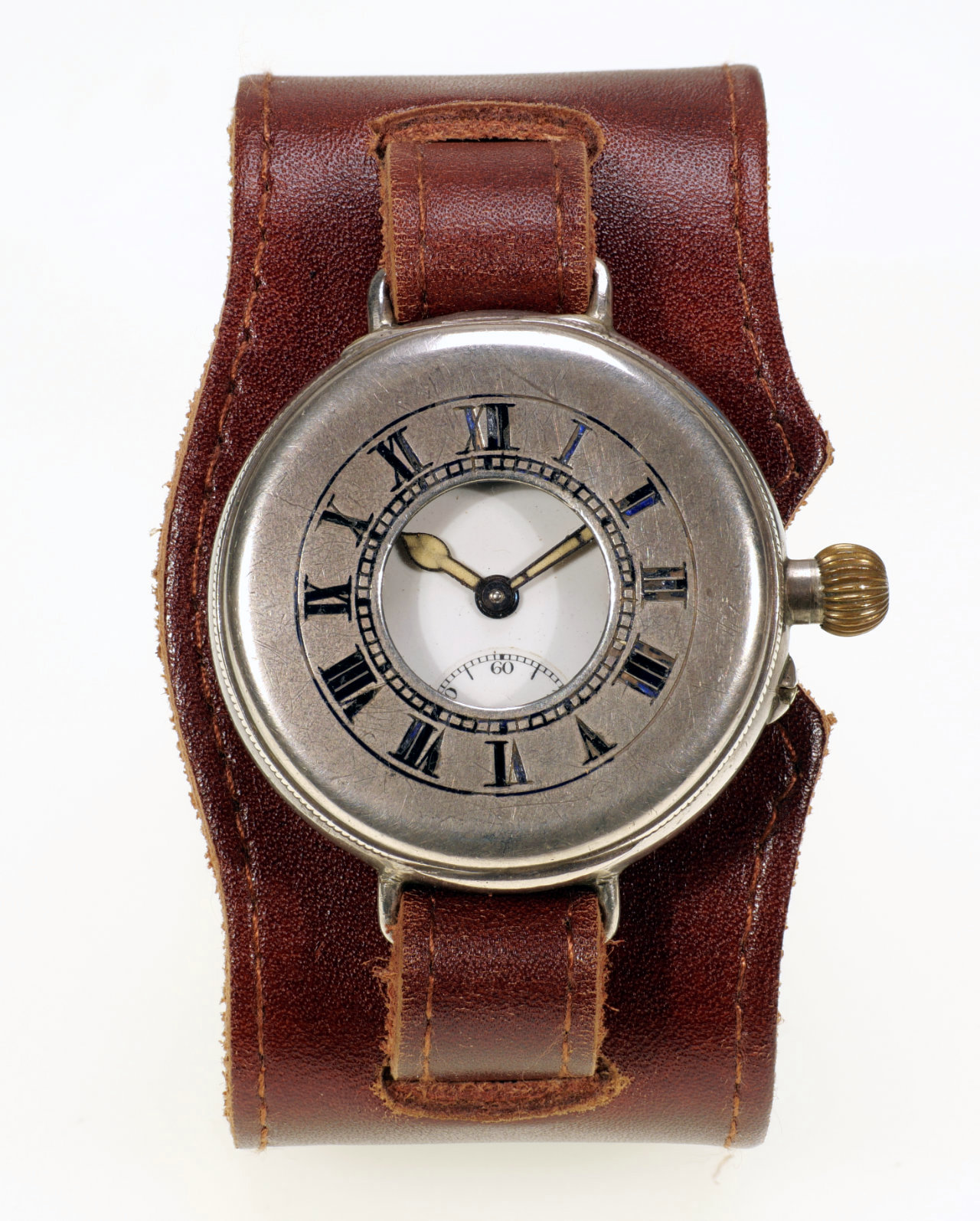
Borgel demi hunter wristwatch: Click image to enlarge

Goldsmiths & Silversmiths Borgel hunter
A hunter or “savonnette” watch has a metal lid over the crystal and dial to protect them. The Borgel company never produced a Borgel screw case with a hunter lid, but the Goldsmiths & Silversmiths Company, Ltd. advertised Borgel cased watches with hunter lids throughout the First World War.
The advertisement from 1916 reproduced here shows a typical watch with a solid hunter lid attached by a joint at 12 o’clock. The crown on a dtem tube projecting from the case and the pin set for hand setting suggest that this is a Borgel screw case, which is confirmed by the statement The only screw-case watch with an attached cover.
A watch with a metal lid that fully covers the dial is called a hunter, or sometimes a full hunter. Later Goldsmiths and Silversmiths advertisements showed a wristwatch with a circular crystal in the centre so that the time could be read without opening it, the same as the case of the wristwatch in the photograph. This design is called a half-hunter or demi-savonnette and is said to have been originated by Napoleon, who got so frustrated with having to keep opening the case of his hunter watch to read the time that he took out a knife and cut a hole in the lid. In fact, Napoleon was given a demi-savonnette watch by Breguet.
But if the Borgel company in Geneva didn't make hunter cases, what's going on here? The watch without question has a Borgel case - the advertisement says that ... it is contained in a one-piece solid silver screw case that makes it dust and damp proof. This is undoubtedly a Borgel case, no one else was making a case of this description at the time, but how does it come to have a hunter lid, described in the advert as a patent cover to protect the glass?
The advertisement refers to Patent No. 11376/15, a British patent filed on 6 August 1915 and granted on 27 January 1916 to "Percy Harman Ball, manager, and the Goldsmiths & Silversmiths Company Limited". The patent doesn't mention Borgel by name but does say that the invention is specially applicable to watches wherein the movement screws into the case from the front - clearly a Borgel screw case - and continues Such watches are particularly suitable for use in exposed places, as the back not being made to open, dirt or moisture can only enter at the front and this is well sealed by the close fitting of the bezel against the case when the movement is screwed home. The added cover then protects the glass from damage, and has a further use for war purposes in that it can be dulled and thus the reflection from the glass which is likely to attract the notice of enemy snipers is prevented. The patent notes that screw cases are not normally made as hunters because a hinge attached to the case would interfere with screwing the movement in, but that the patent design overcomes this by attaching the hinge to the bezel.
The patent holds the answer to how Borgel watches came to be fitted with attached hunter lids; the lids were fitted in England to the order of the Goldsmiths and Silversmiths Company after the watch had been imported from Switzerland. NB: Don't confuse the "Goldsmiths & Silversmiths Company, Ltd." with "The Goldsmiths' Company", the London guild of goldsmiths which has operated the London Assay Office since 1300. The Goldsmiths & Silversmiths Company was a company of retail jewellers and silversmiths established in 1880, converted into a limited liability company in 1898, and in 1952 merged with Garrard & Co. Ltd., the Crown Jewellers.
How many of these conversions of standard open face Borgel screw cases to hunters were performed is difficult to estimate, I have to date seen only a few compared to a large number of surviving Borgel cased trench watches. I would imagine that not very many were made; it added cost to what was already an expensive watch, and it doesn't seem very necessary - a detachable shrapnel guard could easily be added to a standard watch if required - and Unbreakable or "UB" crystals made of celluloid became available in 1915 or early 1916, making additional protection unnecessary.
The add on hunter lid was also not a very good design from a durability view point. The land cut into the bezel is a reasonable size, but the hinge has to be very small, a consequence of the small size of the wristwatch case, and it has only three knuckles; two on the lid and one on the case. Such small hinges are suitable if they are not to be used very often, but with constant opening of the hunter lid to read the time this hinge wouldn’t have lasted very long.
The added cost was also significant. The advert gives a price of £3.12.6 for the watch with a hunter lid, and £3.3.0 for the same watch without a cover, so the extra cost of the cover was a quite significant nine shillings and sixpence.
But the major problem with a hunter wristwatch is that to read the time you must use your left arm to bring the watch into sight and your right hand to open the lid. This defeats the object of the wristwatch as a device that can be easily read by moving only one hand or arm while leaving the opposite hand free.
The demi-hunter style with a small crystal in the centre of the lid improves the watch in this area, and certainly by 1918 Goldsmiths and Silversmiths ads were showing demi-hunter wristwatches. This of course defeats one of the claimed objects of the patent, to provide a metal lid that can be dulled to avoid attracting the notice of enemy snipers. This naturally isn't mentioned in the adverts for the demi-hunter version, and I don't think the claim that reflections from wristwatches attracted sniper fire has ever been shown to be a significant concern. Of the few Borgel wristwatches with this feature that I have seen, there are more demi-hunter than hunter versions.
All in all, this was a rather obvious idea that wasn't needed, a solution in search of a real problem, which explains the small number of such conversions, and indeed hunter wristwatches of any sort, that are seen. Sometimes things are rare simply because they were not a good idea, rather than for any other reason.
Back to the top of the page.
George Mallory's Wristwatch: A Borgel on Mount Everest
George Herbert Leigh Mallory
(18 June 1886 – 8/9 June 1924)
George Mallory was born in Mobberley, Cheshire, just a few miles from where I live. He was a keen mountaineer from an early age after being introduced to climbing in the Alps by one of his masters at Winchester College.
Once when asked why he wanted to climb Mount Everest Mallory is said to have replied Because it’s there; a pithy reply that became the most famous phrase in mountaineering.
The story of the Everest expedition was closely followed by the public with regular dispatches published in The Times. Shortly before his final climb Mallory wrote The third time we walk up East Rongbuk Glacier will be the last, for better or worse ... We expect no mercy from Everest.
At age 37 Mallory was aware that there would be no chance of him joining another expedition to Everest in the future. The third attempt on the summit was the last of the expedition, and Mallory's last chance to conquer Everest. If he got within striking distance of the summit he would have pushed on under any circumstances.
Analysis of the chronology of events and the equipment used by Mallory and Irvine indicates that they probably got very close to the summit, and knowing it was their last opportunity, they may have pushed on for the summit late in the day. This would have meant descending in dusk or dark conditions, which Mallory had done on Alpine expeditions, but which was much more dangerous high on Everest. Given Mallory's determination to summit Everest and knowing that this was his last chance, it seems likely that they did press on to the summit, and then in attempting to descend in the dark they fell, with tragic consequences.
A tribute in The Times after the news had reached London said Mount Everest has taken one of the finest mountaineers that this or any other generation has produced. The deaths of Mallory and Irvine were regarded as a national tragedy at the time, and the mystery of whether they achieved the summit has caused much speculation and discussion. Many books and articles have been written on the subject, and interest continues to this day.

George Mallory's Wristwatch
(© Rick Reanier/Jochen Hemmleb)
Mount Everest was identified as the highest mountain in the world in 1856 by the Great Trigonometric Survey of British India. The first European to make a substantial climb of the mountain, to nearly 23,000 feet, was George Mallory during the first expedition in 1921. It was an exploratory expedition not equipped for a serious attempt, but Mallory discovered a promising route to the top via a northern approach. Mallory returned in 1922 for an unsuccessful attempt to climb the mountain and then again in 1924 for a third attempt.
The 1924 expedition left Darjeeling at the end of March, trekking overland and reaching their base camp location at the end of April. Setting up the higher camps and stocking them with supplies and equipment took up May. Two attempts on the summit were planned. The first attempt, without the use of supplementary oxygen, was made by George Mallory and C. Geoffrey Bruce on 1 June, but was driven back by harsh icy winds. A second attempt was started on June 2 by Edward F. Norton and Dr. T. Howard Somervell. Also climbing without oxygen, they were overcome by fatigue before they reached the summit.
On June 8, 1924, George Mallory and Andrew Irvine made a third, previously unplanned, attempt on the summit, this time using supplementary oxygen. They never returned. They were seen briefly through a break in the clouds by another member of the expedition, Noel Odell, who said they were only a few hundred feet below the summit. There has been intense speculation in the mountaineering community as to whether Mallory and Irvine actually reached the summit, 29 years before Sir Edmund Hillary and Tenzing Norgay did in 1953.
Robert Graves was at Charterhouse when Mallory moved there from Cambridge as an English teacher. Mallory took Graves climbing on Snowdon in the school vacations. In his autobiography “Goodbye To All That”, Graves writes that ... anyone who has climbed with George is convinced that he got to the summit and rejoiced in his accustomed way without leaving himself sufficient reserve of strength for the descent.
Mallory's Wristwatch
On the 1924 expedition, Mallory wore the Borgel wristwatch shown here. Mallory had received a commission as a Second Lieutenant in the Royal Garrison Artillery on 17 December 1915. An officer needed a wristwatch, and Mallory would have bought this wristwatch when he was getting his outfit together.
The wristwatch was found on his body when it was discovered in 1999. It was found in a pocket of Mallory’s clothing, missing its crystal.
There has been speculation that the wristwatch lost its crystal and stopped during a climbing manoeuvre, an arm jam in a rock fissure while ascending the second step, and that the position of the hands could indicate the time at which the arm jam took place. This theory is not credible.
The theory was proposed by someone who evidently knows little if anything about mechanical wristwatches. There is not a trace of damage to the wristwatch case, the bezel or the fragile enamel dial, not even the faintest scratch or crack, that would suggest the wristwatch had ever even been in rough contact with a rock. Any watchmaker or watch repairer would know this simply from looking at the pictures of the wristwatch, and know that any suggestion that the wristwatch was stopped as a result of being damaged by being on an arm jammed between two rocks is ridiculous. The complete absence of any relevant damage to the wristwatch proves that this theory is simply and completely wrong.
The wristwatch has a high grade Fontainemelon movement in a silver Borgel screw case. This would have been an expensive wristwatch when it was purchased by Mallory. The suggestion that he would knowingly have jammed his arm into a rock fissure while wearing it, when he would surely have known that such a manoeuvre would damage the wristwatch, is also ridiculous. People knew that wristwatches were delicate precision instruments and treated them with respect. Today wristwatches are more robust, with steel cases and shock protection, but even one of today's tougher wristwatches would be seriously damaged by being jammed between two pieces of rock. Mallory would not have done it. If he was going to do an arm jam, he would have first taken off his wristwatch and put it in his pocket.
The wristwatch when found was missing its crystal, the clear front that protects the hands and dial, and the delicate skeletonised steel luminous hands had rusted away, leaving only stumps on the central bosses. These stumps are not visible in the picture because they disintegrated when the wristwatch was being examined.
Apart from the missing crystal and rusted hands there is no other damage to the wristwatch. There are no marks on the silver case, on the bezel, or on the fragile enamel dial. In fact, there are no signs that the wristwatch has even been brushed lightly against a rock, let alone crushed between two rocks during an arm jam. If the crystal had been broken as a result of the wristwatch being crushed between Mallory's arm and a rock, then the fragile enamel dial, which is a thin disc of copper coated with an even thinner layer of white glass enamel, would show signs of this; they crack very easily. But in fact the dial of Mallory's wristwatch is perfect and has no cracks.
When the wristwatch was examined it was found that the balance staff pivots are unbroken and the movement is in good working order. Wristwatches of this age do not have shock protection for the balance staff pivots, which are very delicate and can be easily broken if the wristwatch is knocked sharply against a hard object. The fact that the balance staff pivots are not broken shows that the wristwatch did not sustain any such damage. It was reported that when the rusted stumps of the hands were removed the movement started ticking, clearly showing that the only reason it had stopped running was the hands touched something or rusted together.
The most likely course of events is that first the crystal was lost, that it either fell out or was knocked out. It could have been knocked out by a small impact that snapped it out of the bezel. This is quite easy if caught at just the wrong angle, but the lack of any damage to the bezel makes this unlikely. Or it could be that it was an “unbreakable” plastic crystal and the intense cold at high altitude caused it to shrink and simply drop out, a known problem with early plastic crystals. When Mallory noticed that the crystal was missing he would have removed the wristwatch from his wrist and put it in his pocket to protect it. Once in his pocket, without the crystal to protect them, the hands would have come into contact with the lining or other things in the pocket and been damaged, which would certainly have caused the wristwatch to stop.
All watchmakers and watch repairers know that if the hands of a watch touch either each other or the dial or the crystal, even lightly, the watch will stop. But otherwise it is actually very difficult to stop a watch that is running well. This requires either breaking the delicate pivots of the balance staff, or beating the watch flat with a hammer. The suggestion that an arm jam manoeuvre could have stopped Mallory's wristwatch without damaging the case or dial is utterly ridiculous.

Movement from George Mallory's Wristwatch
(© Rick Reanier/Jochen Hemmleb)
Click image to enlarge
An x-ray of the wristwatch showed that the main spring was not fully wound down when the wristwatch was discovered, which is thought to add weight to the theory that the wristwatch stopped as a result of some event. However, it is most likely that the wristwatch stopped before the spring was fully unwound because the hands became entangled with something in Mallory's pocket, or the material of the pocket itself, or were bent and touched each other.
The wristwatch, now in the keeping of the Royal Geographical Society in London, is a typical Borgel wristwatch of the period, the dust proof screw case invented by François Borgel of Geneva, patented in Switzerland in 1891. These were the best wristwatches for demanding conditions that were generally available at the time. They were more expensive than wristwatches with the normal style of hinged case and had been especially favoured by officers during the First World War for the difficult conditions in the trenches, so it is no wonder that one found its way onto George Mallory's wrist.
The wristwatch case has London Assay Office import hallmarks for sterling (0·925) silver. The date letter is the “u” of the London hallmarking year from the end of May 1915 to the end of May 1916.
The mark stamped above the Borgel trademark is the sponsor's mark. A sponsor's mark shows who is the responsible person when an item is submitted for hallmarking. The sponsor’s mark “GS” in cameo within a rectangular surround with a tab on the top edge was entered at the London Assay Office by George Stockwell and shows that the case was carried to England and submitted for hallmarking by the carriers George Stockwell & Company.
The dial and hands originally had radium based luminous paint to illuminate the hands and numerals in the dark. This appears to have come off or moved about during the years on the mountain; you can see how the remaining paint follows the outlines of some of the numerals, particularly the "2" and the "1" but also on the "8," "9," and "12". The brown staining on the dial is probably traces of this paint, and also the parts of the hands that rusted away. It is notable that although the hands were rusted away there was no noticeable rusting of the movement under the dial. The amount of moisture affecting the wristwatch must have been very small; more a damp atmosphere rather than liquid water.
The splines on the onion crown are very well worn, indicating that the wristwatch had been well used. Being a manually wound wristwatch, it would have to be wound by this crown every day to keep it going. The movement is remarkably undamaged considering its history, and it is reported that when the hand stubs were removed during its examination it started ticking.
The movement is a typical high quality Swiss movement of the period, with a straight line lever escapement, bimetallic temperature compensated balance and 17 jewels, cap jewels for the escape wheel pivots increasing the more normal count of 15 jewels by two. It is nicely finished with perlage (engine turning) to the plates. It was made by the Swiss Fontainemelon ébauche factory. Further details of the movement of Mallory's wristwatch can be seen on my Movement Identification page.
The 1953 attempt on the Everest summit was sponsored by Smiths and led by John Hunt. The committee of the British Mount Everest Expedition indicated that the expedition was a national enterprise and would be equipped with British manufactured equipment. On the successful attempt on the summit, Sir Edmund Hillary wore a Smiths Deluxe manually wound wristwatch. Despite reports that Tenzing Norgay wore a Rolex wristwatch, Hillary later stated that Norgay wore a single watch, his own, of unrecorded make. Rolex did supply Oyster Perpetual wristwatches to all members of the expedition, but Hillary stated that, during the final assault on the summit, his Rolex watch remained at Base Camp.
However, it seems likely that the first wristwatch actually carried to the summit of Everest was George Mallory's Borgel wristwatch.
Back to the top of the page.
Louisa Borgel Patents
Louisa Borgel was granted at least three patents, two in conjunction with other people who presumably worked at the company. It was from the first of these that I discovered her first name. The patents are shown in the table, the first under her own name only, the second and third with Charles Rothen and Achille Faivre. Charles Rothen's name occurs again later, but this is Achille Faivre's only appearance in the story.

Louisa Beauverd-Borgel patent CH 75467
Note that the Swiss patent office was now showing both the application and publication date on patents: previously only the application date was shown. The application date is usually over a year earlier than the publication date because it takes time to examine and approve a patent. If a patent for the same invention is received during this time, the priority date determines which patent has priority, and when a patent is granted, the protection it gives starts from the application date.
| Date | Number | Title | Inventor |
|---|---|---|---|
| 24 November 1916 | CH 75467 | Dispositif de fixation d'un fond de boîte de montre à la carrure de celle-ci | Louisa Beauverd-Borgel |
| 19 October 1917 | CH 78295 | Boîte de montre | Louisa Beauverd-Borgel, Charles Rothen and Achille Faivre |
| 12 July 1919 | CH 84785 | Dispositif de fixation d'une couronne à la tige de remontoir d'une montre | Louisa Beauverd-Borgel, Charles Rothen and Achille Faivre |
Patent CH 75467 is for a case with a screw back. The rear opening to the case is internally threaded and the back has a projecting threaded boss that screws into this, very similar to the way that the threaded carrier of a Borgel screw case screws into the front of the case.
Back to the top of the page.
Charles Rothen

Charles Rothen Patent CH88223

Watch with Charles Rothen CH88223 Case
Charles Rothen went on to publish at least four patents under his own name alone. The first one, CH 88223, a figure from which is shown here, was registered on 5 March 1920 and published on 16 February 1921.
The case back and middle part in this design of Rothen's are made in one piece like the original Borgel screw case. The movement, with dial and hands, is carried in a carrier ring d somewhat like the Borgel screw case, but this assembly instead of screwing into the case simply drops into the case back, sometimes on a joint, the stem tube for the winding stem e passing through a slot cut into the side of the case. The upper part of this slot is closed by a tongue of metal f soldered to the stem tube.
There is usually a cover over the back of the movement which snaps or presses onto the inner end of the carrier ring, this is not shown in the figure from the patent. For clarity, the ring d, stem tube e and tongue of metal f, which are all soldered together to form one part, are coloured in red.
The bezel c carrying the crystal screws onto the case from the front, in a way somewhat reminiscent of the original Borgel case, but in this design by Rothen the carrier ring holding the movement does not rotate with the bezel. This design provided an alternative to the original Borgel case which was possibly easier to manufacture, and which because the movement does not need to rotate to be screwed into or out of the case, did not need the split stem arrangement of the original Borgel case and therefore could accommodate stem set movements.
This design is not as well sealed as the original Borgel screw case, the tongue on the stem tube sealing the gap in the case side less than perfectly. The inner cover over the back of the movement was no doubt introduced to improve this. It seems that this design was not very successful because examples occur much less frequently than the original type Borgel case.
The picture of one of these cases shows the slot in the side of the case and the tongue of metal soldered to the stem tube to close the slot. The movement simply drops into the case and is located and secured by the screw on bezel, unlike the swing ring case described next where the movement is hinged to the case.
Because Charles Rothen's name appears along with Louisa Beauverd-Borgel on two of the patents mentioned above, he was presumably at the time an employee of the Borgel Company. But the four patents listed below are registered in his name alone. The first patent, CH 88223, which I discussed above, plays a part later in the story when the rights to it are purchased from Rothen by Louisa Borgel and then sold on to the Taubert family.
| Date | Number | Title | Inventor |
|---|---|---|---|
| 1921 | CH 88223 | Boîte de montre. | Charles Rothen |
| 1923 | CH 102074 | Dispositif de fixation d'une anse à une boîte de montre, de boussole, de médaillon etc. | Charles Rothen |
| 1923 | CH 105158 | Brevet additionnel subordonné au brevet principal nº 102074 Dispositif de fixation...etc. | Charles Rothen |
| 1928 | CH 124164 | Boîte de montre hermétique. | Charles Rothen |
Back to the top of the page.
Swing Ring Cases

A 1924 Swing Ring Case with the Borgel FB-key Trademark
An alternative design very similar to the Rothen case discussed above sometimes crops up with the Borgel FB-key trademark. This case has essentially the same one piece case back and middle with screw on bezel as the Rothen design, but the bezel was carried down much closer to the tube for the winding stem, so that the tongue of metal, item f in Rothen's design, was not needed. Unlike the Rothen design, the movement does not simply lie in the case but is carried in a ring hinged to the middle part of the case.
This style of case was often used for American pocket watches when it was called a “swing ring” case. The swing ring case is actually a much older design than the Rothen and the hermetic, being patented in the USA in 1879 by Ezra Fitch, US patent number 214642. An image of a cushion case watch of this design from Robert Pringle & Sons "Wilderness" catalogue for 1932 can be seen at Swing Ring Case. That one was not made by Borgel.
The picture shows one of these cases with the Borgel FB-key trademark. The case back is hallmarked with London Assay Office import hallmarks for sterling silver and the date letter "i" for the hallmarking year 1924 to 1925, which means that the watch was probably made after the Borgel company had been sold and was called Taubert & Fils. The movement is by Fabriques d'Horlogerie de Fontainemelon (FHF).
These cases are sometimes referred to as the "semi-tropical" or "semi-hermetic" because of some similarity in appearance to the hermetic watches. Hermetic watches used a double case design where the watch was entirely enclosed in an outer case with a screw on bezel, the outer case hermetically protecting the watch contained within. The swing ring case as usually found resembles the hermetic only in that it has a screw on bezel, although the original design patented by Ezra Fitch in 1879 had a screw cap over the crown and would have been truly hermetic.
In the swing ring cases usually encountered today the stem is brought out through a hole in the side of the case which is not sealed. There is nothing actually “hermetic” about the case. I have seen mention of gaskets being used with this design to seal around the winding stem tube where it passes through the case side. I have several watches with this type of case and none of them has any such gasket, or any provision for one.
Although they sometimes carry the Borgel trademark, this case was made by many different manufacturers since its original design by Fitch in the 1870s. It would be wrong to call one of these a "Borgel case" even if it does carry the Borgel trademark. This type of case should properly be called a "swing ring". If it carries the Borgel trademark it may be said that it was "made by the Borgel company" (or for the one shown above that it was made by Taubert & Fils), but preferably not that it is "a Borgel case".
Back to the top of the page.
Francis Baumgartner?
I have seen many instances of watch cases bearing an FB mark, or waterproof cases in general, being attributed to Francis Baumgartner. This is an error, based on the common initials of FB for François Borgel and another Geneva case maker, Frédéric Baumgartner. The two identities appear were conflated, in the process turning "François" into the Anglicised "Francis".
The fact is that there never was a case making company called Francis Baumgartner.

Patek Philippe case back
This image is from an 18 carat gold Patek Philippe case back, and it bears the collective responsibility mark of a small Geneva key with the number 2 stamped on the lever. Thanks to TimeZone member candle7 for permission to use the image, and for the information that the watch is a 1962 Patek Philippe ref. 3434. The collective responsibility mark was registered to F. Baumgartner SA of Geneva. Candle7 has informed me that the case is a simple snap back. Just metal on metal, no rubber gasket, and no marking anywhere to indicate the watch was ever intended to be water resistant. The 1949 edition of La Classification Horlogère Suisse reveals that F. Baumgartner SA of Geneva, case maker, was Frédéric, not Francis, Baumgartner!
Frédéric Baumgartner was the maker of the cases for the 1932 Omega Marine, the first dive watch, and was the designer and maker of the case for the 1939 Omega Marine Standard, a waterproof rectangular watch with a clip back case. You can read more about this in my section on Omega.
These Omega watch cases appear to have been Frédéric Baumgartner's only waterproof watches. I have found a series of 11 patents granted to Frédéric Baumgartner starting in 1929 with the design of a hinged case for a small clock or pocket watch. There is no provision for making this case waterproof, and apart from three patents issued to Baumgartner for the Omega Marine Standard design in 1940 - 1941 all his other patents concern the appearance of watches rather than their waterproof qualities.
Frédéric Baumgartner was not involved in the design of the waterproof case for the 1926 Rolex Oyster.
To read the next chapter about the takeover of the Borgel company by the Taubert family, click this link: The Taubert Family.
References
- Dennis Harris "François Borgel: Watch Case Maker 1856 - 1912" BHI Horological Journal November 1997
- Kathleen H. Pritchard: Swiss Timepiece Makers 1775-1975
If you have any comments or questions, please don't hesitate to get in touch via my Contact Me page.
Copyright © David Boettcher 2005 - 2026 all rights reserved. This page updated January 2026.
Back to the top of the page.